Ah, summer in Italy. Anselmo has been sent off by his parents to work at a farm after “wasting” a semester. Living off the land, basking in the golden sunshine, and working an honest, hands-on job: It’s nice work, if you can get it. There is one problem, though: minutes into his tour of the farm, Anselmo discovers that the Farmer’s prize horses are little more than people stripped naked and stuck in horse masks. So begins a fortnight of walking on eggshells and witnessing the horrors of a people farm.
Thanks to Steam banning the game based on a demo build from 2023 and Epic randomly following suit before launch, there has been a lot of talk about Horses. So many burning opinions about monopolies and censorship, but few people talking about it who have actually played the game. So: What is Horses?
Horses is provocative. Anytime it could unsettle or pull the rug out from under you, it does. You’ll relive one late-game scene three times thanks to dream sequences, all in distinct and disturbing ways. Expect to see gore and suicide and sexual assault and mutilation and brainwashing during the three-hour runtime. The game’s website has a bevy of content warnings, as does the game itself when you start it up, and they’re there for good reason.
Horses is cruel. Similar to last year’s Mouthwashing, it forces players to perform objectionable tasks to progress the story, mirroring how Anselmo is forced to comply lest he end up in the horse pen too. As much as you try to help the “horses,” you’re forced to be complicit in the atrocities at hand. In a standout scene, you’re asked to motivate a horse to get back to work and given the choice between the classic carrot and stick. With each failure to motivate him with carrots, the sticks grow bigger until all that you can do is use a brutal baton on him, the Farmer’s dog blocking the only way out.
Horses is Italian. Taking full advantage of the countryside setting, and translating text from the default into English, it is keen to remind you that you’re in Europe whenever possible. When it tackles purity culture and the ever-moving target of “deviancy” in society, it makes it clear that this is not an attitude unique to America or other English-speaking countries, but the whole world.
Horses is sexual. It is not sexy, nor is it romantic. Much like the “fornication” the Farmer asks you to keep an eye out for between the “horses,” it is something more animal, cruder. The Farmer has defined his life in opposition to any sexuality, engaging with it only when heavily drunk, through a chastity belt and a horse mask of his own. When he’s in this state, he may as well be an entirely different character, caught in a stupor of long-repressed urges that he takes out on his inmates.
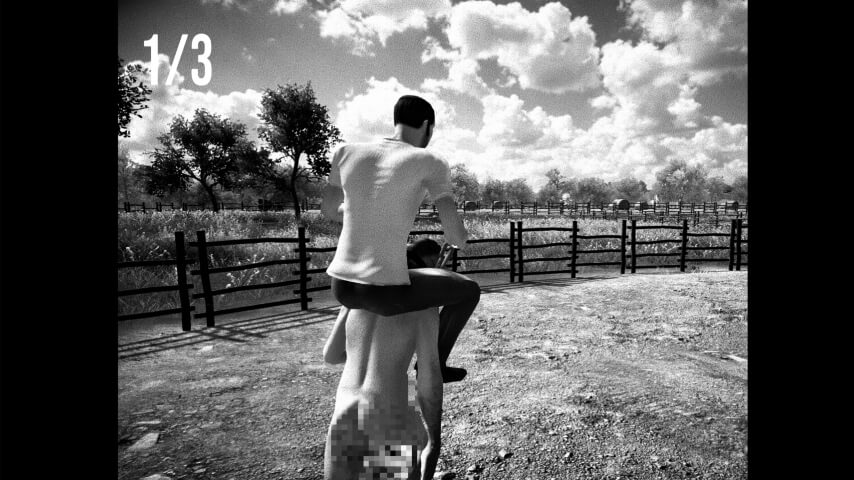
Horses is absurd. Distancing an audience from a story’s inner reality with absurdity is a tried and true tactic, but often it’s to the game’s detriment. These malnourished, castrated, brainwashed husks of people living in their own filth carry whole human adults on their shoulders. A few times, Anselmo is asked to go around a course on one of the horses, racking up points in the top-left corner, which works pretty well as far as the verfremdungseffekt goes. There is a constant buzzing from a film projector at all times, to remind you you’re in a “film,” not to mention how every time a character speaks, a text card pops up on the screen to tell you what they said.
Horses is unsubtle. It’s something of a trend lately with art making the subtext as textual as possible. There’s a version of this game that isn’t so blunt that frankly would hit harder. It doesn’t take long for the Farmer to break character about his herd, for instance. In the scene that developer Santa Ragione speculated drew Steam’s ire in its original form, the daughter of the man financing the farm pays a visit and makes it clear to Anselmo that she’s well aware these are people kept in slavery. The original version had her as a child, but the adult woman in the final game spells it out to you:
“I know these aren’t real horses. But… you know, the way they used to live… A lot of people find that unacceptable. I don’t care, personally. But usually, people exhibiting immoral behavior also have dangerous ideas. So dangerous ideas are a concern for everyone. Because if the machine jams, everything falls apart.”
But is Horses good? It’s not particularly effective at what it sets out to do. It is certainly a harrowing and memorable experience I won’t soon forget, and a standout in 2025 for its imagery alone, but not one destined for the limelight outside of the controversy. It’s ironic that a game tackling the hypocrisy of purity culture and dehumanization of “deviants” would end up in such people’s targets after the initial ban, but reality is stranger than fiction. Horses deserves to be played, but at times feels like a shock-value PETA game that tackles its tougher topics with the subtlety of a jackhammer. To hinge a studio’s success on this game would be risky even if it was on Steam, but I still hope that, to paraphrase the financier’s daughter in Horses, the people at Santa Ragione get to live the rest of their lives as game developers.
Horses was developed and published by Santa Ragione. It’s available for PC through GOG, Humble, and Itch.



 Keep scrolling for more great stories.