
How House Of The Dragon found its way into Rhaenyra Targaryen's deep, dark mind
Director Clare Kilner talks about evoking the new queen's challenging plight in episode three.
Photo: Ollie Upton/HBO
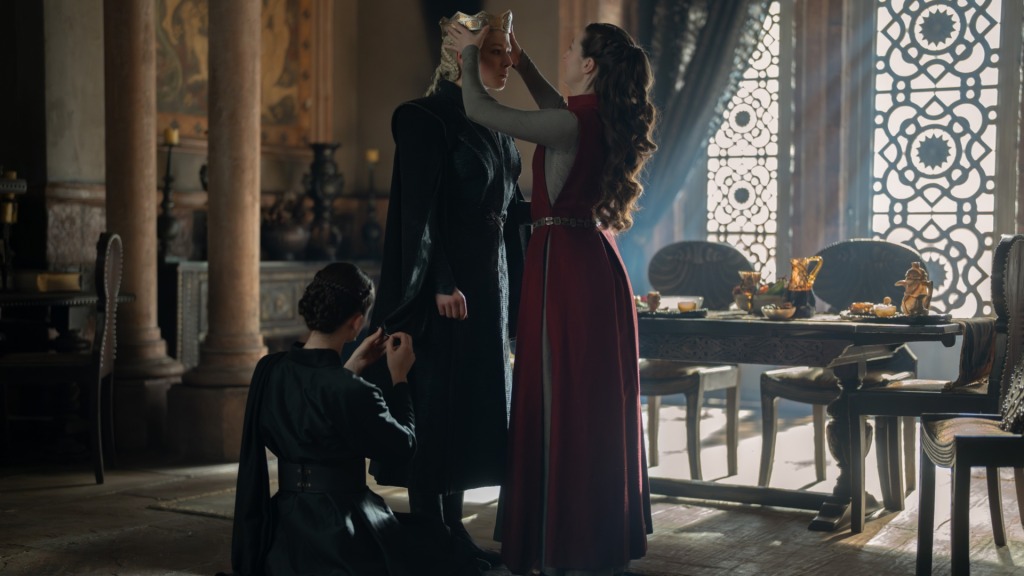
“You will do things that your heart will have recoiled from,” Alicent Hightower (Olivia Cooke) tells her former best mate, Rhaenyra Targaryen (Emma D’Arcy) in the third episode of House Of The Dragon‘s third season. In response, the realm’s newest ruler claims, “I dispute that I must become what I am not.” Rhaenyra’s desire to stay true to her intentions in season three is noble, but this week, it’s clear she recognizes the difficulty of sticking to that dream. Having recently beheaded Otto Hightower (Rhys Ifans) and been told to repeatedly kill claimant Daeron Targaryen, she now knows that—to quote another piece of memorable pop culture advice—with great power comes great responsibility.
For episode director Clare Kilner (who also helmed last week’s big outing), the goal for episode three was to visually highlight Rhaenyra reckoning with the power she holds in ways big and small—and how it affects her psychologically. Rhaenyra’s taken over King’s Landing, but now comes the challenging part: Actually ruling over the damn kingdom. To stay in her POV, Kilner frames a lot of the episode with a Steadicam to follow Rhaenyra around her gilded cage in what ends up as a unique HOTD hour. The A.V. Club spoke to Kilner about the process of stepping into Rhaenyra’s mind, the logistical challenges of this episode, and why she prefers to direct character-driven stories.
This interview has been edited for length and clarity.
The A.V. Club: Was it planned that you’d direct this three-episode block—which isn’t just any stretch of episodes, but what ends up being a pivotal start to Rhaenyra’s reign over Westeros?
Clare Kilner: Yes. I love doing the more intimate scenes. I’m always interested in family dysfunction, and I really love the show’s dramatic scenes. Of course, I also love doing CGI and huge stunts, but I’m more fascinated by working with these really wonderful actors and digging into the nitty-gritty of who their characters are, how they’re changing, who the most important person in the room is, and how they all disagree on that. [Series creator] Ryan Condal sees that in me as well and asked me to direct these three episodes. It was a huge undertaking. We shot the third episode first all the way through, and then we proceeded to do the others.
There’s something very rewarding about doing a block of three episodes because then you can chart the progress within those. In season one, I did episodes four and five, and then nine. Having a gap in between means you have to really chat with the other directors and the actors to fill you in on what they’ve done. Working with Emma, Olivia, and Matt Smith is easy because they have an incredible handle on where they want to go and how their characters have to change.
AVC: Even though she gets the throne, Rhaenyra suffers big time in season three so far. Can you talk about what it was like on set with Emma and cultivating an atmosphere that allows them to get so vulnerable, like when Rhaenyra processes Jace’s death?
CK: It’s really about making sure everybody on set feels supported and heard and then also that everybody understands the process the actors have to go through. I feel sometimes on different sets that I’ve experienced, people put the filmmaking process first and then expect the actors to come on and just deliver. I have a great first assistant director, Nick Heckstall-Smith, and a really brilliant director of photography, Alejandro Martinez. They’re both sensitive to the world we’re creating on set for these people to step into. And I just like listening to the actors and what they’re bringing, and I also always pull on my own experiences with grief and talk about it. I want to give freedom to everyone around to gain people’s confidence. As a director, if you reveal yourself, it gives permission for everyone else to reveal more secret sides as well.
AVC: Episode three is one of the first times in a Game Of Thrones TV show that it feels like we’ve truly stepped into this character’s headspace. What were some of the things you wanted to make sure you capture or evoke through your direction here?
 Keep scrolling for more great stories.