AVC: How did you find your way into the film? Did they reach out to you specifically?
JB: I was very interested in the subject matter, because I’ve also been through that period of time. You know, being between a child that is growing into falling in love and becoming an adult in a way, and risking being pregnant or something like that. And on the other side you have a parent that was sick…So it touched me so much, and I thought, “Oh, this is a necessary film.” This subject matter hasn’t really been told in films. I don’t remember seeing a film about that.
AVC: It’s very interesting the way it develops. Tom Courtenay and Anna Calder-Marshall are absolutely fantastic together, but Calder-Marshall is particularly remarkable, just because of everything she has to go through with her role.
JB: Yeah, and Lance [Hammer] is very particular, the way he’s guiding us into the process for this film. He really made us feel like we were a family. And also asking all the questions, “If this happens, what would happen?” This sort of intrusive procedure that you didn’t expect. You know, because I’m calling [the police] just to have some help, because I feel totally powerless, and then it becomes a crime scene, and then there’s a criminal investigation, and then this violence of the examination for my mother that I didn’t expect. This develops in places that you would never expect. There’s a sort of a thriller kind of thing, and what’s going to happen?
That’s what people go through in their lives, especially when you’re getting older. You think you’re going to stay in the same place forever, and actually it’s not going to happen, because there are dangerous stairs, for example. And also the question of consent, I find that very interesting, as far as Alzheimer’s [goes]. There are laws that protect [people with] Alzheimer’s, that you cannot have sex with them, but when there’s love between a couple, how is the husband going to stop loving his wife? It’s asking a lot of questions that I find just fascinating. And necessary, because films are here to help us in case we’re in that situation. That’s what the ancient Greeks were doing: They were telling tragedies in order for people to prepare for their lives.
AVC: When you found out how the film ends, was there a moment where you went, “Is this really how it’s going to end?” Or were you happy to go wherever the film took you?
JB: No, I found it interesting, because then you don’t know who’s right or who’s wrong. It’s really questioning you, what was the solution in that case? The law is not really helping in that specific case, and yet if you stay at home, it’s also not working. So there’s a big question: How can we make it fair? Consciousness is about being in front of questions, and as an audience, we need to be filled up with questions in order to grow and make our lives a little better.
Liberty Belle (1983)—”Rally Girl”
AVC: This was your first film role, correct?
JB: Yeah, well, I had to do one line, which was, “You fucking c-nt, get out of here!” or something like that, because he was raping me or something. I remember getting on set and going to hair and makeup, and they said, “You don’t need anything.” And I felt very hurt by it, that they didn’t want to take care of me. Of course with distance I felt, “Well, probably they were right.” Because I was a young 18-year-old actress, and the way I was, I was good to be shot, with nothing. I also remember being invited by the director because he wanted to talk to me about a role for another film, and he actually ended up trying to kiss me. So I pushed him away, and I thought, “Okay, this is a pain in the ass, this job, because you have to put [up] limits very early on.” Talk about consent!
AVC: Both your parents were actors in some capacity, but what was it that actually made you decide to follow that path? Was there a particular moment when you decided you wanted to be an actress?
JB: I didn’t feel that I was following a path. I was just recognizing the need of playing. Because it’s not acting, but playing. Because it brings joy, because it brings imagination, because you’re preparing something inside you and you’re exposing it to others. There’s something joyful about it, something like a gift of some kind. I was playing all the time when I was little. So I didn’t feel that I was following anybody’s path. I was just recognizing my path. I can only thank my mother—and my father, but especially my mother—for allowing me to see a lot of concerts and plays, reading out loud during Christmastime… Racine, Chekhov, and all the Shakespeare, sometimes sonnets. There was a lot of joy in discovering the arts with her. I was eager. I [had a] thirst [for the] arts. And my father would take my sister and I to big tours, because he was in the theater and doing tours here and there. So I thought I was going to do theater more than films, and I was surprised to actually end up being more in films.
AVC: There were considerable trials and tribulations in getting this film to the finish line, but you reportedly never doubted that it would get completed.
JB: No, I never give up. Because if I was giving up, it meant that everything was going to garbage. You have to have faith. And sometimes you have to put aside [everything] and go until the end. That’s really what happened. So I said “no” to a lot of films that I could’ve done, but that’s part of what it is. Sometimes you have to choose one thing and really go for it until it’s over and done. So we stayed and made the film. It was the actors, the directors, and the producers and executive producers. We held on until the end to finish the film. But we had three different investors from the producers to finish the film. It was rough.
Hail Mary (1985)—”Juliette”
Mary (2005)—”Marie Palesi”
AVC: You’ve done two Mary-centric films in your career: Hail Mary in 1985 and then Mary in 2005. I’m particularly curious about the experience of working with Abel Ferrara, because I’ve interviewed him, and he’s a handful.
JB: I really enjoyed working with him. He’s a real artist. He’s a little explosive and full of life and ideas, but there’s something in him that’s really, really deep, and I love that. He has his own way of working, like a lot of directors I’ve worked with. They have their own way, and you have to adapt. Sometimes I didn’t know where the camera was, and it was fine. You have to throw yourself into different kinds of experiences. And I think as actors, that’s what we’re expecting, in a way: to face yourself with something new so it’s going to transform you. You’ve got to lift yourself into a place you’ve never been into before.
AVC: Do you remember anything in particular about the Hail Mary experience?
JB: That was one of my first films, with [Jean-Luc] Godard. I learned not to expect anything from a director. I learned that you’ve got to go and be prepared, because the director’s not here to help you. [Laughs.] He’s not a coach. He has his own stuff to deal with. I learned from him very much that you’ve got to be ready when you come on the set. That was very clear.
Godzilla (2014)—”Sandra Brody”
AVC: This was an outside-the-box film for you at that time.
JB: Well, it was three days of shooting. I don’t have very much to say. It was fun for me to do it because of my son, because he loved Godzilla, and it was a way for me to give him a little bit of a wink. That’s all.
The Unbearable Lightness Of Being (1988)—”Tereza”
AVC: This was kind of a big mainstream breakthrough for you.
JB: Yes, it was, in America. What would you like to know?
AVC: Well, first and foremost, how was the experience of working with Daniel Day-Lewis? He’s someone who takes his art very seriously, as do you.
JB: Yeah, and in that way, we were very close. Loving what we were doing. I think he changed with My Left Foot. He went deeper. The Unbearable Lightness Of Being was just before that. But I love Daniel. I was in love with him, and I loved him as a person. He’s a poet, and he’s an amazing actor. Phil Kaufman was always saying “yes” when we wanted to do another take, and that was cool. He trusted the actors so much. And he came with his family—his wife Rose and his son Peter—and there was a feeling that making a film in Europe for him was special, I think.
Damage (1992)—”Anna Barton”
AVC: That was an intense film for the viewer, and my understanding is that it was perhaps more so for you as an actress.
JB: My relationship with Jeremy [Irons] was very hard. It was not easy to work with him. So I was crying a lot in my dressing room, trying to escape a little bit of the tension, and I felt very alone during the shooting. But I really loved the Josephine Hart book, and I was honored to be chosen for this film, because there were other actors who wanted to do it, and I was chosen. I was surprised to be chosen, actually. The book is about this carnal passion that these two people have, and they can’t stop. There are people who live that, and as actors, we’re not only heads talking, we have bodies—we’re telling stories with our bodies.
Chocolat (2000)—”Vianne Rocher”
JB: It was beautiful. It was easy-going. Fun. A lot of work for me, because I was working every day. But I prepared in a chocolate factory.
AVC: Were you sick of chocolate by the end of filming?
JB: No, I’m never sick of chocolate. [Laughs.]
Cosmopolis (2012)—”Didi Fancher”
JB: That was a short shooting for me. It was three or four days. Not even. That was odd, because the director was someone else—in his truck—and we had a voice coming out of speakers saying, “Now, do another take, and do it quicker.” Or slower, or whatever. So it felt more alone in this car. It was fun, because I’d never been in a situation like this, but it felt a little cold at the same time. I loved the DP [Peter Suschitzky]. He was very warm and worked for hours in between takes. He did an amazing job.
AVC: It’s funny, I was going to ask you how it was to work with David Cronenberg, but it sounds like you didn’t work very much with him directly.
JB: Well, yeah! Because he was in his truck, seeing if the editing was working or something. It was his way of working. Very technical. But also very freeing, because he asked us to improvise the scene in the car, and then he said, “Well, I like it this way.” So I was surprised by the means he was using in order to shoot, but at the same time, it was something quite freeing.
The Staircase (2022)—”Sophie Brunet”
AVC: When you’re playing a real person like Coco Chanel, do you do deep research, or do you let the script speak for itself?
JB: Oh, no, because you have to inspire the script as well, because they’re writing while you’re shooting. So I read a lot, and I did a lot of research. And I tried to influence some of the writing as well, and it was fun, really. But a lot of work. I was shooting 10 episodes, and it was very intense, but I loved the experience of it.
AVC: You haven’t done a lot of TV, but you did The New Look, and then you also did The Staircase. Is TV something that you’d like to continue doing?
JB: I really enjoyed The Staircase, and I became very good friends with the editor. But it depends who’s directing and who’s the showrunner and who’s the subject matter. It depends on a whole lot of things. For me, being in film has a sense of art, and I think a TV series should be the same. So if I have the feeling of that, then of course I want to be a part of it.
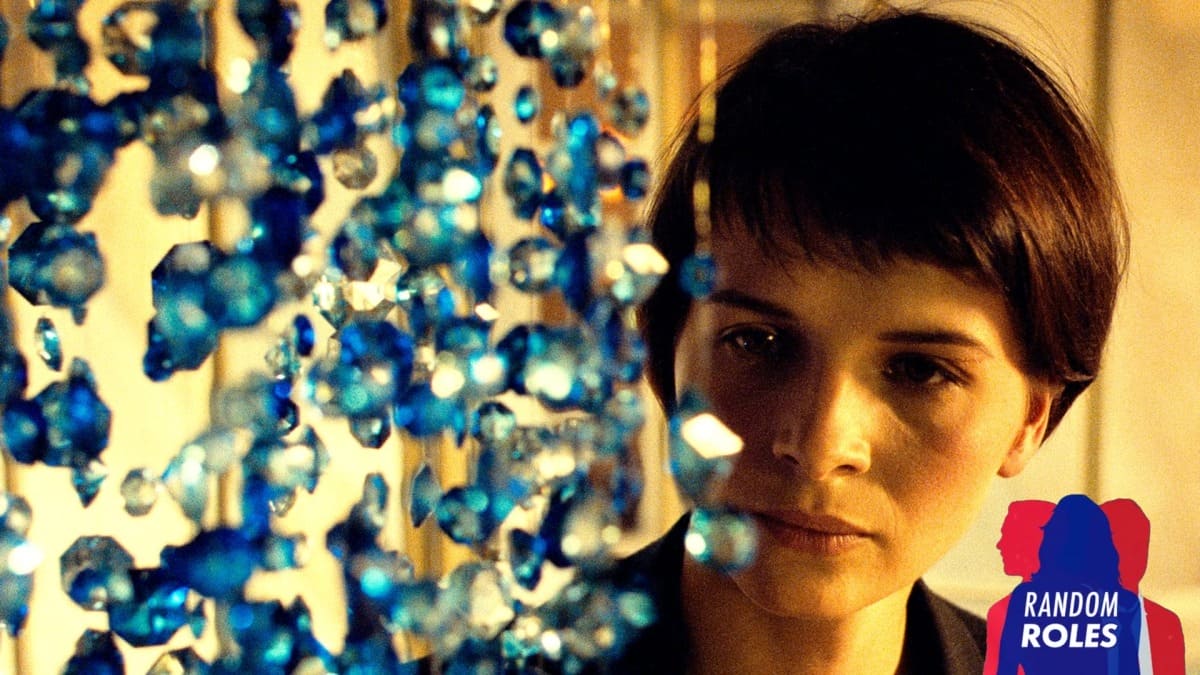
The Three Colors trilogy (1993-1994)—”Julie Vignon de Courcy”
JB: A very joyful experience. Very light. Even though the subject matter was quite dark, it was done in a very heartful way. Much like Queen At Sea. We enjoyed each other so much, and shooting was great. And Blue… I was wondering if the reason that it was received so well, was it because we were so happy while shooting it? I thought, “Maybe it’s related!” [Laughs.]
AVC: It’s clear that the films still resonate even now.
JB: Yeah, I miss [Krzysztof] Kieślowski. He was such a wonderful director to work with. And also very quick in the way of putting the camera on and doing the light. Everything was so quick.
The English Patient (1996)—”Hana”
AVC: This may be the film that’s had the most lasting impact on your career.
JB: It depends on what kind of impact you’re talking about.
AVC: Well, you secured an Oscar for your performance, which is certainly a good thing.
JB: Oh, definitely. With Anthony [Minghella], we did two films together, Breaking And Entering was the one after, but The English Patient was magical, because we’re in Tuscany and the script was so beautifully written. But before we started the film, the film was going to stop about a week before we started filming. We didn’t know how we were going to resurrect from this catastrophe, because they didn’t want to do the film. So Harvey Weinstein did it. Miramax did it. So the shooting went on, and it was very special.
AVC: I have to ask the obligatory question: Where do you keep your Oscar?
JB: Uh… [Looks around for a moment.] Good question! [Laughs.] Ah! It’s in my studio.
Slack Bay (2016)—”Aude Van Peteghem”
AVC: This was an outright comedy, and it looks as though everyone on that film was having an absolute ball.
JB: It was fun to make as well. I had done a film with Bruno [Dumont], Camille Claudel 1915, so that was really the opposite. That was very much a tragedy, and this was a wild comedy. Fun to make, and a fun character to create.
AVC: Did you take inspiration from anyone in particular for your performance?
JB: I actually did, believe it or not. A woman I know.
AVC: Was she aware of it?
JB: I don’t think so, so I’d better not say who she was!
Ghost In The Shell (2017)—”Dr. Ouelet”
AVC: Did you enjoy making such a big-budget film, compared to some of the decidedly smaller-budgeted films you’ve worked on?
JB: I don’t really think about that. But I was struck by the artform of all the people being involved and how they had to invent to make the craft they needed. It was amazing. There were 300 people working on the film. But at the end of the day, it’s you and the camera and what’s inside you. But I loved working with Scarlett [Johansson] and all the actors. They’re very warm and welcoming and special people. And the director as well. There were a lot of expectations and a lot of work from everybody. I was impressed to start with, because I had to work on the invisible things [editor’s note: green screen], and it feels stupid to do things, but at the end of the day, it’s working because they complete the film with the special effects. But when you’re not used to that, you feel like, “How do I deal with it?”
AVC: As a last question, have you ever worked with someone on a project where you had to fight to keep from going full fangirl?
[After a brief explanation of what it means to go “full fangirl.”]
JB: I don’t think so. When you meet wonderful actors, you’re very much into the work. I don’t know how to explain this, but you admire the person. It’s not about being a fangirl. It’s about loving what’s happening in the way of listening and the way of looking at each other. Because you’re seeing the soul inside of the eyes, and you want to be with that soul. So it becomes about something else.
It’s not about being a fan, it’s something that’s about person-to-person, and meeting this person inside of a canvas, which is the story, the film. You feel united. There’s a fulfillment in that. You’re nourished by it. Because it’s a soul-to-soul kind of connection, and it’s often what’s happening. With Ghost In The Shell, I remember with Scarlett, I loved working with her, because there was a soul-to-soul connection. That’s what you want. Like with Daniel Day-Lewis as well. You’re really inside of the person’s intimacy, in a way, through the eyes and through the way of listening, the rhythm of the other [person]. You’re not coming from outside, you want to be inside in order to really have that privilege to work with the other actor.
This interview has been edited and condensed for clarity.


 Keep scrolling for more great stories.