American college football players, now eager Marines, explain the concept of “nuance” to each other partway through the pandering WWII drama The Mosquito Bowl. It’s an unfortunately instructive sequence since one of the men confuses the term with “nuisance” after his superior officer, Sergeant Wilkes (Dominic Bogart), insists that he wouldn’t understand what the Americans were trying to do during the Battle Of Okinawa. Nuance, as one of the ex-collegiates then clarifies, is what allows you to appreciate a good hamburger: If you don’t pay attention to the constitutive ingredients, you’ll miss all the nuance.
That awkwardly explained concept is ostensibly important for viewers to bear in mind as the filmmakers—led by director Peter Berg and his co-writer Mark L. Smith, who adapted Buzz Bissinger’s eponymous non-fiction book—build up to the title event. Here fetishized terrors and idealized bonhomie define the Pacific War, and the only heroes are a quartet of unbelievably patriotic athletes who keep calm and soldier on when they’re tasked with putting on a morale-boosting football game after Bob Hope fails to entertain the troops.
Berg and his colleagues avoid real nuance by burying its tough-talking but naïve protagonists under layers of dirt, sweat, and blood. If The Mosquito Bowl were a burger, it would be an unwieldy mess overflowing with garnishes, which blend together into an overstimulating mess.
The Mosquito Bowl starts and then occasionally follows-up on the rivalry between two college football players: the somber John McLaughry (Nicholas Galitzine) and the cocky Tony Butkovich (Ray Nicholson), since the latter stole the former’s chance at making a record-setting play. Once at Okinawa, the two men, along with their fellow young sportsmen Bob Baumann (Bill Skarsgård) and David Schreiner (Tom Francis), are put through the same apolitical meat-grinder of horrors that reduces the war to a sensory-overloading massacre, and both the Japanese soldiers and civilians to mindless props in the young Americans’ muddled story.
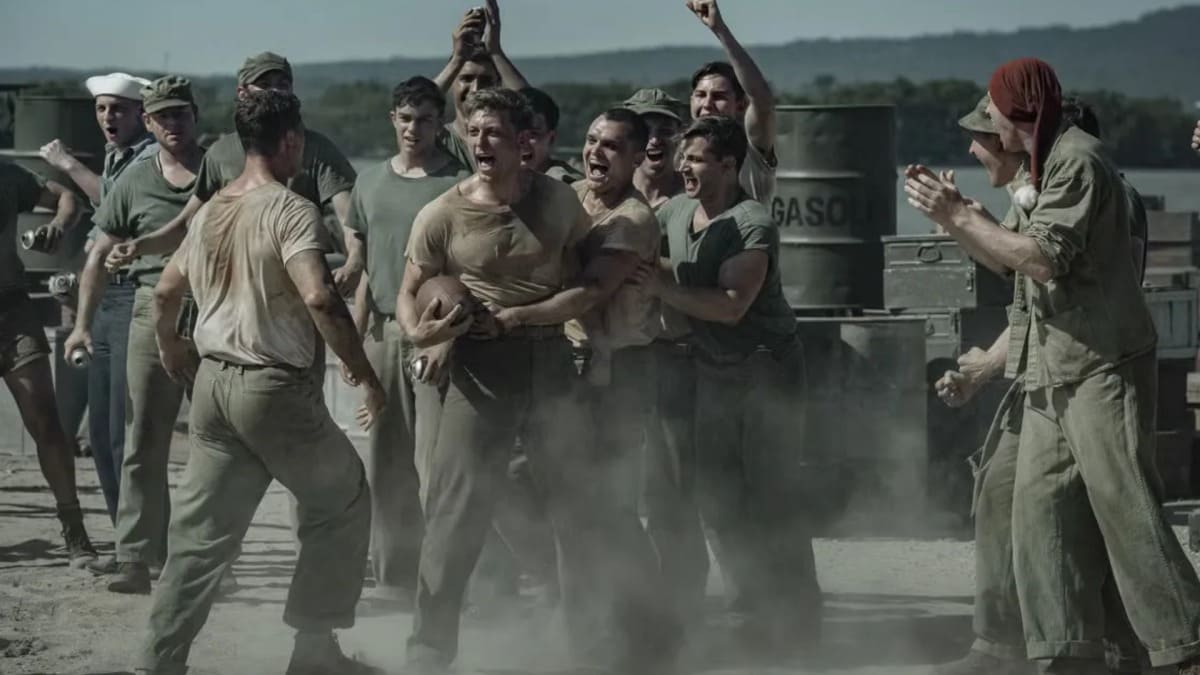
Football, in this context, briefly restores the characters’ humanity, defined initially by alternating rounds of male bonding and ball-busting. So before they go to war, our boys pound some beers and curse a bunch for the same reason that their truncated football matches all use leering, uncomfortably close handheld camerawork and muddy-looking filters: to make the past seem more relatable to modern viewers.
The drama in these establishing pre-war moments is obviously also heightened to contrast them with the nightmarish assault that follows. After that, the movie’s emotional register never shifts, as Berg and his collaborators rely too much on unabashedly corny dialogue, a bland tone-heavy score, and jarring, effect-driven melodrama to emphasize McLaughry and the gang’s tragic disillusionment.
The filmmakers show little interest in what this quartet of bright young men experienced beyond nerve-shredding panic and disorientation. They rally heroically anyway, though it’s hard to care too much about their well-being since we don’t know much about what motivates them beyond a generic sort of patriotism. It’s also pretty telling that the filmmakers include newsreel footage that hints at Japanese war atrocities without any historical context, as if all modern American viewers need to get their blood up is to be reminded that the Japanese were an enemy that had to be stopped.
Here’s where the movie’s understanding of nuance purportedly makes a difference. First, we’re encouraged to cheer on our troops as they torch some enemy soldiers with a flamethrower, or pummel another bad guy (repeatedly, headfirst) into the ground, or trap a tank driver and then blow him up with hand grenades, just to be sure. Then we’re asked to watch in horror as some other American soldiers commit war crimes, like when one Japanese POW is executed simply because he can’t stop howling.
Eventually, The Mosquito Bowl becomes a slurry of hyperstylized traumas and triumphs to illustrate how alternately precarious and bittersweet life during wartime can be. Even Bob Hope’s performance for the troops takes on an ironically nightmarish appearance as it’s cut up into visually and sonically blown out bits and pieces, which unnecessarily reminds viewers how upsetting it can be when nudged in the ribs by entertainers who only want you to forget your troubles and embrace your fellow man—or something like that.
By the time the filmmakers get to the titular football game, it becomes clear that they’re only interested in what their characters represent in the abstract and not how they processed their emotions or what distinguished them as people. As a result both the sports and war scenes appear ungenerous and rushed since they’re more about the adrenalized rush of going through hell without pausing to either reflect or simply incorporate what we know about these real people.
While The Mosquito Bowl occasionally gestures at sharp tonal shifts, watching the movie is a monotonous, overbearing wallow, with the occasional breaks from numbing violence filled with equally flat dramatized sports play. Anyone who’s pre-sold on this particular type of hamburger may still enjoy gnawing on it, but everyone else should order something else.
Director: Peter Berg
Writer: Peter Berg, Mark L. Smith
Starring: Nicholas Galitzine, Bill Skarsgård, Ray Nicholson, Tom Francis
Release Date: October 30, 2026; November 25, 2026 (Netflix)


 Keep scrolling for more great stories.