Without a doubt, Laika’s stop-motion epic Wildwood is the distillation of the studio’s two decades of evolutione. By 2016, when the studio released Kubo And The Two Strings, audiences could already see that Laikahad transmuted from a traditional stop-motion studio, like Aardman or ShadowMachine, into its next form.
Under the guidance of CEO Travis Knight, Laika’s practical artisans have embraced the incorporation of technologies, like CGI, state-of-the-art armatures, frame grabber software, and live action when warranted. Yet at the heart of Wildwood, with its vast array of locales, characters, and battles, remains the studio’s commitment to steel, silicon, fabrics, and a herculean patience to tell stories frame-by-frame.
“We want to tell all types of stories, and that’s why we really embrace technology,” Knight tells The A.V. Club of his expansive ethos regarding stop-motion. “I don’t see any difference between the way we approach it and live action. If it’s story relevant, if a character speaks, or if it’s proximity to camera, those are things that we will do physically. Then we’ll make sure and work with our VFX team in the digital realm to harmonize the look between the two worlds.”
“And sometimes they don’t get enough credit because the one thing we do get for free is that it looks real,” he continues. “It looks physical. We spend a lot of time working with [VFX] to make sure that their work looks like the work that’s being done on the stages. It’s a testament to both sets of artists that this film holds together in that way, where you can’t see the seams between digital and physical.”
Laika stop-motion animation supervisor Brad Schiff offers that what they do is far more complicated than the typical binary argument of physical versus digital. “Fusing old school craft with modern day technology isn’t just stop-motion and CG. It’s everything within the stop-motion medium, and that means the materials that they build puppets out of can be lighter,” he details. “To get these kinds of performances, puppets need to be tensioned really lightly. If the materials are dense, you can’t get that type of tension on a puppet to be able to just practically blow on it and get these finite movements.”
Wildwood BTS (Image: Laika)
Schiff says even 3D printers have revolutionized their craft. “From Coraline, we had a single-colored resin printer so that all the faces needed to be primed, hand-sanded, and painted. All her freckles need to be painted by hand, so it took over a week to process one of those faces. Now the fidelity is so good and the processing is so quick that we have bespoke faces for every shot in the [Wildwood]. No faces are reused in the film at all, which allows us to get really subtle, emotionally nuanced performances.”
Special effects supervisor Ollie Jones adds that while their printed heads still have seams, the VFX “seam team” comes in to digitally blend out the joins. “Apart from that, what you’re seeing is really what’s coming off the 3D printer,” he says. “The marvel of the work that gets put into this, the translucency of the material, the complexity of the paint jobs that the team is able to achieve, and then working with the physical silicon department to make sure that that continuity is expressed through arms, through necks, through any other part of the body, that is really part of the illusion in making sure that that those two things are together.”
One of the few outsiders to join Laika’s pipeline for Wildwood was cinematographer Caleb Deschanel (The Black Stallion). Wooed by Knight to bring his naturalistic eye to their production, Deschanel says he had never worked with stop-motion but was intrigued. “Of course, I was not told the whole story about how complicated it would become and how difficult,” he laughs.
“You’re shooting bits and pieces so it’s like putting a giant mosaic together with one little shot at a time,” explains Deschanel. “It takes a while before the images start to take shape and for you to get an understanding of what you’re creating. All the permutations of it were very, very complicated. But in the end, I’ve always loved solving problems and solving puzzles. I actually took some of the puppets out into the woods and filmed them…to get my head into, ‘What is the look of this movie that will give it the best sense of its reality?’ And by reality, I mean the reality for this particular movie.”
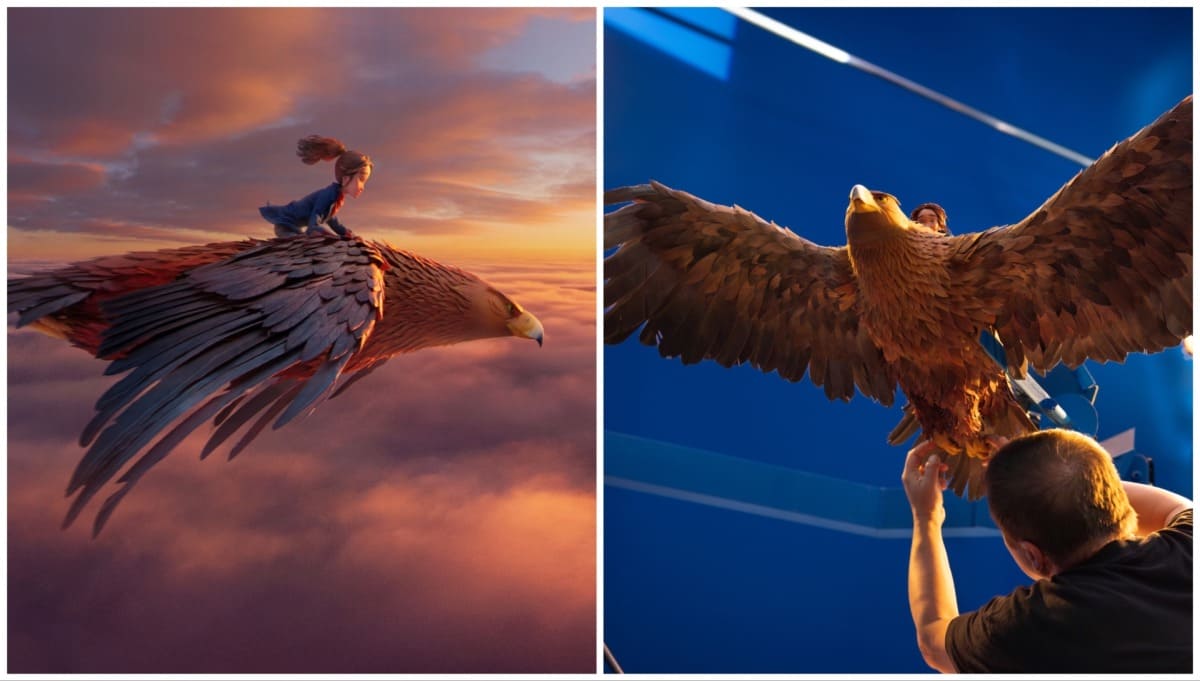
One of many sequences in Wildwood that illustrates the harmony between analog and digital comes in the second act when The General (Angela Bassett) swoops in to save outsider Prue McKeel (Peyton Elizabeth Lee) from enemy Alexandra’s (Carey Mulligan) ruthlessly pursuing crows and coyotes.
Wildwood BTS (Image: Laika)
Together they rocket through the forest, ascend into the clouds and dogfight with a massive murder of crows hot on their tail. “It’s essentially like a ride in a theme park,” Knight says. “We used these crazy camera moves that could enhance that. It really was an extraordinary feat of artistry and craftsmanship and engineering.”
Throughout the minutes-long sequence, the furthest environments and set extensions are CG, as well as the waterfall, river water, and the cloud augmentations. For close-ups, production designer Nelson Lowry built sections of the riverbed, roads, and forest. And then the General and Prue are puppets.
“We really wanted people to believe in this bird,” Jones says. “This bird is a giant compared to Prue; she’s 50 feet tall. We needed her to be bird-like, but she had to emote like a real character. We spent a lot of time trying to balance out how we would deal with things like breathing and shoulder movement. I didn’t know before we started making this that birds have a fused clavicle, so we had to think about—are we going to actually honor that, or do we want to have a little bit more expression and more real estate to work with so this character can emote?”
In previous films, Laika fabricators used silicon to build characters but they decided to build The General out of fabric feathers so she wasn’t too heavy to animate. “She has this gold thread that runs through the polysatin, so she’s modulated,” Jones explains. “As she’s moving against the dawn sky, she’s actually shimmering a little bit, and we’re trying to make sure that we can balance that aesthetic and the legitimacy of the performance that Brad’s team is going to deliver.
Schiff confirms they used 3,000 individual feathers on The General, with the tips wired so they could be animated. “Birds are so streamlined in real life that their feathers really don’t move a whole lot. We had to move them more to make her feel more alive. The counterpoint to that is we have Prue on the back of her, so basically she’s on the outside of a plane with this ponytail that, in actuality, would just be going all over the place. We had to dial that back. The ponytail was moved much less to give it a very lucid kind of feeling, but that it would feel authentic. You don’t notice that that’s moving less than it actually would, or the feathers are moving more than they actually would. Both of those things really help come together to make it feel more alive in our world.”
For The General’s face, Schiff says the animators control her eyes because they’re the windows to the soul. “That’s where you’re going to get all of the emotion,” he points out. “So, the animators are able to control the eyeball independent of the lids, and the lids, independent of the eye, to help get the emotion that they’re trying to get out of each performance.” The VFX team then smooth movements around the eye.
Wildwood BTS (Image: Laika)
And then there’s Deschanel’s camera, which is far from static, following along, twisting up the eagle’s body and shifting perspectives to capture the breathless pace of the chase. “When the bird flies away, it’s actually a camera pulling away from it, so you see it go away; everything’s kind of in reverse of what you’re seeing,” Deschanel explains. “There are a couple of complicated shots in there where they actually had to use two or three stop-motion cameras to achieve it. The camera would move to a certain point, and then it would be mounted on another one to get around to the front, and then another one to move it up to the top. There were 97 motion control rigs used, with a whole team of people and technicians who really know how to do that. The camera guys taught me a lot. They did all the programming, and really created that feeling of flight from the bird, and of course, the incredible animation.”
Knight adds that The General and Prue were hand-animated by “genius animator” Dobrin Yanev, one frame at a time, over two years to complete the sequence. “He brought this extraordinary puppet into such vivid life,” he says. “It’s just a stunning thing to behold.”
Laika currently doesn’t have a next film greenlit as the box office for Wildwood will determine the scale of the studio’s future ambitions. Regardless, Knight says Wildwood feels like the culmination of everything they’ve done over the 20 years of Laika’s existence. “It required us to do things that we’d never tried before and things we’d been scared of even attempting before,” he admits. “How the team rose to its challenge and what they accomplished, it makes me less fearful of failure because I look at this and I say, ‘This team can do anything.’ Any story that we fall in love with and have a desire and an ability to tell, I know this team can pull it off because they can do absolutely anything. On some level, that’s very, very liberating. But every story asks something different of you, and Wildwood asked a lot of us in a lot of different ways.”
“I know some of the stories that we were developing might not necessarily be the scale of Wildwood, but they push animation and they push our team into very uncomfortable territories,” he says of the future. “They will challenge us in different ways, and that’s one of the many things that excites the artists and the craftspeople at our studio, which is we really want to push the art form into places it’s never been. As I look ahead at the stories that we’re developing, that tradition will continue.”




 Keep scrolling for more great stories.