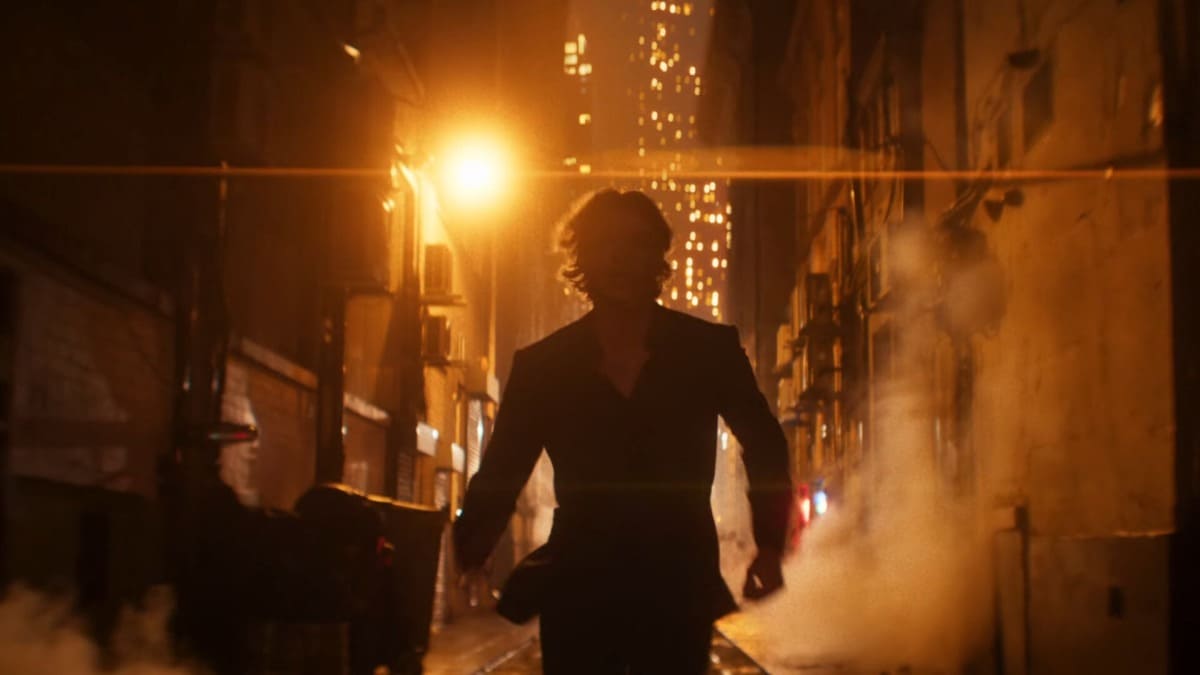
Take Matt Reeves’ Gotham, designed by James Chinlund, with its perpetually rainy, sepia-orange visuals. Beyond enhancing Pattinson’s vengeance quest, the film’s backdrop reinforces its themes of institutional rot through a confluence of crumbling bricks and spewing gutters. It feels as though the city is about to collapse under the weight of its moral failures. Gotham is its own terrible space in The Batman, which keeps the film thrillingly contained within itself. “What we’ve always said is that there’s a consistency to the look, but the next filmmaker that tackles Gotham, they [can] use it as a starting point; they can all feel different,” DC Studios co-CEO Peter Safran told IGN in October. “We want each film to have its own reflection of the vision of the filmmaker.”
This freedom to work outside expectations and a house style akin to the Marvel Cinematic Universe benefited the HBO series Lanterns. Instead of placing its Green Lanterns (Aaron Pierre’s John Stewart and Kyle Chandler’s Hal Jordan) on an alien world or even in its own version of Coast City (Hal’s stomping grounds in the comics), the show’s creators opted for a fictionalized version of Rushville, Nebraska. It was a surprising location choice that visually distanced Lanterns from its live-action forebear, Martin Campbell’s Green Lantern, while providing a backdrop that complemented the mystery the series wanted to explore. Despite its familiar rural provinciality, Rushville is unlike any place we’ve seen in the DCU so far. It’s distinctive even compared with the version of Smallville, Kansas, in James Gunn’s Superman, especially in its use of darker, grimmer color grading. Co-creators Chris Mundy, Damon Lindelof, and Tom King wanted Hal and John to navigate a community that felt sapped of warmth and mired in suspicion.
Abetting a galactic fugitive will do that. And once Hal and John have their destructive showdown with Rushville’s robotic benefactor (Poorna Jagannathan), Lanterns jumps ahead in time to show how much worse things have gotten for the community. It charts the ways Rushville tries, and often fails, to heal itself—a poignant effort after it lost the alien who kept its people healthy and thriving. Rushville’s spaces—the diner, the motel, the football field, Hal’s dilapidated rental home, the town square that rejects its Green Lantern signal light—house the show’s best scenes. The country expanses surrounding it, which obscure their own peculiar secrets, feel like an earthbound version of the cosmic backdrops more typical of a Green Lantern adventure. They go on and on, the space between here and home very, very far away.
Contrast Rushville with the thriving, optimistic design of Superman‘s Metropolis, which connects its characters to their history. Beneath its nosebleed-inducing, CG-rendered spires lies the city’s chaotic street level, where art designer Beth Mickle incorporated Cleveland, Ohio, home to Superman creators Jerry Siegel and Joe Shuster, into its look. When we see gigantic kaiju stomp around the city, or Lex Luthor (Nicholas Hoult) splitting it in half through dimensional mad science, the people fleeing from danger are surrounded by the avenues Siegel and Shuster themselves walked when they were still kicking around the persistent idea of a man who could fly. It’s more than appropriate, then, that the last shot after the movie’s credits is Superman (David Corenswet) and Mister Terrific (Edi Gathegi) evaluating an imperfect crack in a building Luthor had previously ripped apart. Metropolis is Superman’s home, and his work isn’t over once he’s stopped the bad guys from trashing it. Superman wants to set Metropolis right, and that crack suggests he’ll never quite be able to. The movie understands that this is why we like Superman: He keeps trying anyway. (Even if it annoys his super-friends.)
DC’s embrace of eclectic, unexpected places helps explain why Craig Gillespie’s Supergirl doesn’t work: It has no meaningful sense of place and never quite figures out what “home” means to its protagonist. Kara Zor-El (Milly Alcock) is a nomad in her own movie, flying off to planets with a red sun to indulge in destructive drinking binges. She has no home, and it’s ruining her life. That’s a promising angle for a Supergirl story—the comic it’s based on, Supergirl: Woman Of Tomorrow, made a compelling, cosmos-spanning adventure out of it. But the movie botches its execution by keeping Kara’s true home out of reach for most of its runtime. Instead, she zips around the galaxy looking for a cure for Krypto, her pet dog and the other survivor of her doomed home planet, after he’s been poisoned by the film’s anonymous baddie (Matthias Schoenaerts), all while navigating a strained relationship with Ruthye (Eve Ridley), who’s hired her to track down the brigand who slaughtered her family.
With Krypto mostly out of the picture, Kara trudges from one indistinct alien locale to the next, each evoking the same ho-hum sci-fi we’ve tolerated from franchises like Marvel and Star Wars. The movie’s muddy visuals allow the emotional core of its hero—and her rambunctious pup—to be swallowed almost entirely in a brown, forgettable smear. We see Kara’s home, Krypton, destroyed in a flashback, but the movie never quite lets her reckon with that loss. When she returns to Metropolis at the end, it doesn’t feel like a triumphant homecoming, just another stop along the way. She’s still settling, still unmoored. Supergirl never gives its hero a space to land, for all its cosmic sprawl.
Supergirl‘s open-ended finale, coupled with the knowledge that Kara will return in next summer’s Man Of Tomorrow, feels more in line with the MCU’s ceaseless continuity machine than with the DCU’s evolving patchwork approach. It’s a curious misstep for a franchise that has otherwise made a virtue of letting each story find its own way. We don’t yet know where this first cinematic “chapter” for DC Studios is headed—we may not even know by the time Man Of Tomorrow flies into theaters—but we can at least appreciate how every major release so far has created a sense of place that enhances the stories being told. Metropolis, Gotham, and Rushville are distinctive houses for stories that stand on their own, thanks in no small part to the new foundations DC Studios lays each time it calls a new superhero (or villain) to duty.


 Keep scrolling for more great stories.