This, as last week’s “Lights Out” shows, is a fakeout. Macon is actually in love with the Manhunter Hal and John are after, revealed to be his not-actually-estranged wife Zoe (Poorna Jagannathan). Over 30 years, Zoe has protected herself by slowly placing all of Rushville in her debt, performing small miracles to keep the entire town alive and thriving. She has some thoughts about this; when John asks about why she chose to be a woman of color here on Earth, Zoe says that starting at a disadvantage is the best way to understand, and then conquer, a society.
This is an interesting inversion, to introduce a phony villain who traffics in Great Replacement who’s actually a willing party to the conspiracy he seemed to warn against. It’s a little too queasy to be funny, the way Lanterns effectively uses its alien metaphor to validate the ideology of characters who echo real-life white supremacists, but we’ve still got three episodes to go, and plenty of room to land this tricky plane. Which is good, because Lanterns’ use of aliens as a metaphor is all over the place.
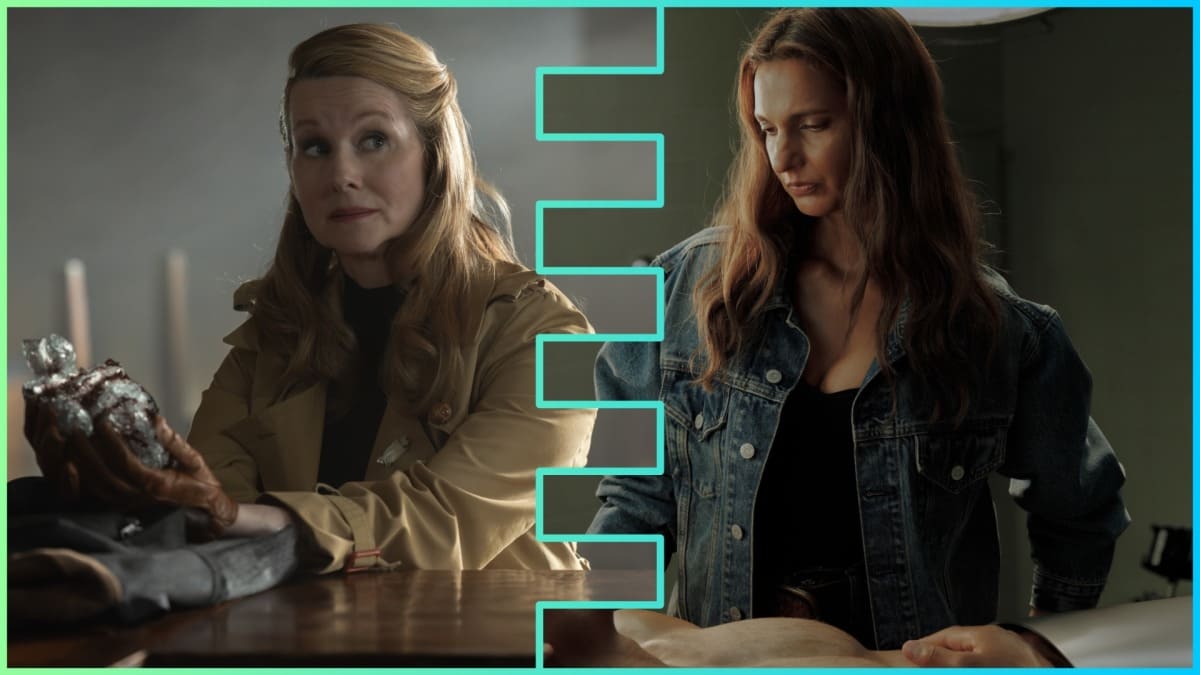
There’s the Macon flip-flop, for one, but then there’s Lianna (Laura Linney) to consider. The Guardian Of The Universe managing affairs on Earth isn’t doing a particularly bang-up job of it, and seems interested in having a Green Lantern she can control rather than participating in any galactic peacekeeping effort. “Lights Out” goes a long way towards making just about every problem Lanterns’ heroes face the Guardians’ fault—if not this particular Guardian. The Manhunters, we’re told, were the Guardians first attempt at a Green Lantern Corps, and necessitated destruction because of their brutal efficiency. Zoe doesn’t know how or why she was spared this fate, but Abin Sur meant to hide her on Earth, and killing him, John surmises, was the only way to ensure her survival.
It seems likely that Lianna may ultimately prove to be Lanterns’ big bad. Right now, however, she’s mostly a meddler in the affairs of humankind broadly and John Stewart’s life specifically, and a racially insensitive one at that. Lanterns’ use of Lianna has mostly been as a vessel for institutional frustration—she is the authority figure who refuses to take responsibility, who manipulates constantly, who hides behind bureaucracy in a pointed effort to avoid providing clarity. In other words, while her arc is braided into a different set of themes Lanterns is exploring, she is ultimately another alien that humans seem better off without.
Here is where the perils of close reading and mystery-box storytelling converge in the least satisfying manner. It’s possible to dismiss the question of “What do aliens mean in the context of Lanterns?” as classic overthinking, a failure to simply enjoy the sci-fi show in front of us. But Lanterns is built on the idea of grounding the cosmic shenanigans of its DC Comics characters in very earthbound parallels: The Green Lanterns as one more agency arguing over jurisdictions with Sheriff Kerry Kane (Kelly Macdonald); the Guardians holding recruitment meetings in a mall, just like the branch of the U.S. military with which John served. A mystery about an intergalactic threat, but one that begins on a small town’s high school football field and is tied to Rushville’s fortunes in a world that is not kind to small towns. Lanterns is an attempt to use the Green Lantern’s power ring to grasp at something real, but as things stand, it is mostly confused. A shame for a show where its heroes’ power is directly proportionate to their understanding of how things work.


 Keep scrolling for more great stories.