
Stuart Gordon and Jeffrey Combs formed horror's friskiest, nastiest trio with Edgar Allan Poe
The director of Re-Animator and his leading man shared an appreciation of grotesquery, gallows humor, and dark literary fiction.
Photo: Ward Boult
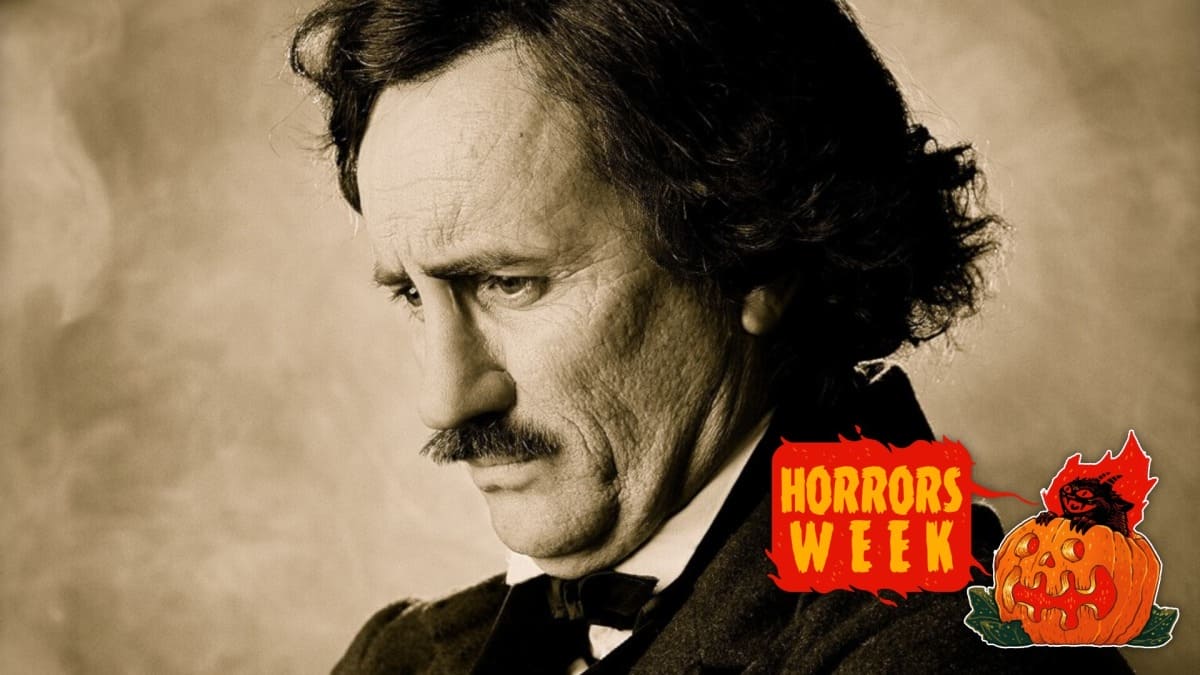
The story of filmmaker Stuart Gordon and actor Jeffrey Combs begins and ends with Edgar Allan Poe. Roger Corman sparked it: His Poe adaptations such as House Of Usher and The Pit And The Pendulum, budget-conscious chillers with a sincere, lurid approach to the macabre, captivated Gordon during his formative teenage years and led him to discover Poe’s poetry with all its troubling, romantic imagery. His fascination with 19th-century American horror informed a career spanning over a dozen transgressive, often very funny films, eight of which employed Combs. The actor wasn’t immune to Poe’s power, either: Years after their first film, eager to portray a historical figure on stage, Combs landed on Poe’s life story and declared him “America’s Van Gogh,” an observation that led to his final collaboration with Gordon: the 2009 one-man show Nevermore. Following the poet during the year between his young wife’s death and his own, the play was the final act in a career-long friendship that brought out their best.
Gordon made literary horror sordid, horny, and funny, and Combs was always there to match his freak. H.P. Lovecraft was another of Gordon’s abiding influences, a troubled writer who began his career riffing on Poe’s work before charting his own path into eldritch, almost exclusively asexual terrain. Given the sexlessness of Lovecraft’s work, it’s notable just how much sex governs Re-Animator, Gordon’s feature debut, and indeed most of his work on screen and stage. Blame his fascination with Poe, whose doomed romanticism drapes over this perverse terror tale about reaching beyond humanity’s grasp. Instead of settling for Lovecraft’s male-centric template, Gordon throws a woman into the mix, depicting his three leads—Barbara Crampton, Bruce Abbott, and a wiry, nervy Combs as Dr. Herbert West—in a psychosexual trifecta driven as much by libidinal desire as splattery mad science.
Throughout Gordon’s work, Combs took on lead roles, supporting parts, and even voiced a faceless 911 operator in the director’s final feature, Stuck, in 2007. Whatever the role, Combs was always game for the gnarly depths his director wanted to explore. That shared inclination toward the dramatic and the messiness of human desire stemmed from their theater backgrounds, though they took different paths. While Combs trained at universities on the West Coast, Gordon studied theater production in Wisconsin and eventually founded Chicago’s Screw Theater in 1968. His subversive production of Peter Pan depicted Wendy’s Lost Boys as hippies and Captain Hook as Chicago mayor Richard J. Daley, and projected a psychedelic trip to Neverland across a row of nude women onstage. This creative choice led to one performance ending with Gordon and his future wife, Carolyn, being arrested on an obscenity charge—an early indication of a sensibility that would later fit snugly and defiantly within the horror genre.
Combs had also made a name for himself on the stage when Gordon began casting his modernized telling of Lovecraft’s “Herbert West—Re-Animator.” Their first meeting was simplicity itself: Casting director Anthony Barnao had seen Combs perform and recommended him for the part. “As soon as he walked in and started reading, we knew this was the guy,” Gordon told Paste in 2015. It helped that Combs possessed an attitude that Gordon responded to. Even if he didn’t have Herbert West’s blond hair and blue eyes (Gordon described Combs as “dark and small”), the actor showed a willingness to bring off-putting, even repulsive traits into his performance—a skill that would serve their professional relationship well.
Soon into the production of Re-Animator, however, Combs discovered that the film’s extreme gore required a pressure valve to make him more comfortable with the work. “[Stuart] approached it as very serious. He never once said, ‘Let’s make a joke here,'” Combs said. “Secretly, though, Bruce [and] I kind of went, ‘You know what? This is very, very gruesome, gory stuff, and we need to find release points.'” While Combs and Abbott avoided outright slapstick and winking comedy, they found moments in their scenes to loosen up, giving the audience space to breathe amid all the grody unpleasantness.
These comic instincts carried over to their next film. In From Beyond, the actor fused mania and sincerity brilliantly: Combs, as the traumatized scientist Crawford Tillinghast, explains how an experiment with Dr. Pretorius (Ted Sorel) went so wrong. Gordon has cinematographer Mac Ahlberg frame Combs’ face as he goes for broke delivering his insane lines. (Gordon’s camera pushes in so close that we can practically feel the spit coming from his mouth: “It ate him! Bit of his head—like a gingerbread man!“) Gordon frequently dwells on Combs’ face in Beyond, closing in to underscore the film’s mounting sense of dread and disgust. Naturally, when Tillinghast’s pineal gland awakens and begins throbbing (a recurring and appropriately perverse image in the film), Gordon once again hits him with a close-up, and together, they nail the moment’s sense of pain and pleasure. When Combs sucks the brains out of a doctor’s eye socket, neither he nor his director flinches at the sequence’s hideous absurdity. Instead, they lean in.
 Keep scrolling for more great stories.