Time moves fast. 260 years can zip by in the blink of an eye. That’s how long it took me to fly from the failing Earth of the far future to humanity’s new home upon the Interstellar Arc. One second, I’m closing my eyes within a virtual reality headset inside a warehouse outside Las Vegas, the next, a glowing blue fox with the most ostentatiously “soothing” voice ever is catching me up on the last two and a half centuries of humanity. It is, by definition, a trip.
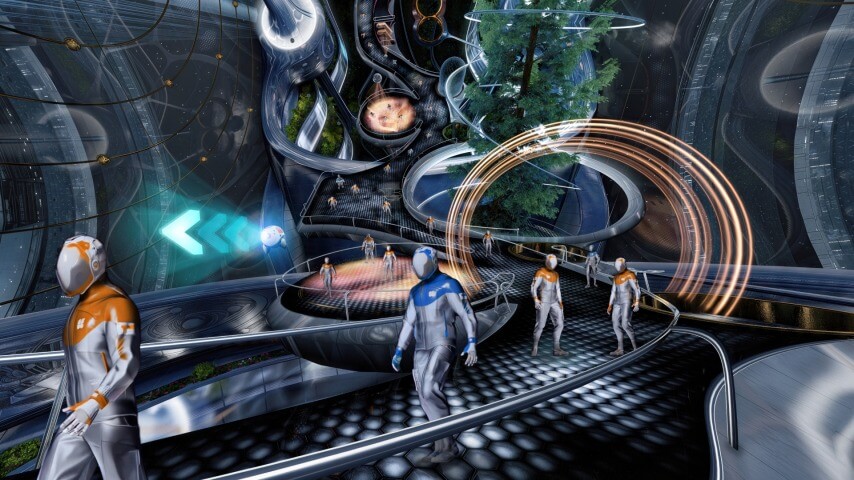
It turns out I’ll let a glowing blue fox lead me anywhere, even if my attempts at petting it leave me hanging. It cautiously guides me through a massive space station that houses the sum total of human wisdom and knowledge, often changing form into a massive woman with perfect cheekbones and no hair and the serene demeanor of a sleep technician. The fox, obviously, isn’t real, nor is its human form; I’m seeing both in virtual reality. Nothing I see, from the cryo pods and capsule-like shuttle that housed my group of Earth ex-pats during our journey, to the Mass Effect-ian space station we’ve traveled light years to reach, is real in the physical sense—save for the railings that flank every walkway, and the human-shaped forms who appear around me in anonymous orange and white spacesuits. We have to know where we are, obviously, so we don’t blindly stomp on each other.
This is what it’s like to visit Interstellar Arc. It’s one of several new additions to AREA15, a collection of immersive experiences in Las Vegas that also includes Universal’s Horror Unleashed and Meow Wolf’s Omega Mart, and like those exhibits, it aims to transport us to another place. Unlike those two, which rely on physical sets, practical effects, lighting, and sound to create their illusions, Interstellar Arc is almost entirely intangible—a fact that becomes apparent when I pull my mask off for a moment and realize we’re groping around in a giant blue room that’s empty outside of the network of railing that guides us.
Interstellar Arc is the most sustained and impressive use of VR I’ve ever seen. It’s also more proof that the value of VR might be pretty limited. During the hour-long expedition I walk along what appears to be a circular path spiraling through the center of the space station, in a gravity-defying illusion that evokes 2001. I follow that fox towards glowing golden orbs, where, in its human form, it explains the science behind this project and the Earth-like planet we’re trying to colonize, while also warning us of repeating the same mistakes that forced us to leave our planet in the first place. At one point a giant Carl Sagan appears to briefly explain the cosmos and humanity’s attempts to understand it. It’s basically a school lecture inside a video game.
For that reason Interstellar Arc also gives me more reason to question the long-term value of VR. It’s an accomplishment, alright, but not one I especially enjoyed—and one that makes it clear VR still has a good way to go to create visions that have any weight or soul to them.
Interstellar Arc’s VR is a little blurry, and unless I’m holding on to the space station’s ever-present railing, there’s no sense of any physical connection between what I’m seeing and what I’m doing. There’s no weight to any of it—which is obviously an inherent problem with VR, but still one worth noting. It never quite makes me sick, though, which is a step up for VR. The most striking moment is when I see a torii with a view of Mt. Fuji at sunrise on the other side of its posts; when I walk through the gate, I’m suddenly surrounded by the golden light of that image, as if it transported me to Japan, with the space station now only visible through the gate’s opening. Other than that unexpected trick, Interstellar Arc’s visual delights are limited, muted, with the nondescript style of a generic sci-fi video game.
If immersing yourself in a 360 degree version of a video game sounds fun, note that Interstellar Arc is deadly serious about its mission. It’s an incredibly earnest explanation of how we could theoretically relocate all of humanity to a planet hundreds of light-years away—and unfortunately that earnestness makes it all a little boring. It’s a dry hour, counting on the presumed awe of immersion to keep guests interested for the whole show, and then hitting them with edutainment so light on the ‘tainment that it makes 1980s EPCOT seem like a joyride. That sincerity and total aversion to cheap thrills is legitimately commendable, but the script could still use some levity. Nobody will hear you laugh in this space.
Interstellar Arc does try to dress its science up in a couple of ways. There’s a nod to gamification in the form of collectibles; silvery blue orbs are often seen suspended in the distance, and if I reach towards them, they’ll float towards me. The VR headset keeps track of how many I’ve found like they’re stars in Super Mario 64, giving me a final count at the end. There’s also a photo tool in the headset, complete with selfie mode; if I jab the air with my right hand, like I’m pushing a button, it’ll turn my visor into a camera, letting me snap photos of my orange-suited stand-in all throughout the space station. Links to those “in-game” photos are emailed to me as I check out of Interstellar Arc, letting me download them at my leisure. It also rewards me with Xbox-style achievements throughout, no doubt in hopes of getting me to return to try to 100% it. None of it provides the hook that Interstellar Arc needs, though—the thing that would turn it from a tech demo/university lecture into a human, lifelike world worth visiting.
Interstellar Arc admirably strives to be educational, entertaining, emotional, and eco-conscious all at once. It only pulls off the first and last of those four, and unfortunately it’s the other two that are most crucial to connecting with an audience. It might focus on humanity’s future, but it lacks the humanity of something like its AREA15 neighbor, Omega Mart, not to mention its sense of wonder and other-worldliness. Interstellar Arc aims for the stars, but never really takes off.


 Keep scrolling for more great stories.