The first season of ABC’s Agents Of S.H.I.E.L.D. was a thrilling experiment in television because it existed on the ground level of an extraordinary world. The show followed a ragtag group neutralizing threats that didn’t quite rise to the need for the Avengers, while still granting audiences the chance to live in the age of marquee superheroes beyond their films’ runtimes. It deepened the franchise’s lore and interrogated the idea of human effectiveness when compared to otherworldly beings.
But soon enough, dozens of superhero series clogged our streaming feeds, piling on the required viewing just to keep up. In time, Agents Of S.H.I.E.L.D. was cast aside in favor of more integrated MCU series and lived out its final years introducing deep-cut superheroes kneecapped by their irrelevance to the larger story. Unfortunately, that is the territory that Apple TV’s Monarch: Legacy Of Monstersis teetering toward.
For those who aren’t versed in the Monsterverse, the series exists in the same world as the ongoing film franchise that includes 2014’s Godzilla, Kong: Skull Island, Godzilla: King Of The Monsters, Godzilla Vs. Kong, Godzilla X Kong: The New Empire, and the forthcoming Godzilla X Kong: Supernova. While this is hardly the vast Marvel universe of generation-defining movies, the Monsterverse has become a lucrative blockbuster play with an intertwined mythology that exists on Earth, as well as in an alternate dimensional land called Hollow Earth and an in-between void known as Axis Mundi.
This is the narrative weight that sits on the shoulders of Monarch: Legacy Of Monsters as it looks to prove that it stands as mighty as its theatrical siblings. The series is named for the government agency that ignorantly believes it can put guardrails around the Titans that live in, under, and somewhere between our worlds. Season one charted the rise of Monarch in the 1950s and ’60s, while also navigating the murky morality of its work in the present day, after Godzilla’s destructive debut in 2014. Lee Shaw, who’s played as a young man by Wyatt Russell and as an older one by his real-life dad Kurt, is here to bridge these eras.
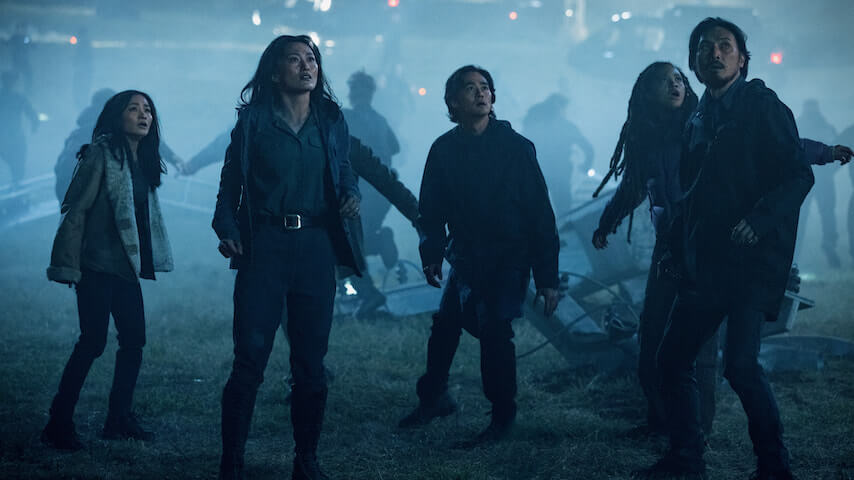
Take a deep breath because here’s where the show stands. The season-one finale found older Shaw, G-Day survivor Cate (Anna Sawai), and tech whiz Corah (Kiersey Clemons) trapped in Axis Mundi, where they encountered a still-youthful Keiko (Mari Yamamoto), Cate’s grandmother, who Shaw believed died after falling through a rift during their Monarch expeditions in the 1950s. (Her 56 days of survival translated to half a century on Earth.) The season ended with Cate’s father and Keiko’s grown son Hiroshi (Takehiro Hira), along with his son Kentaro (Ren Watabe), saving the group—minus Shaw—from Axis Mundi. In the season-two premiere, a rash decision to open another rift and go back for Shaw unleashes a new monster, known as Titan X, on our world—one that a younger Shaw and Keiko happened to encounter decades earlier. This tentacled Titan, which is aquatic until it isn’t, is on the move toward something unknown, with plenty of military, civilians, and collateral damage in its path. Standing in the way of Monarch stopping it is Apex Cybernetics, a tech company looking to reap the rewards of Titans rather than keep the peace between species.
Needless to say, there is a lot going on in Monarch season two, often to its detriment. At times, it bogs down the fun with too much technical jargon, bureaucratic red tape, and confusing talk of rifts. The series also doesn’t know what to do with its characters beyond the collective mission to not cause mass devastation by toying with Titans. Only when it finally hones in on its new monster does the season manage to tell a surprisingly emotional story that leans into the human-Titan connection at the core of the films. But increasingly, Monarch also pulls its punches. Had2024’s Godzilla X Kong: The New Empire been a flop, the series might have had more freedom to use the titular warriors at will. But the film was a hit and stands as the most successful Godzilla movie ever. It showed there is still potential in this franchise to make money at the box office, which means TV series will always come second.
Unlike the MCU, which only had its actors for so many contractually obligated appearances, Godzilla and King Kong are not SAG card holders. Their digital creations can be conjured up whenever the budget allows. But too much Godzilla and Kong on TV might dull the audience’s hunger for them on the big screen, leaving money on the table. As such, if the films are sold on the promise of clashes, how many punches can be thrown on TV? The answer can be found in the back half of season two. Godzilla’s long-awaited deployment should bring audiences to the edge of their couches, but the spiky guardian’s arrival feels stunted as soon as he unleashes his first shriek. The camera barely finds him as he engages in battle, which is over almost as soon as it begins. Even the characters bristle at the reasoning for why he doesn’t stick around longer. Similarly, a more substantial appearance by Kong is shot almost entirely from the ground to find the human characters in the chaos of Titan limbs. It’s an interesting perspective, but it also means that the series doesn’t have to show Kong actually fighting that much.
Instead, the camera always finds Titan X, a whole-cloth creation of Legendary Pictures, which holds the rights to Godzilla, Kong, and other adjacent characters. By concocting their own monster, Titan X can be the placeholder when Godzilla and Kong’s time is more precious. This isn’t necessarily bad: Titan X’s emotional arc is by far the most effective thing about season two. But it does prove the series and the films are playing in different leagues.
To keep from overindulging in monsters, Monarch turns its attention toward humans. Coming off her Emmy win for Shōgun, Sawai is still underused here because the series doesn’t know what to do with Cate. In season one, she was grappling with the PTSD of saving her students from Godzilla’s wrath in San Francisco. This time around, she has only inflicted more guilt upon herself, which gives her the same emotional beats to play. Only when she gets an intriguing story involving Titan X does Sawai get a chance to let loose a bit. But it’s too little too late. Instead, the series’ MVP is Yamamoto, the only actor to play their character in both timelines. Keiko’s empathetic impulse to learn more about the Titans in the past and protect them in the present gives her the most substantial arc here.
She is a great match for the Russells, whose strapping charisma goes a long way to reacquainting the audience with the inherent fun of this premise when things get a bit dour. Let’s not forget: This is still a story about massive creatures who talk with their fists, tails, and roars. Even if they aren’t seen as much as they are discussed, this was always meant to be a rock-’em-sock-’em good time. And Monarch still can be just that—when it actually lets itself glove up.
Hunter Ingram is a contributor to The A.V. Club. Monarch: Legacy Of Monsters season two premieres February 27 on Apple TV.


 Keep scrolling for more great stories.