Lizzie Borden’s story has been co-opted plenty of times in the 134 years since she was accused of hacking her father and stepmother to death in their Fall River, Massachusetts, home. Stage plays, a musical, and podcasts have explored Borden’s difficult upbringing, the crime, the trial, and the incessant public attention; there’s a heavy metal band named after her; actors Elizabeth Montgomery, Cristina Ricci, and Chloë Sevigny have portrayed her in films and a TV series. There’s even a factually incorrect yet popular nursery rhyme about this saga. That same children’s song plays in the premiere of Monster’s fourth season during the theatrical opening scene in which Lizzie (Ella Beatty) gleefully prances around the house as she murders Abby (Rebecca Hall) and Andrew Borden (Charlie Hunnam), with blood spatter all over her tidy white dress. But is this the harsh reality, or merely a version of events that people assume took place?
This montage alone indicates exactly what to expect tonally from Ryan Murphy and Ian Brennan, who, after seasons centered on Jeffrey Dahmer, the Menendez brothers, and Ed Gein, set their sights on Borden for another salacious take on a wildly infamous story. The result is delirious, whether it’s the over-the-top dialogue, musical cues (The Runaways’ “Cherry Bomb” plays often in the premiere), or the characters’ heightened relationships and behaviors. Not to mention whatever commentary about true crime, victimhood, generational trauma, and women’s burdens that the male co-creators think they’re getting away with in season four, at least in its first episode.
Monster has never been about examining why certain crimes took place or the reaction to them. For the most part, the Netflix anthology is exploitative and exaggerated for shock value, qualities that require a degree of fabrication and creative liberty. It remains the case with The Lizzie Borden Story as well, a fact established as early as episode one. The show takes the premiere’s title, “Bloodbath,” a little too literally: Brennan—who penned every episode of season four—and director Max Winkler cover the proceedings in arterial spray, be it that gory opening scene, intense discussions and depictions of menstruation, or in how the Borden’s new housemaid, Bridget (Vicky Krieps), tells Lizzie about the power that blood can hold. But what does it all lead to?
The appeal of true crime stems from wanting to understand the psychological, emotional, cultural, or societal pressures that led to horrific events, and if any lessons might be learned from them. (The profitability of those explorations—and why the Monster franchise exists—is a whole other matter.) But The Lizzie Borden Story, like previous Monster installments, doesn’t cut that deep. It prefers to sensationalize and dramatize said events. Most of “Bloodbath” attempts to kick off a conversation about why women kill, questions steeped in antiquated notions of the “fairer sex.” The answers are largely unsatisfactory.
So what could make someone like Lizzie—who is seemingly sweet, friendly, and hopes for a better life outside her claustrophobic home—take a hatchet and bash her parents to death? In Monsters’ superficial reading, Lizzie has been a punching bag for a long, long time, begrudgingly raised by stepmom Abby following the death of her biological mother. Abby seems to loathe her stepdaughter for no particular reason, and despises that she remains unmarried, despite being in her early 30s. Even the suitor Abby hopes will ask for Lizzie’s hand rejects her because, ugh, Lizzie’s face reminds him of a horse. (Never mind that she’s being played by the child of two famously gorgeous movie stars.) Lizzie’s neglectful father is no help whatsoever; he’d rather focus on his business of making caskets and taking care of his precious axes. It’s safe to say that Lizzie has no one on her side, not even her sister (who doesn’t appear in the premiere).
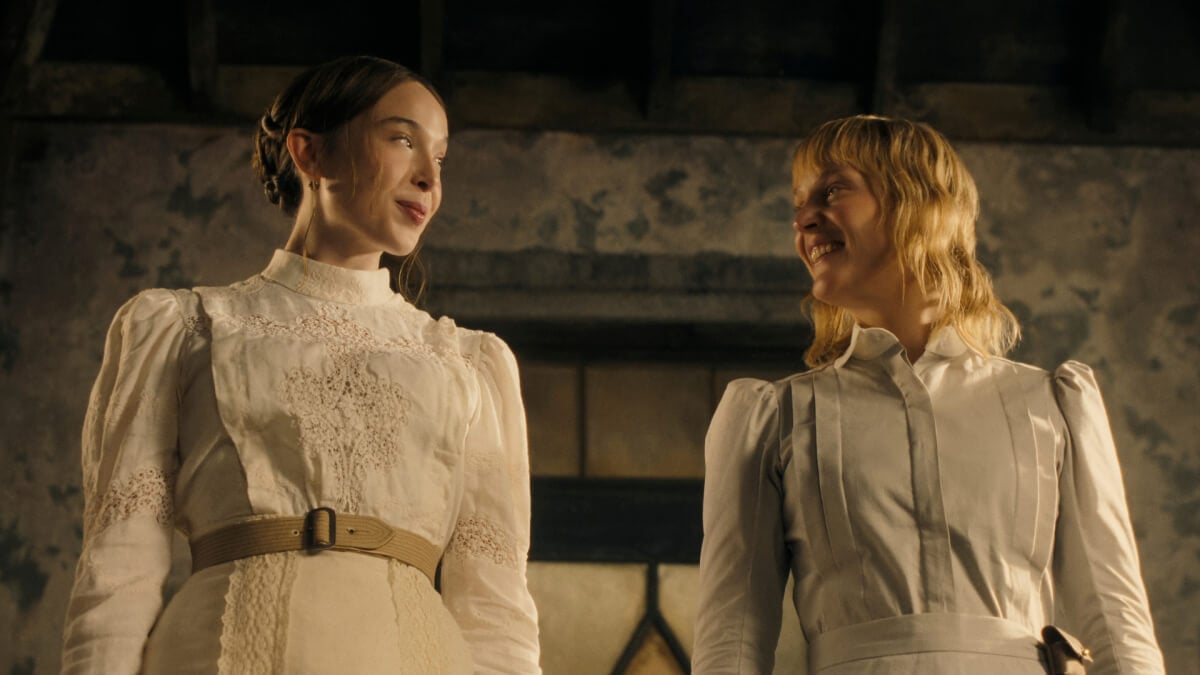
All that changes when outspoken and independent Bridget enters the picture, four months before the murders take place. Bridget shakes things up, all right. She observes, understands, empathizes with, and quickly befriends Lizzie, pointing out the unfairness with which she is treated by her loved ones (although Lizzie happily makes excuses for Abby… for now). More than that, Bridget also impresses Abby with her cleaning and cooking skills, and she makes a secret deal with Andrew, the kind where he pays Bridget to sleep with himher because she’d do almost anything to earn money.
The instant connection between Bridget and Lizzie takes up so much space in episode one that Monster is evidently setting up the tale of how their friendship evolved (toward romance and MURDER?!?!). In no time, Bridget’s presence in the house has an impact on Lizzie, particularly when it comes to grasping her own identity. To do that, Bridget teaches Lizzie about Elizabeth Bathory, a Transylvanian (technically Hungarian, but why split hairs—Monster doesn’t bother to) noblewoman who allegedly killed young girls and bathed in their blood—complete with another splattery of Bathory’s (also played by Krieps) tale coming to life.
It’s a far-fetched way for Monster to discuss how, for centuries, women have had to fight to take control of their lives, whether it’s in the 15th or 19th (or, heck, the 21st) century. Women have to fight tooth and nail just to be seen and heard, and for Lizzie, Bridget does both. It helps that Bridget, who has traveled and lived in different parts of the world, has more awareness than Lizzie. Together, they make a dangerous pair. What they accomplish for now, inspired by Bathory, is to soak in a bathtub filled not with blood, but the next best thing: four bushels of cherries that Lizzie juiced. As the two women strip and step inside that cherry bathwater, surrounded by pigeons and pigeonshit, The Lizzie Borden Story‘s premiere ends with a promise that’s more akin to a threat: The two of them could plot to rule the world, or at least the Borden household. Though, at this juncture, they’re stranded at the center of a miniseries with no clear point and nothing to add to its worn out story beyond a fresh coat of red. That may change as the saga unfolds, but within its first episode, the new Monster justifies its existence in only the most sordid details.
Stray observations:
- • Abby is obsessed with a particularly fancy couch in the Borden’s parlor, with Winkler’s camera weirdly lingering on its design and fabric for far too long. And when Lizzie’s period blood stains that fabric, Abby throws quite a hissy fit until Bridget cleans it up.
- • Among other things, Bridget gifts Lizzie a 19th-century vibrator, testing it out on Lizzie’s palms and giving her tips on how to use it to stimulate pleasure.
- • Lizzie points out that when Abby became a new stepmom, she was so exhausted, she started consuming formaldehyde, ammonia, and paint thinners.
- • Hunnam, who was just nominated for playing Ed Gein in Monster season three, dons an entirely new look and accent for The Lizzie Borden Story.
- • I didn’t mention the performances, mainly because none of them leave a mark just yet. Still, Hall is clearly having a ball in this role.
- • Andrew: “Will you stop your caterwauling? I’m powfagged.”
Abby: “Flapdoodle. This is my personality.”
Saloni Gajjar is The A.V. Club‘s TV critic.


 Keep scrolling for more great stories.