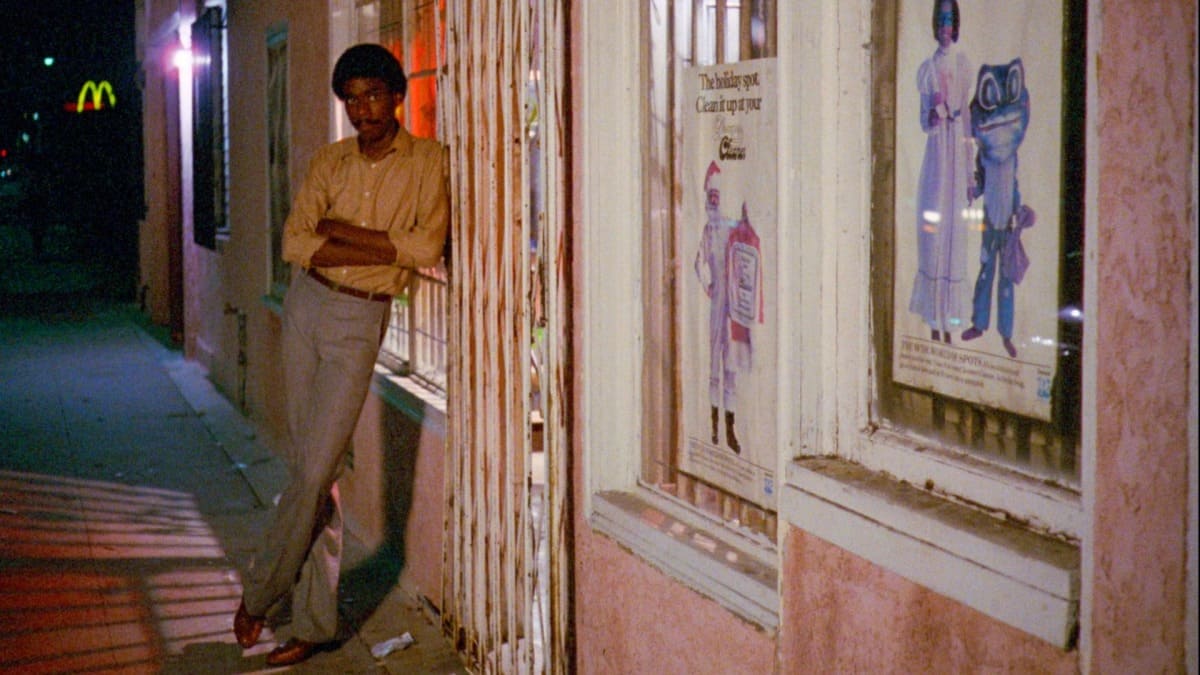
Charles Burnett wanted to see what the movies never showed him: people like him, his friends, and his family living with day-to-day problems, celebrating milestones, and sharing heartfelt conversations over supper. After making short films at UCLA, his master’s thesis Killer Of Sheep became a monumental title in the history of independent film and one of the early entries into the L.A. Rebellion. The movement, led by Black filmmakers at UCLA, centered on Black characters and stepped away from conventional Hollywood techniques and narrative arcs to lean into realism. Burnett’s 1983 sophomore feature, My Brother’s Wedding, uses the same free-flowing slice-of-life approach to follow the rhythm of a young Black man’s experience, but this time on color film stock, capturing a snapshot of South Los Angeles in sunsoaked detail.
My Brother’s Wedding follows Pierce (Everett Silas), a busy man about town going nowhere fast. He tries to help his parents with their dry cleaning business, but he’d much rather spend his time goofing off with his best friend, Soldier (Ronnie Bell), now that he’s out of jail. Despite his best efforts, he’s a disappointment to his parents—especially compared to his brother, a lawyer who’s soon to marry into a respectable middle-class family. On the day of the big wedding, Pierce is torn on whether he should be there for the family that thinks he’s a lost cause, or attend his friend’s funeral after an accident.
Although Burnett is celebrated today as a pioneer of Black cinema, in the early years of his career, success and financing eluded him. Killer Of Sheep was difficult to see in its original version because of its music rights, and after an early cut of the film received a chilly reception at New Directors/New Films in New York, My Brother’s Wedding was shelved for decades, until Milestone Films bought the rights and allowed Burnett to finish editing the film for an actual release. Now, after the recent restoration of Killer Of Sheep, it’s My Brother’s Wedding‘s turn for a 4K makeover. Burnett spoke to The A.V. Club about the film’s long journey back to the big screen, learning to work with both professional and non-professional actors, and the company that’s helped reconnect his work with audiences.
The A.V. Club: What inspired you to write and direct My Brother’s Wedding?
Charles Burnett: Two things. One, I got some money from ZDF, German television, because I made a short film that won a prize at the Berlin Film Festival. Then ZDF came and asked, “Well, would you be interested in working with us on another project of yours?” I said, “Sure.”
Two, I was working at this agency, and there was a young lady who came and got a job there, and she had just came from Iowa, or I can’t remember which state now, but she and her boyfriend—they were going to get married, and they didn’t have too many friends, so they invited me to be a part of their wedding. At some point, a friend of mine died, and strangely enough, the wedding and the funeral happened at the same time. I decided that I was going to go to a funeral and the young lady who was going to get married, who I promised I’d be at her wedding, walked up to me and I had this look on my face and she said, “You’re not going to tell me you’re not going to come to the wedding.” And I said, “No, no, no, I’ll be there.” I was too chicken to say that I really have to go to the funeral because that seemed to be more important. I sort of gave in to her and decided to go to the wedding. I made the commitment, and then I tried to find a way out. I was trapped in between and trying to decide which one to go to, and I ended up trying to please everybody and ended up screwing up everything.
The lesson I learned is that in order to be a brother’s keeper, you had to be responsible. The guy who died, he was a young guy who had a lot of problems, and I wasn’t equipped to be a brother’s keeper or be responsible for someone in that sense. It was sort of autobiographical in that sense.
AVC: There’s a duality between the two brothers. The older brother who’s getting married embodies the American Dream and getting ahead. Pierce doesn’t seem to know where he’s going, and everyone seems mad at him except for his friend. What inspired that dynamic?
CB: There were a lot of things going on there when I was coming up in South Central. There was this issue about class, and there was this notion that there was a great divide between the middle class and the poor. People who did quite well were [considered] very materialistic, who you might say abandoned their roots or where they were from. There was a lot of anxiety in the community about people who became very famous, and those who didn’t make it. Are you leaving us behind? We romanticized the poor and had this false notion about the middle class for all the wrong reasons. Pierce’s parents were from the South and very rooted in Southern culture and so forth, but they had Pierce’s brother who did quite well and was moving up and had this notion about “I made it and you can make it.” It was that sort of attitude in my neighborhood.
AVC: My Brother’s Wedding and Killer Of Sheep share a slice-of-life story. Things feel natural but composed. How do you recreate that sense of realism?
CB: In terms of working with the cast, it was mostly friends of mine. And so I found people that were living that life in a certain sense. They weren’t actors. They were playing themselves in many ways, so that was easy. We understood one another, whereas using actors would’ve had an advantage in many ways as well. Having since then worked with professional actors, it was a whole different atmosphere and a whole different way of approaching things and getting things done that I really come to respect.
When I was becoming a filmmaker, there was this notion that non-actors were much better and they played a part and they knew what they were doing because they were playing themselves. Then you learn that that’s not the case. You learn that professional actors will give you what you want immediately because it’s all about budgeting and coming in on time. Whereas, when you do an independent film like Killer Of Sheep and My Brother’s Wedding, you can take your time and you don’t have executives arguing with you about being way behind time.
AVC: My Brother’s Wedding has a distinct rhythm as it follows Pierce on his errands, taking his time to talk to friends and elders, or wandering around. How did you develop that pacing?
CB: This took place in South Central Los Angeles, and most of the people there were from the South. Everyone I knew was born in some part of the South, in Tennessee, Alabama, Mississippi, places like that. The whole community was Southern. To find someone who was born in L.A. was very rare. People went to church on Sundays. There was a church on every corner and a liquor store near the corner. People had these values that they brought from the South. If there was a funeral or something like that, you were a part of the family and everyone would be there and bring food.
My family knew the preachers. It was a community that had a lot in common. We were always concerned about taking care of our grandparents and being respectful. Everyone knew everybody. We were trying to make films that reveal what Black life was like living in the community because everyone had a thought that, well, they knew what it was. L.A. was very segregated, a lot of people who lived in the West Side didn’t know what life was like on the East Side or in the Black community. When the Watts riots happened, people didn’t realize why people were acting the way they were acting. If you lived in Watts, you got to understand the Black community was very oppressed.
AVC: What prevented My Brother’s Wedding from getting to the big screen? What’s changed with this restoration?
CB: The film wasn’t even completed. It was like a rough cut in many ways. Then, with Dennis Doros and Amy Heller [of Milestone Films], they came, and when they agreed to distribute the film, they were able to find money so I could go back and make these changes. A lot of material was lost because it was held up for months. It took a while, and if it wasn’t for them, it wouldn’t have probably been finished. It allowed me to make some trims in what we shot already.
[For the restoration] they cleaned up the sound mostly, and things like color correction. [The original] was badly done, I was surprised people looked at the darn thing.
I was so mad about it in a way because [one of the actors] left in the middle of the shoot and demanded more money and really hurt the film and delayed broadcasting it and getting the finish. You learn a lot doing these kinds of films and all their difficulties. If you get through that, then you learn, you never repeat them again. It’s one of the things you look at and you say, “Okay, you survived.” There’s always one or two things that go wrong, but you have to overcome it. If you read the history of a lot of these films, most of them have more trouble than I had in many ways, so I can’t complain.
AVC: You’ve had a long relationship with Milestone. I’d love to hear more about your relationship with them since now that Maya Cade heads the company.
CB: They’re the ones who came and helped with Killer Of Sheep because that happened when I was at UCLA. It was during that time when independent films were just getting a foothold in the industry to some extent. What I mean by that is you could make an independent film, but you couldn’t screen it theatrically because it didn’t have a union seal on it. Since you can’t get a union seal unless you work as a union person in the industry, you wouldn’t be able to profit from your film. If you want to use music and get licensed for it, you had to pay a lot of money for it. But if you made an independent film that’s not going to be shown theatrically, you didn’t have to worry about getting the rights to the music, because it’s not going to be shown, so you didn’t have that problem.
So most of the students, because their films weren’t going to be shown, didn’t worry about getting the rights to the music in the same way when I was doing Killer Of Sheep. I didn’t worry about trying to get the rights to the music. I should have tried then, because once you use a piece of music in it and it’s been married to the film, then it’s very hard to negotiate the rights, because they figured they have more control because you might really want the music, so you’d pay anything for it.
When Dennis and Amy wanted to distribute the film, they had to renegotiate the rights for all the music I had in Killer Of Sheep, and there was a lot of music involved in it. When we applied to get the rights, they wanted everything. They really respected what I was trying to do in terms of music, and Dennis found a way to negotiate the rights to it and get a deal. It took a while to do all of that, but they stuck with it. I was very happy that that happened, and that they came along at the right time.
This interview has been edited for length and clarity.


 Keep scrolling for more great stories.