The New Stanford Prison Experiment proves nothing

Netflix has rendered an infamous psychological study into a reality competition series that yields neither academic insight nor compelling TV.

The New Stanford Prison Experiment proves nothing

There’s a lurid appeal to the story of the 1971 Stanford prison experiment. The planned two-week simulation only lasted five days, but in that time, participants designated as “guards” inflicted increasing psychological abuse on those designated as “prisoners.” Sure, the experiment was famously unethical and unscientific, but it sparked compelling questions about power dynamics and social roles. If only someone could replicate the experiment and get to the heart of some of those questions without all the accusations of fraud and malpractice!

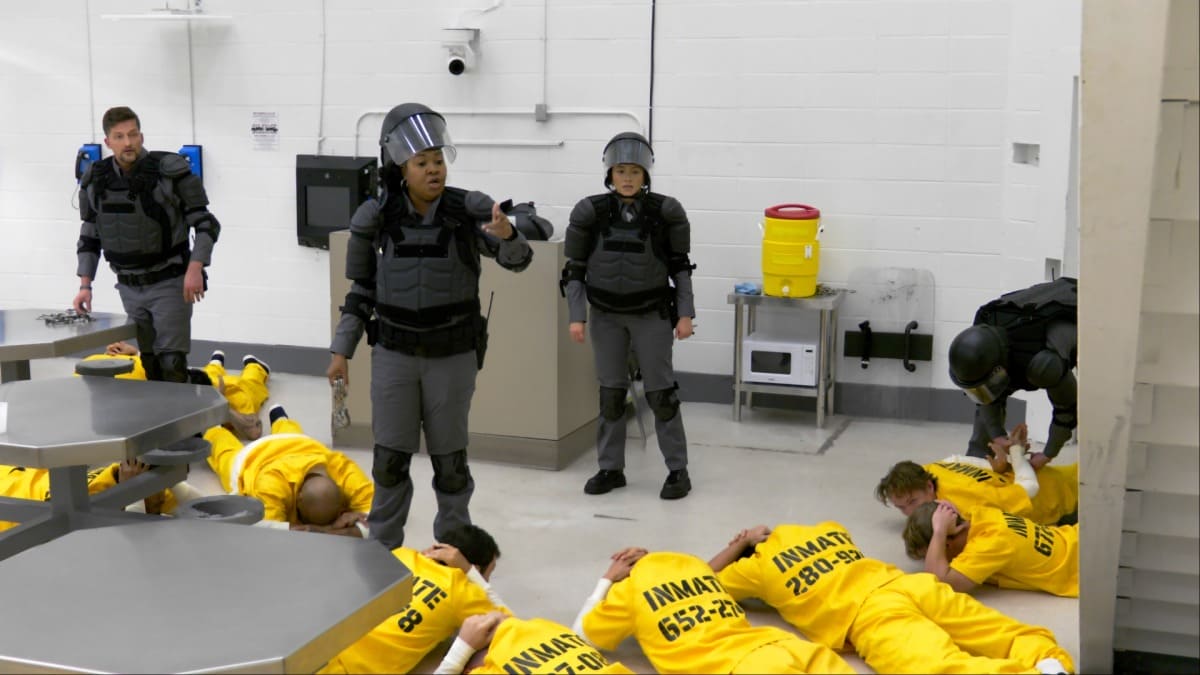
That’s the idea of Netflix’s recent six-episode reality series The New Stanford Prison Experiment. This time, there are 30 volunteers, 22 inmates, and eight guards, and they’re spending two weeks in a real Georgia correctional facility. That cast is joined by three experts who watch the prison footage and weigh in throughout every episode: Alison Wood Brooks, a Harvard professor and behavioral scientist; Trymaine Lee, a Pulitzer Prize-winning journalist; and Michael Cantrell, a retired federal corrections officer. They also introduce each of the four phases of the experiment: transformation, hierarchy, role reversal, and self-governance.

Brooks in particular appears deeply invested in watching this scenario play out, laying out the stakes by posing one central question: Will this group fall victim to conflict and division, or will they learn to come together? Sure enough, familiar patterns play out right away. It’s a bit jarring at first, really, to see just how quickly the guards start doling out harsher-than-necessary punishments—especially assigning two smart-mouth inmates to a “23-and-1” (23 hours locked in a cell and one hour outside for relief) just for discussing the possibility of resistance—but none of the behavior is truly surprising. There have always been people like Chet Hudson, the oil rig supervisor from small-town Mississippi explicitly dedicated to representing ’Merica by punishing those who have a problem with authority.

Most of the series’ ultimate conclusions are obvious. Yes, power can corrupt, or at least bring out the ego and control issues of men like Hudson—or CEO and entrepreneur Chris Lee, a more outwardly benevolent guard who brings a cheesy camp-counselor vibe to the prison but adheres to a strict “respect authority, no matter who’s giving the orders” philosophy. But people can also, yes, come together and fight back against their programming. That plays out when the experiment moves to its “self-governance” phase in the finale: Without any guards left to enforce the rules and keep everything going, the inmates gradually come to the shared consensus that it’s time to leave together. How heartwarming.

The New Stanford Prison Experiment tries to pass itself off as serious science, especially with that ever-present expert commentary. But the existence of the cameras (and this entire production in and of itself) renders the experiment almost scientifically meaningless; unlike the original experiment, there’s no privacy here, no ability to witness how these people might truly act without the constant awareness that this will all show up on Netflix. If the goal, for some godforsaken reason, was to reproduce the results of the original experiment, that’s not possible either, because there’s an obvious limit to the guards’ ability to act out themselves. They can impose harsh restrictions—like cutting off already-slim phone time and imposing the aforementioned 23-and-1s—but you get the sense that real psychological torture is not a possibility here. Nor should it be! But with the parameters of the production so murky, it’s difficult to know what this simulation could even hope to reveal.

Even accepting that core constraint, the show dodges opportunities to comment on anything real or valuable. There are some new variables here unexplored by the infamous experiment, particularly gender: Three of the guards are women, but they all get steamrolled by Hudson and Lee in the early days. Yet the show mostly chalks this up to a difference in personalities and leadership styles. Race, too, gets nodded toward without further probing, as when one white inmate asks, “Have y’all never been arrested before?” and a Black inmate replies, “You gotta wait till the Black people leave. You’re not allowed to ask us that.”

It’s notable, also, that the two inmates most willing to push back against the guards are white—and that most of the inmates urging them to keep their heads down are Black. Perhaps selective editing contributes to that impression, but there’s something interesting to grapple with in that dynamic, especially when it comes to standout character Derrick Eldridge, the self-described snitch who quickly becomes a friend and favorite of the guards. Again, though, these topics are mostly ignored in favor of trivial observations like “power corrupts, but also having authority is really hard.”

The experts never manage to create a convincing veneer of academic rigor, but their presence also negatively interferes with the actual storytelling. Rather than analyzing complicated social dynamics, they’re boiling them down to fit simplistic narratives about power, control, and how to function as a team; they’re also overexplaining the drama itself, violating the basic “show, don’t tell” rule over and over. Too much of the series’ limited runtime gets wasted on armchair psychology from an actual psychologist.

It’s a shame, because The New Stanford Prison Experiment isn’t all bad, even if it was doomed from the start with that questionable name and premise. The casting is solid all around, and the guards are well-chosen; Hudson and Lee would both make great villains on a show like Survivor, and Kiana Gaona Guerrero’s one-episode transformation from meek, Jesus-loving beta guard to vindictive head guard is something to behold. Indeed, the show’s reality-competition aesthetics (like talking heads, along with riot control drills and head-guard elections that essentially function as challenges) put it in the same general category as something like Netflix’s Squid Game: The Challenge. Ditto the ridiculous, somewhat entertaining twists, like in phase three’s role reversal: Three guards spontaneously become inmates, while the three most rebellious inmates become guards.

 Something else the show shares with reality-competition series like Squid Game: The Challenge: frequent chatter about strategies for “making it to the end.” On Survivor or Big Brother, this language makes sense; there’s a prize waiting for those who last longest. Here, though, there’s an odd gap, something missing in explaining the drive to stay the full 14 days. (Sure enough, many participants do call it quits along the way, a steady source of anticlimax.) Fifth-grade teacher Pete Zaremba and fellow rebel-turned-guard Brendan Hardey are determined to challenge the system and test the limits of the experiment, but most of the inmates are floaters (to use a Big Brother term) like Eldridge, content to run out those 14 days without any unnecessary friction. And there’s no reason not to do that in this scenario, other than a desire to create engaging TV. Without characters like Zaremba and Hardey to counteract adherents to the status quo like Eldridge (equally compelling in his own way), this is just watching people live through a standard prison simulation. There’s nothing novel in that.

Perhaps ditching the scientific framing altogether and leaning into the cheesy competitive instincts would’ve led to an interesting or fun climax. Instead, there’s no motivating force, no sense of the season’s narrative building toward anything in particular—and thus the ending itself, framed as an empowering moment of people coming together and choosing their own fates by agreeing to end the experiment early, rings hollow. Is there really anything radical or inspiring about watching a bunch of impatient people decide to pack their bags and head home once there’s no longer anything keeping them there?

“I think a very clear takeaway from what we’ve seen here is that power can be given and taken away, but respect and love must be earned,” Brooks says at the very end of the finale. It’s a forced way of tying a bow on this experiment—the type of tidy resolution all but promised in the setup to the first episode. In the end, The New Stanford Prison Experiment doesn’t fully work as either an academic study or a compelling reality show. There are no new conclusions to be found here, in the field of psychology or the infamous cautionary tale that inspired the series.

 
Join the discussion...
Keep scrolling for more great stories.