
Nope, seeing Cats the musical will not help you understand Cats the movie
Image: Photo: Noam Galai/Getty ImagesPhoto: Universal PicturesGraphic: Rebecca Fassola
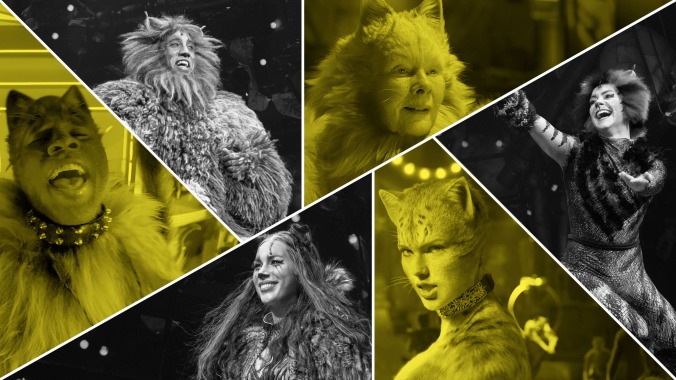
Three months into my freshman year of theater school, I found myself fake-laughing my way through a raucous parody of Cats—a show I had never actually seen, but one that was apparently being hilariously skewered based on the reactions of everyone around me. As a lifelong musical theater fan, Cats was my most embarrassing pop culture blindspot. So when I noticed a national tour was coming through Chicago, I pounced at the chance to ensure my first experience with the musical wasn’t the digital-fur-fueled monstrosity Tom Hooper is serving up this Christmas. I had hoped that finally seeing Cats would help me understand the cultural phenomenon. Instead, I came to discover there is no understanding Cats. There is only experiencing Cats.
To say Cats has no plot oversells just how little any of it makes any sense. As part of a wave of late 1970s and early 1980s song cycles and concept albums, Sir Andrew Lloyd Webber (the composer behind Jesus Christ Superstar, Evita, and later Phantom Of The Opera) adapted some goofy, cat-themed children’s poems from T.S. Eliot’s 1939 anthology, Old Possum’s Book Of Practical Cats. Lloyd Webber and producer Cameron Mackintosh enlisted director Trevor Nunn, choreographer Gillian Lynne, and costume designer John Napier—all veterans of the prestigious Royal Shakespeare Company—to give the show some kind of narrative spine. The creative team inadvertently wound up inventing a whole new genre of big-budget blockbuster musicals designed to appeal families and tourists.
The tour I saw largely recreated the aesthetics of the original 1981 production, complete with skintight body suits, furry leg warmers, and some uncomfortably sensual cat choreography. My one wish for the evening came true within the first 30 seconds of the overture, as a member of the audience-interacting Cats ensemble stationed herself right by our seats for the opening number. The rest of the night was a rush of inexplicable theatrical storytelling that sometimes left me wide-eyed in shock and sometimes lulled me into a trance. While my experience with drugs is admittedly limited, I can’t imagine there’s any high as trippy as seeing Cats from the seventh row.
Cats is a sung-through musical that does away with the idea that stories need things like protagonists, comprehensible world-building, or rising and falling action. The show opens with an ode to “Jellicle cats” in which the ensemble pauses halfway through to neg the audience for not knowing what a Jellicle cat is—despite the fact that it’s a term Eliot made up to lampoon the slurred speech of drunken aristocrats. The Jellicle cats are a mix of house pets and strays, and they gather once a year under the “Jellicle moon” for the “Jellicle Ball” in which immortal “Jellicle leader” Old Deuteronomy (usually played by a man but played by Judi Dench in the movie) makes a “Jellicle choice” and picks one cat to travel to the “Heaviside Layer” (a real-life atmospheric phenomenon that is also apparently the cat version of heaven). The chosen cat is then reborn into a new “Jellicle life.” (Cats is very big on using “Jellicle” as a modifier.)
The rest of the show consists of cats introducing themselves for two and a half hours. Ostensibly, they’re pitching themselves to Old Deuteronomy, though he doesn’t make his big entrance until about 40 minutes in, so Jennyanydots and Bustopher Jones really screw themselves over by going first. There’s also the impending threat of criminal cat Macavity, who finally arrives in act two and does a whole lot of nothing. The closest thing the show has to a throughline concerns Grizabella, a faded “glamour cat” who’s now cruelly ostracized because she’s old and ugly. She pops up throughout the show to suffer tragically before (spoiler alert) singing the 11 o’clock number, “Memory,” after which she’s chosen to be reborn, riding a giant flaming tire to heaven. (“Giant” relative to the cats’ dimensions, dwarfed, like their movie counterparts, by oversized scenery and props.)
 Keep scrolling for more great stories.