Fidelity isn’t the be-all and end-all for adaptations, especially for adaptations of ancient classics who’ve survived in part because of how rich they are for interpretation. For Christopher Nolan’s take on The Odyssey, the way he approached familiar mythical moments from Homer was just as much fun as the content of the scenes themselves—be they gods, monsters, or other familiar images from the Greek canon. Below, some A.V. Club staffers venture from island to island, discussing which legendary encounter was best translated to the big screen.
Speaking to the dead
While I enjoyed all the monsters and body horror of Odysseus’ boneheaded trip back home, nothing was more moving to me in the film than his quick pit stop at Hades. Venturing into the underworld is impressive and misguided—and, fitting with Odysseus’ whole thing about being too clever for his own good (and, in Nolan’s version, the good of humanity), this scene immediately chastises him.
Making tangible the sticky ritual of blood sacrifice, the dead rising, slurping, and speaking is both grim and sacred. And then, of course, the dead have nothing much to do but give the living a piece of their mind. It’s bitterly funny and surprisingly grounded that these shades simply gossip amongst themselves, questioning those still shuffling around the mortal coil about news of those they were close to (or who killed them). It’s a way to make the mythic world of Homer feel real, making the realm of the dead a simple shoreline away. It’s also moving that, of the corpses who rise, all still feel done dirty. The towering Agamemnon (Benny Safdie), with his intimidating black helmet, tempers Odysseus’ expectations around homecoming while Sinon (Elliot Page) gets to give Odysseus a piece of his mind for serving him up as bait in order to pull off his Trojan Horse plan. The acting is heartfelt and pained, the grimy muck of death is tactile, the reckoning emotionally effective.
It’s a magical prelude to the big narrative-wide reframing in the third act, where Odysseus’ actions and assumed heroism is deflated right in front of him. This, the corpses say, is coming for us all, no matter how smart and successful you may be in life. All that will remain are memories, stories, and songs—a legacy that will likely not be flattering. That it all comes to a head with an angry army of fallen soldiers chasing off their living counterparts is funny and poignant. It’s not like they’re monsters or giants, just impotent shadows who used to be people, now with enough perspective to want to drive off the people partially responsible for their deaths. That it all takes the form of yet another island that these seafaring adventurers don’t belong on makes it all the more potent. [Jacob Oller]
The song of the Sirens
I thought Nolan’s decision to make the Sirens’ song both inaudible and, as it’s eventually revealed, not really a literal song, was among the most inspired and pragmatic scenes in the film. Pragmatic in the sense that music and taste are subjective, and assigning a specific musical track to the Sirens no doubt would have alienated some in the audience. But from a different filmmaking point-of-view, the decision to place the audience in the aural perspective of Eurylochus (Himesh Patel) and the other men was, plainly, cool. Aside from being a creative solution to the problem of depicting the Sirens, it’s one of the few (if not the only) times in The Odyssey that we’re actually put into the perspective of Odysseus’ men. Though I didn’t love the physical depiction of the Sirens—I recall them being bird-like beasts, while they looked to be just regular attractive women in the film—the sequence as a whole felt like it honored the original point of the text while still adding a unique authorial spin. [Drew Gillis]
Circe’s magic
Dare I say that The Odyssey‘s Circe (Samantha Morton) sequence is not only its spookiest, but also one of the most visceral scenes that Christopher Nolan has ever made? It made me instantly wish he’d direct an all-out scary movie. The choice to let the camera linger on Morton’s hand movements as Circe turns Odysseus’ (Matt Damon) men into pigs—a punishment for their gender’s crimes against her and her island—is a stunning work of body horror. Circe adding a whispery “Go back to your disguises” makes the whole thing even more baller and jarring. But it’s a memorable scene also because of the focus on Eurylochus and the rest of the guys uncontrollably feasting on the meat that Circe served them, emphasizing their literal hunger, but also their sense of greed and desire to take—a theme that, of course, The Odyssey explores all the way to its end. I appreciated Nolan’s take on how Odysseus figures out the truth, no Hermes necessary, and convinces Circe to turn his crewmates back from swine into dudes. It’s a worthy payoff to the suspense that started building with a shot of the wild beasts Circe has around her home. I wasn’t expecting such a gruesome portrayal of these events, but that’s exactly why Circe’s scene (along with Morton’s tremendous performance) has been stuck in my mind. [Saloni Gajjar]
Escape from the Cyclops
There are so many great moments to choose from in The Odyssey, but one of my favorites was how Nolan handled the Cyclops. It was such an effective case study of “less is more,” slowly revealing the monster bit by bit so that the viewer’s imagination would run wild. He’s mostly in the dark, and we see his hands come out to feast on Odysseus’ men one by one, creating a mini-horror movie in the middle of this great big adventure. The Cyclops munching on the troops looks like Goya’s “Saturn Devouring His Son,” and while Nolan mostly spares us from how gory that scene could have looked, he does not skimp on the bone-crushing sound effects and wailing of his victims. The monster moves in shadows in the cave, and he’s backlit when standing against the sun, making him look even more imposing and mysterious. When Odysseus does strike back at the Cyclops, his wailing is just as terrifying, and blind the beast may put the remaining survivors at further risk of getting stomped on, making their escape even more dangerous. Additionally, Nolan used a 60-foot-puppet to create the Cyclops, a monument to the power of real movie magic. [Monica Castillo]
The Trojan Horse
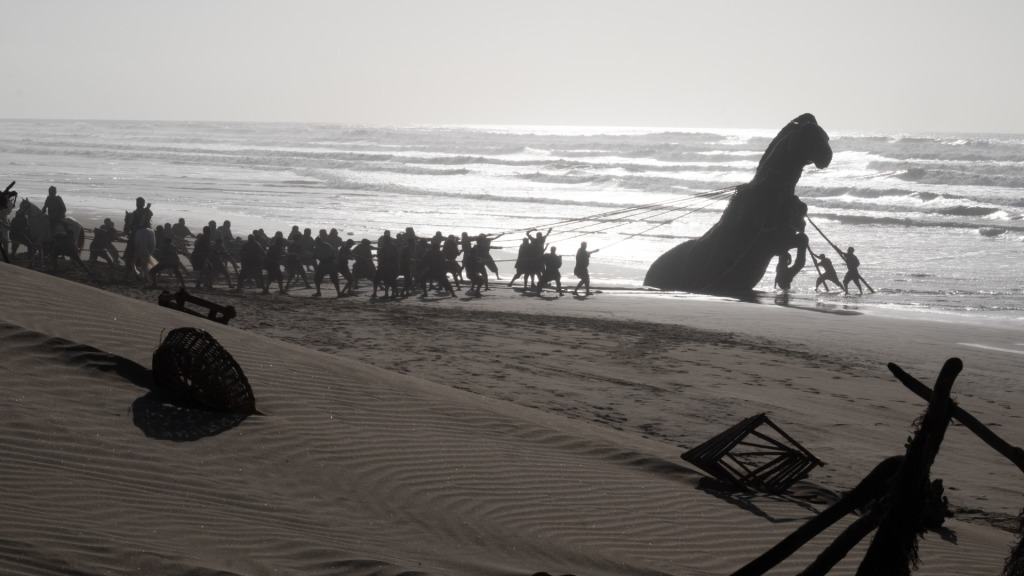
Christopher Nolan’s subversive take on the mythic in Homer’s Odyssey doesn’t only extend to the gods and monsters, but also to Odysseus’ feats, particularly the building of a giant wooden horse out of bits of his dismantled fleet. The design and execution of the horse’s exterior and interior is a gift worth accepting, a plot device that lives up to the grandeur of myth, complete with a little rope tied to a platform that allows its men to sneak out quietly. However, following eons of praise for his wily warmongering, Odysseus’ most infamous tactic is recontextualized for what it truly is: Dishonorable. Nolan frames the film around the original sin of sacrificing his smallest soldier and packing the rest into the horse to sneak into Troy, all so the Greeks can sack the city in a terrifying display of violence. Is killing throngs of innocents really obeying Zeus’ Law? Couldn’t that young woman be Athena in disguise? These are the questions that Odysseus wrestles with and which give the film its golden spine. It’s a fascinating and simple reformation of one of humanity’s most enduring tropes, one that flips the 3,000-year-old story into something surprisingly fresh and vital. [Matt Schimkowitz]


 Keep scrolling for more great stories.