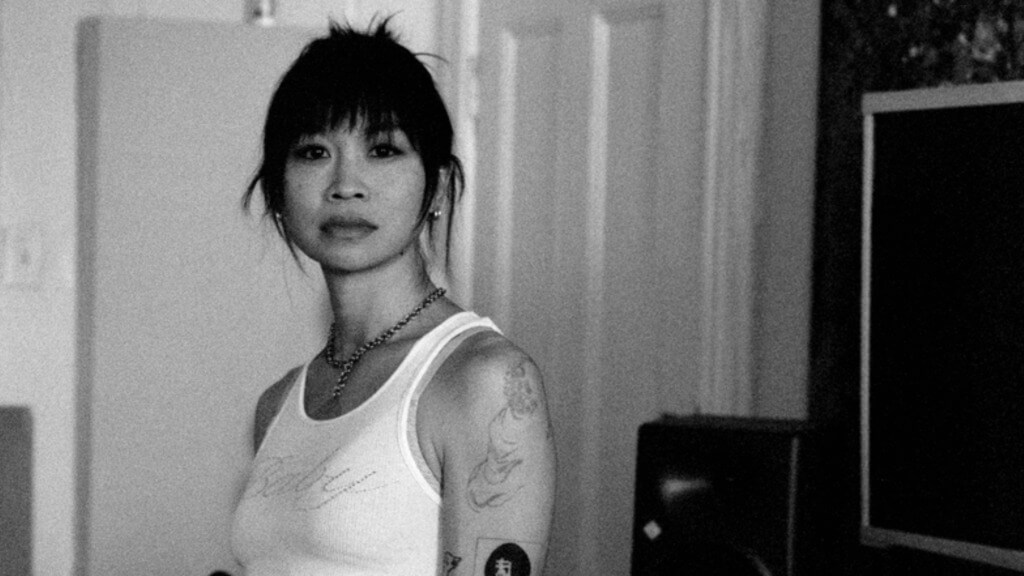
To be trans in America is to live amongst death and fear your own. Lia Ouyang Rusli makes sounds that stay present in the body, no matter its form. A year ago, “no good” phased between bantam electronic gestures, blow-out raptures, raver torrents, and light shifts. In the description of the track’s music video, Lia quoted an Olivia Sio Tse poem: “[ / I trust these stars I do ] / there before I was there.” “all dolls go to heaven” awakens IOWA, an ambient detour from the lyrical pop exhibitions of her wonderful 2025 tape, You Are Always On My Mind. The single approximates stillness, as Lia, who operates under the name OHYUNG, takes a decaying tape hiss, mangled hymns, and tempered synthsounds and sweeps them into a liberated afterlife. IOWA came packaged as Lia’s “experimental trans Bruce Springsteen Nebraska.”
But that was sort of a joke, Lia tells me. After she saw the black-and-red cover of Nebraska and thought it was for a “dark ambient record,” she envisioned an album of her own with identical artwork. That’s where the similarities end. “I kept re-listening to Nebraska and I was falling in love with it,” she remembers. “But he’s telling a different story about America.” Even cosmetically, the folk songs about outlaws and killers in Springsteen’s opus don’t line up with OHYUNG’s latest, which synthesizes prairie watercolors, chorales, and found sounds into a trenchant, spacious, post-rave undoing. Still, Lia “loves thinking of something ridiculous and making it happen, but taking it as seriously as possible.” The nugget of humor that charted the beginning of IOWA’s conception was important, but IOWA quickly turned into one of her most sincere projects. And, like Nebraska, her music seeks deliverance.
Lia lives in Brooklyn but grew up in central Pennsylvania—the “Pennsyltucky” part of the state, she clarifies—on a diet of classical music and Top-40 radio until she started playing in bad pop-punk cover bands in high school. She also has a wide vocabulary in rap production from listening to RZA and watching YouTube beat tutorials. “My whole life I’ve been playing with different kinds of music, just for the craft of how to make a thing,” she says. “Switching genres always satisfies a different urge in me. I don’t entirely understand artists who make one kind of music.” Lia is the type to get curious about an idea and follow it to the very last thread, no matter the genre. Every record she’s done has obliged a different feeling within her. IOWA, she gestures, tends to her want for softness and quietness.
In 2023, Lia left the clatter of Bushwick behind to live in Iowa City with her partner, who was attending the Iowa Writer’s Workshop. The beautiful parts of the Midwest allowed her to revisit her rural childhood as an adult with agency. It was disarming at first, settling into the stillness of America. Back east, artistic expression exploded all around her. The trade-off for a sort-of-cross-country move, she reckons, was mental clarity and time. “I had lived in New York for 13, 14 years before [moving], so I think I needed to get a different understanding of America and a different way of living,” she adds. “And I think it was productive. I was by myself a lot. I got a lot of things done.”
While living in Iowa, she worked on two OHYUNG records (IOWA and last year’s You Are Always On My Mind) as well as film scores for Neo Sora’s Happyend and Eva Victor’s Sorry, Baby. She and her partner rented a cheap three-bedroom house near campus so they could each have a studio of their own. “I wasn’t in school, I was just working from home,” she explains. “I’d just wake up and start working on stuff in the studio, and then I’d just walk around town and meet people.” She stimulated herself by joining the local music scene, going to hardcore punk shows and finding gratification in Feed Me Weird Things, an experimental music organization run by Chris Wiersema, who passed away while Lia was living there.
But what people make and what they consume can be totally different. Despite ingratiating herself in Iowa City’s hardcore punk scene, Lia doesn’t have any interest in making hardcore punk music. In New York, she went to raves more than anything else, but only because she loves to dance. “That’s my #1 priority when I leave the house,” she laughs. “But then, I’ll end up at an experimental noise set, and I’ll really appreciate the tactile nature of the sound.”
In big cities, there’s more of a proximity to capital, which corrupts the purity of music communities. Most of the venues in Iowa City are basements, except for Purgatory and Hell. Lia wasn’t close with her partner’s writer friends, so she found people like Grace (who runs Hell), and Chris from Feed Me Weird Things. “I spent a lot of time with people around town, that felt really nice,” Lia recalls. “It was nice that everyone worked in town. No one had fake jobs like everyone does in these big cities. Everyone I know [in New York] has a job, but I can’t literally go to a store in my neighborhood and see them. In Iowa City, I could just visit them at work.”
She also met a bus driver named Patrick in town, and they started playing pickup basketball together at a community center. She found out that he was also a DIY nerd who figured out how to make ambient music on cheap toy synthesizers and performed under the stage name toyaway. He and Lia talked about making music together for a long time. When they finally did, it was jamming on a digital synth loop for an hour with an NBA game playing on the TV behind them. Lia set up a field recorder mic, capturing the game commentators, her and Patrick’s conversations, and her pet parakeets’ chatter. They came up with this droning, undulating duet, but Lia tucked it away for a while. Eventually, it became “memorial,” the 12-minute conclusion of IOWA dedicated to Wiersema.
Lia started You Are Always On My Mind in New York but finished it in Iowa. But even while she was exploring those hard, abrasive sound experiments on You Are Always On My Mind, she was also mining a sense of stillness for herself on IOWA. Both records informed each other, almost as if in a feedback loop. Ambient records like IOWA take longer to complete, she reveals—though her first ambient album, 2021’s imagine naked!, “poured out really fast.” When she tried it again, she couldn’t make anything that she liked. “I didn’t do ambient music for another three years. With ambient, it’s a process of waiting, processing, and then unloading all at once.” (Though, she’s quick to suggest that live ambient music can get boring. “In my live sets, I like to rage,” she smirks.) But unlike those earlier attempts at crafting ambient records, she describes the making of IOWA as an emotional, spontaneous experience. “I’m mapping out a concept and then I’m trying to execute it. Sometimes you start a song and you don’t even know if you can make music anymore. It’s like, I hope something comes out.”
Her approach to titling has a lot to do with how she imagines a group of songs living together, or the feelings and memories that resurface while she’s making them. “An abstract painting with the right title can completely change the substance of the work,” Lia says. “The context is almost everything, especially with ambient music. I don’t ever want my music to not feel political in some way, and I don’t want it ever to not feel personal to my life.” Even without uttering a word, IOWA says a lot about how Lia’s people in the Midwest are trying to survive the region’s ever-blurring moral compass. Her titles suggest who she met and what she experienced while living there: “january,” “purgatory,” “storm chaser,” “all dolls go to heaven,” “the black angel.”
While doing press for You Are Always On My Mind, Lia said she was “filled with fear” but, by the time that record came out, her fear was gone. “Do you feel similarly about IOWA, since it was made around the same time?” I ask. “I think lyrics are terrifying. It’s a lot more naked,” she admits. “I was definitely still in a quite uncertain time in my life. There’s less live processing on [IOWA]f. It’s more of a time capsule of my time there, honoring my experiences outside of my own internal turmoil.” The feelings are there, she reckons, but not as front and center as they are on You Are Always On My Mind. “It took me a lot longer to make that record, to wrap my head around it as a fleshed-out concept with a beginning and an end. It’s a little easier with ambient music.”
I could spend a long time writing about why IOWA makes me feel more ecstatic or less dysphoric, but ambient music so often brings about feelings that are failed by words. “It’s a hazy emotion that I can choose how I want to interpret and imbue, and that gives me a lot more flexibility when I’m structuring the record,” Lia says. “I’ll title songs and then rearrange them, and then change the titles. It’s fun to have such a blank canvas too, once all the music is done. I can really play conceptually. It’s a more fun process than something that I really had pressure on myself to figure out the concept and order of. This is a little more fluid and free from that pressure.”
IOWA is PC music made “in the box.” Lia used soft synths and contact synths, processing textures through analog tube compressors. Patrick gave her a cassette player, and she added that to her board gear, allowing her to feed samples through old-tape pop and grit. Lia used a lot of tape-delay emulation, constructing IOWA on her laptop. In her score for Sorry, Baby, she started using voice as an instrument to evoke loneliness and compliment protagonist Agnes’ physical isolation in the film. But loneliness, she argues, can be a good thing. On IOWA, she processed mouth sounds with reverb, searching the deepest corners of YouTube for community church choir recordings to chop up, distort, stretch, and build out. “My initial concept was, like, ‘I’m making this record about Iowa, and I do feel like this is a beautiful place, but I also feel this Christo-fascist aura around me,” she says, pointing to Iowa City’s population being 76% white. There are trans people there, sure, but many of them are white trans people.
Subwoofer thuds invade OHYUNG’s Iowan pastorals, where terror unpeels in chorale disfigurements: “driftless” soothes before it discombobulates. The ceramics in “nevada” are tinted by a stormy warning. Lia’s pet birds are absent from “dancing parakeets” but a prismatic interplay recreates their conversations. “kiara” spirals through bleared voices. Her disregard for genre on every album reminds me of Arthur Russell. I don’t tell her that, instead stumbling over some clumsy statement on rigid undertones. Kindly, she says that she craves interjection in her art. “I’ve always felt this way where, if I make something beautiful, I can do that, but then I have to have an element that is unsettling in connection with it. When something’s too beautiful and without contrast, it’s saccharine. It’s not beautiful anymore.” Lia mentions listening to Funkmaster Flex on Hot 97 and getting obsessed with how he “constantly interrupts the song and screams,” doing DJ drops. “This is an ambient version of how to do that, where I’m just dropping explosions in the music in a more cerebral, landscape way.”
Lia spent 11 postcard months looking for those explosions, and she found them near pork steaks, smelly farms, graduate programs, caucuses, funnel clouds, and a rectangular American Gothic. In Iowa City, she played the part of film composer, moshpit ghost, and pop-music obsessive, dressed in leather yet surrounded by corn. It makes sense that Iowa’s glacial lobe lent her a 15,000-year atmosphere to record over. It also makes sense that violence sounds louder in the green-and-gold vastness of rolling hills and river valleys. In her sky of prayer on IOWA, Lia unsettles the beauty with music that makes room for harm around her: trans demonization, ICE raids, warmongering, despotism. Why do you think so many artists come to the Midwest’s quiet for answers? There’s truth in these plains.
IOWA is out now.
Matt Mitchell is the editor of Paste. They live in Los Angeles.


 Keep scrolling for more great stories.