“It was my stepmother who held on and shepherded the footage after the original shoot,” David Greaves tells The A.V. Club. “They had done a lot of additional shooting after that over the decades into the ’70s, ’80s, ’90s, 2000s, until my father passed. They were filming practically everything that moved up in Harlem so that they could, I imagine, show the Harlem Renaissance how it traveled through time.” Occasionally, clips from the collection were shown in special screenings at institutions like the Smithsonian. At that screening, Jon-Sesrie Goff of the Ford Foundation approached the Greaves family and said that the footage must be restored. The Ford Foundation became the first of many supporters to fund the project, first restoring the footage and then making a movie out of the material.
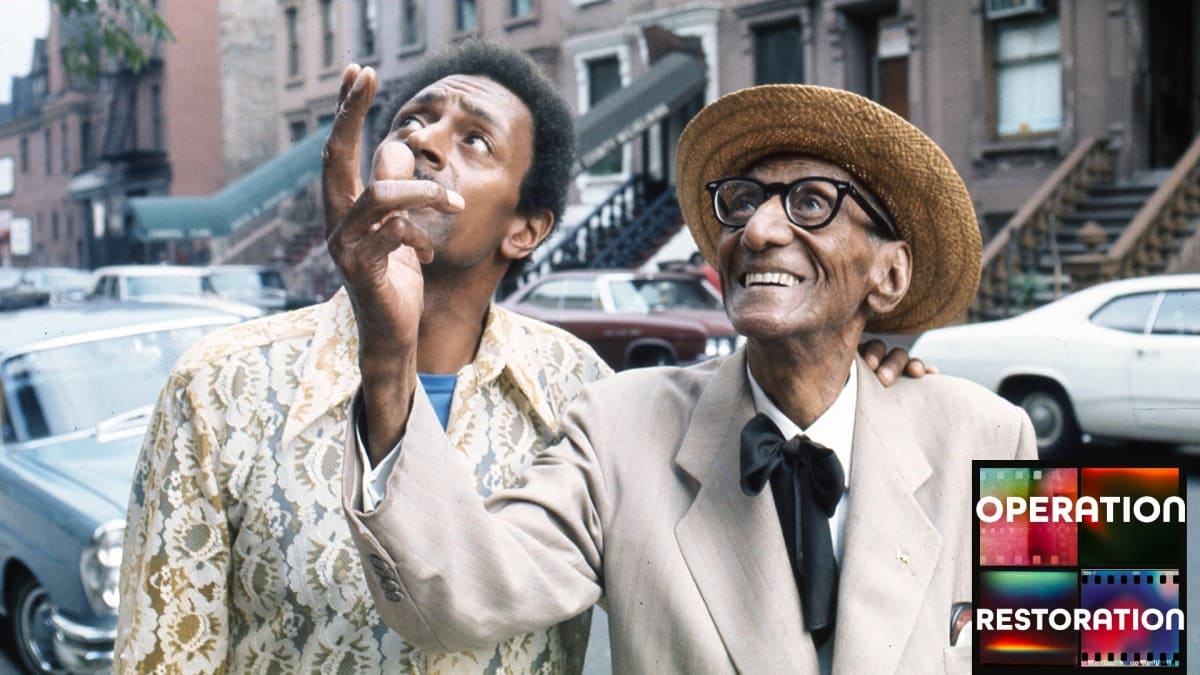
Focusing on the party footage alone, restorationists fixed approximately 60,000 feet of film so that Greaves and editors Anne de Mare and Lynn True could make a documentary out of the material. “My father always said, ‘If something is visceral, David, go with it,'” says Greaves. “Things that I looked at that affected me—and it had to be on different levels or layers, if you will—because there’s so much. I said, ‘Okay, it’s entertaining. They look good. It’s historically significant, and look at the way she looks away, and look at that way so we get everything.’ It went from 60,000 feet to, ‘Can we get a few more frames of this? Can we get a few more frames of that?’ The editor said, ‘It’s a hundred minutes today, but we’re done.'”
Before filming the party in Harlem, William Greaves made a number of vital documentaries during the Civil Rights era and beyond. One of his earliest short documentaries, The First World Festival Of Negro Arts, captured the momentous event for historical records. His genre-defining experimental work, Symbiopsychotaxiplasm: Take One, blurred the boundaries of fiction and nonfiction. A few years later, he made Nationtime, a film about the National Black Political Convention in 1972; the same year, he worked on the project that would become Once Upon A Time In Harlem, which is a return to more traditional forms of documentary storytelling. But the movie would not exist in the same way without the effort to restore and preserve the footage for future generations.
David Greaves jokes that he was blissfully unaware about the next steps to get the film to festivals, including its eventual premiere at the Sundance Film Festival earlier this year. “Once we finished the film, then I saw the schedule for the finishing house, like a week in the mixing studio and another week for the color corrections.” He credits de Mare for bridging the gap to get the film to audiences. But that also means that there’s far more footage that could fit in the film, and Greaves excitedly shares that the riveting conversations will be available in their entirety in the future: “I do say the film is like a trailer for the archives because there’s going to be a Memories Of Harlem Renaissance Archive that will be a searchable database,” thanks to a grant from Harvard University. “Which will be a lot of fun for folks when they’re able to say, ‘Let me hear all of Richard Moore. Let me hear all of Leigh Whipper. I want to hear those stories from Eubie Blake. You’ll be able to hear it all.”
As for future family and historical archivists, Greaves encourages them to capture those memories now while those family members and other subjects can still remember. “There is the now, and you don’t think it’s very important, but you look at it 50 years later and say, ‘Oh man, that’s what they were talking about,'” he says. “In the ‘80s, I asked one of my great-aunts, and she told the story of the family coming up pretty much from slavery up to Chicago and all that. I would say grab these family histories from these old folks while you can because you won’t see them again. If you already have something that you’ve done, look at it again because people may have said, ‘Oh yeah, I remember so-and-so had pictures from 50 years ago, 40 years ago.’ At the time you were looking at it, it wasn’t all that important to you. Now 50 years later, where is that stuff? Time makes a difference.”


 Keep scrolling for more great stories.