The way Colin (Henry Melling) wears his barbershop quartet attire—ocean-blue stripes on mustard, with a porkpie hat atop his messy mop of hair—you’d think it was his court-ordered punishment, but a strangely fitting one all the same. Leaking from his demure aura is the feeling that this outfit, but not the levity it may convey, is a defining part of his personality. When, on a “date” with an enigmatic biker named Ray (Alexander Skarsgård), he slips into a leather jacket that was once his father’s, you can see Colin growing into a new look, a fresh skin. As writer-director Harry Lighton’s Pillion moves from bootlicking to wrestling to picnic orgies, the awkward and gangly Colin tries on, at the direction of his new dom, a variety of new shells—singlets, biker gear, swim briefs—that illustrate a world of kink and fetish that is at once a vessel to better understand the self but also transform into something, or someone, else entirely.
Film is littered with depictions—of varying levels of authenticity and sincerity—of leather and kink culture, from Cruising and Secretary to Fifty Shades Of Grey and Professor Marston And The Wonder Women. But Pillion, adapted from Adam Mars-Jones’ novella Box Hill, differentiates itself not only through the variety on display, but through its mix of romance and prosaicness. Colin’s initiation into Ray’s biker world toes the line between thrilling (a new dynamic where he must learn the rules with little tutorial) and unremarkable (a lot of it is cooking dinner for Ray). But this new “arrangement,” as Colin describes to a coworker, nonetheless functions as an opportunity to literally wear a different version of who he thought he was or might be.
Ray’s biker dom aesthetic is already defined: black leather, calf-length boots, and chaps with a slick and shiny coal-tinted zipper. In their first alleyway tryst, Ray leaves his jacket, with cream accent stripes running down the back, on a rack, revealing leather suspenders. When adapting Box Hill, which is set in the 1970s, to the present, Lighton reflected on the way leather and biker culture had changed in the 50 or so intervening years. “I knew that I wanted [the outfits] to be kind of contemporary and have hardware on them and be a color which wasn’t [only] black. It took a while longer to arrive at the cream leathers,” he tells The A.V. Club.
In other interviews, Lighton has confessed that he hasn’t watched films like Kenneth Anger’s Scorpio Rising and mostly avoided referencing classic leather culture iconography like Tom Of Finland. “I love the look of Tom Of Finland’s drawings, but I thought that, with updating the time period from the novel to the contemporary day, it gave us an opportunity to try and think about what might get fetishized within the biking space today, as opposed to the ’70s,” Lighton says. Lighton looked instead to other references, including Power Rangers, whose fingerprints are on the chrome helmets that Ray and Colin wear when biking. They’re modern, smooth, glistening, and robotic-looking, contributing to a feeling of empowered anonymity.
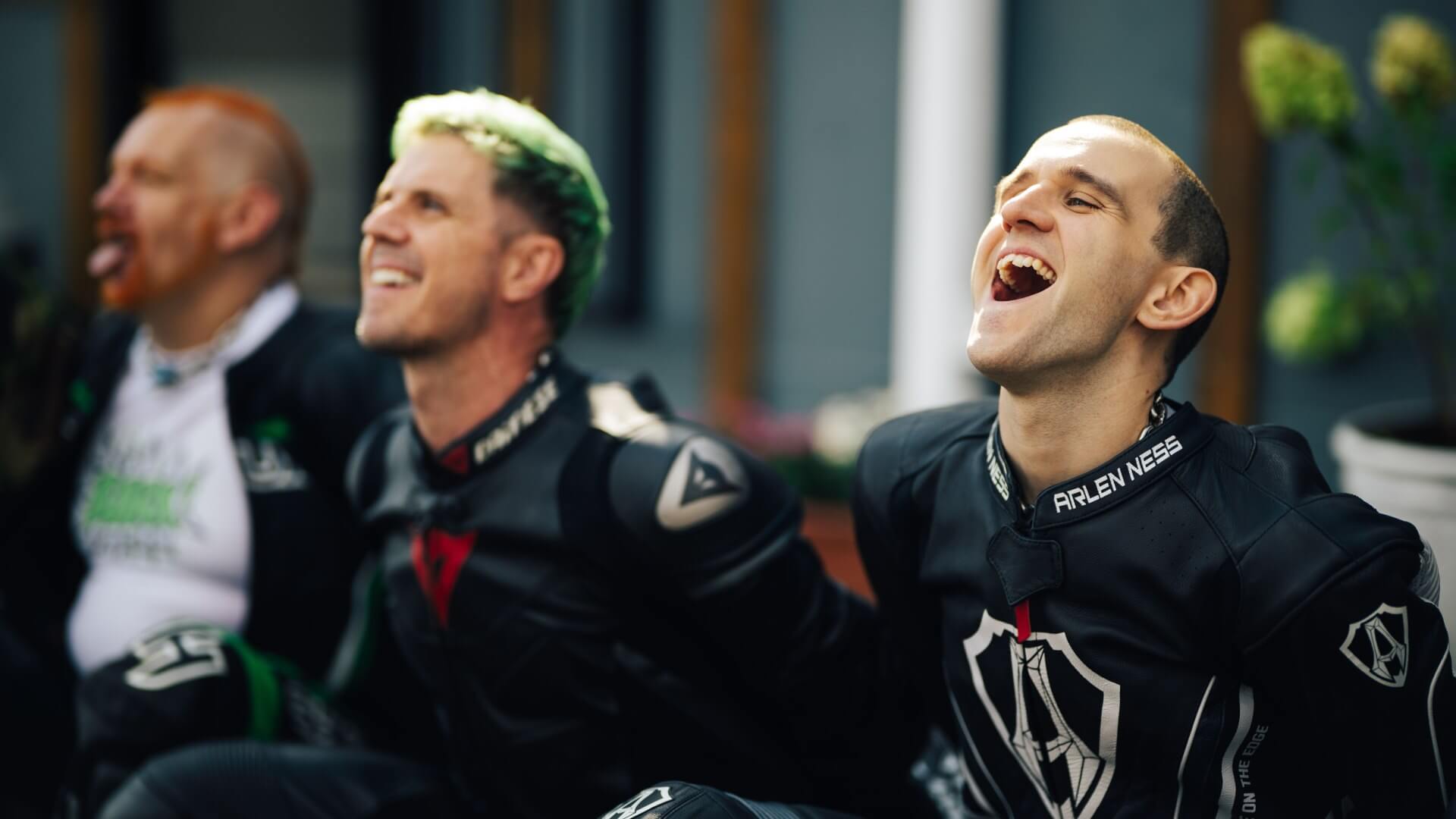
Much of the biker gear that Ray and Colin wear is from custom biker designer Arlen Ness. Arlen Ness’ clean matte look suggests a decadence beyond mere sleekness. “My costume designer Grace Snell did lots of research into what brands were popular in the fetish space, [like] Arlen Ness and Dainese,” Lighton explains. “[Arlen Ness] looked hot to me.”
With Ray’s biker established, the narrative was then an opportunity for Colin’s character to grow into the kind of fetish aesthetic that makes sense to him, albeit entirely in relation to Ray. Colin wears a slate-gray nightshirt at bedtime, has a chain and lock around his neck (to which Ray has the key), and his own Arlen Ness suit is all black, like someone mirroring their parent or partner. “[The mirroring] extends to areas outside of costume. Ray’s reading a book at one point [Karl Ove Knausgård’s first volume of My Struggle], and then later in the film, Colin’s reading the same book,” Lighton says. “This is Colin’s first experience of love, and often that experience is one where you become infatuated with someone to the point of copying; you know, if they suggest a movie, suddenly that movie is your favorite movie. Costumes were one fun way of showing Colin’s idol worship of Ray.”
It’s through the costumes that the flow of power between the men is expressed, as in the wrestling scene where the pair are in singlets. “There’s a shot where Colin is kind of trying to stop his shoulder from falling down, and that was a way of emasculating the character,” Lighton says. Ray is in a tight, abs-bearing, tundora uniform, and Colin’s is a color-matched opposite, one that’s loose, covered up in front, and assless. “I just knew that I wanted Colin’s to be arseless,” Lighton laughs. “I thought it was a fun way of showing that Ray doesn’t entertain the idea of losing that wrestling match, that it’s a foregone conclusion, even though there’s the pretense of it being an even-handed match.”
This power dynamic extends to the pedagogical bent established early on, like when Ray sends Colin out with a shopping list of gear and toys to purchase for them. When Colin returns, there’s already a pile of boxes for the newly minted sub to unwrap. “We knew that we wanted the leathers to be something which Ray put a lot of thought and care into, as opposed to a butt plug,” Lighton explains. “It’s something which he would take a lot of pride in the specificity of.”
“When we see Colin finally in his one-piece leathers, it’s his high-school transformation moment. So the idea of having them arrive in packages was to show that Ray’s spent money on this, and he’s gone to a specialist, rather than just, like, headed to the High Street and found the first shop.”
But Pillion exists beyond this couple, within this broader landscape of fetish looks. Featuring some real bikers from the Gay Bikers Motorcycle Club, the film’s world of kink includes aprons, corsets, septum gauges, latex gloves, chains, leather gloves, helmets, Prince Charles piercings, and more. When asked about this vast, yet specific collection of looks and expressions of queer kink, Lighton replies, “It was really just going out to biker meetings in the flesh and seeing what people were wearing and taking photos. An obvious go-to word was ‘authenticity’.”
But Lighton was also aware of the way that Ray has a different presentation from others in his gang. “Ray sits slightly outside the look of the general group in that he has this heightened physical presence. Feels a bit of an alien in Bromley and in the bike world. Everyone else [are] bikers. They come from that world. And so they were really our resource. We went to them and were like, ‘What costumes do you already have?’ Maybe we can use some of them. With the septum gauges, they already had those. And the tattoos. So that provided this immediate texture, which lent to that realism.”
Part of that realism was shaped by Kvasir, an enthusiastic pup featured in the film in his green-accented mask. “He got in touch with me and said, ‘You know, I’d love to speak to you. I’ve heard there’s this film happening.’ And he brought his pup mask to the pub. We went for a drink, and I thought he was such a great guy and a great character. And I then asked him, ‘How do you think a pup might operate within this community in the film?’ I gave him the script, and he came back with, like, 3,000 words about different ways we could incorporate a pup into various scenes. He totally brought that character to the screen. It had nothing to do with my writing.”
Lighton uses these details to juxtapose the gear and the film’s expanding sense of place. The bikers at once fit in more generally within their bar, yet are immediately noticeable in the Bromley suburb. The leathers, singlets, and padlocks feel at home in the privacy of Ray’s flat, but also stand in stark relief to Ray’s minimalist living situation. More invigorating is a picnic scene with the biker gang by the lake. There’s a sense of liberation out in the open, and a stimulating contrast between the modern look of the gang and the natural, pastoral environment. “Often in depictions of kink, it feels like it’s quite contained, to like the domestic space or to the dark, whether that’s a dark club, or the night, or an alley,” Lighton said. “As Colin goes through the film, [he] becomes more confident in his sexuality, so I wanted that to be a scene where kink happened out in a very idyllic, open environment.”
Pillion‘s greatest asset is that it is not particularly precious about any of this. Lighton’s film is matter-of-fact in its understanding of a quintessential component of queerness and kink: the space between an essential self, an idealized self, and an escape through performance and play. They all swirl around to create a blueprint of a life where power is elastic and participatory. This is the relationship, the world, and its accoutrements that Colin becomes immersed in. Some of it works for him, some of it doesn’t, but he chooses to place the metalware around his neck, slide into his one-piece leathers, and disappear behind a helmet. There’s an almost reptilian nature to fetish gear, Colin learns. He can shed his skin and grow a new one if he wants. Be it with latex, or leather, or cut-out fabric, Colin can create himself anew with materials that transform what it is to desire and be desired.


 Keep scrolling for more great stories.