Ramayana: Rise Of A Legend is the newest Indian mega-production to rival Hollywood blockbusters with a Desified answer to the Marvel Cinematic Universe. The Bollywood action-fantasy is the biggest Indian movie of all time, with an enormous budget of 4,000 crore, or $420 million, though that figure includes the cost for the first of two planned sequels. The film follows other recent attempts at reimagining the Hindu gods and their modern-day followers as superheroes, some more literally than others. It’s also the latest bid at carving out an international following for Indian commercial cinema after Telugu writer-director S.S. Rajamouli delivered a cross-cultural moment, first with the 2015 mythological action-fantasy Baahubali: The Beginning and its record-breaking sequel, and again with the 2022 anti-colonial epic RRR.
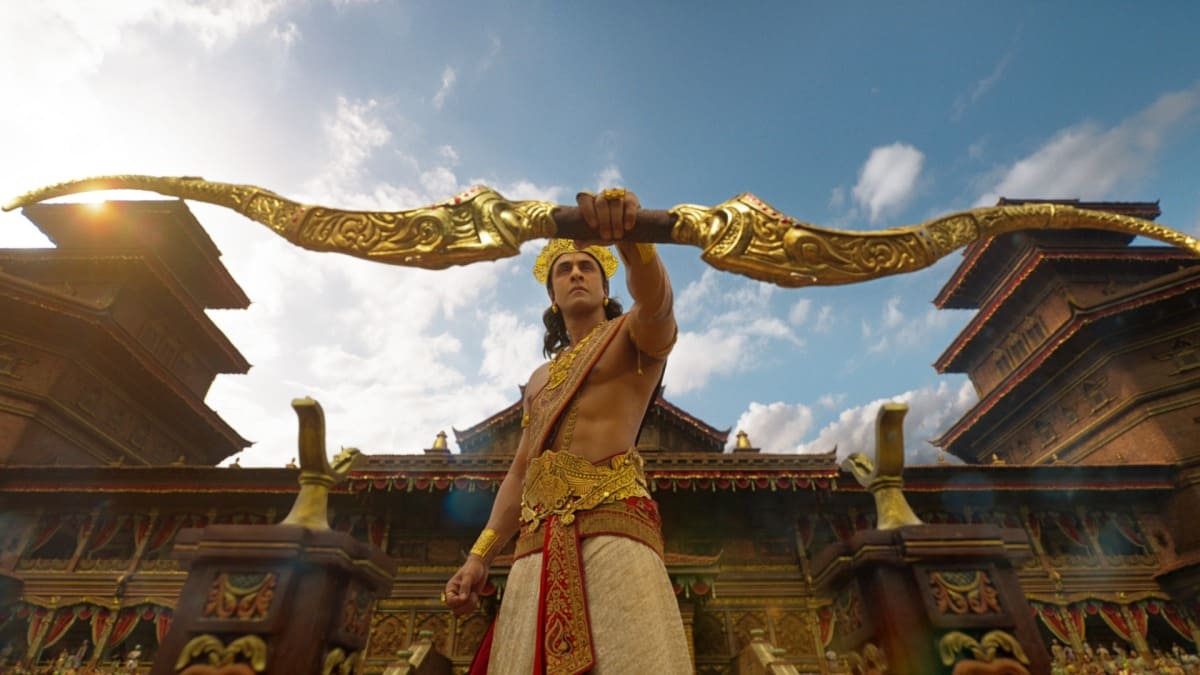
This new Ramayana adaptation presents a revised origin story for the demigod nemeses Prince Rama (Ranbir Kapoor) and Lord Ravana (Kannada star Yash), both of whom have mortal origins and divine destinies. Even newcomers who are unfamiliar with the Hindu gods and their renowned cosmology can follow along as Rama first becomes a noble and righteous leader, then the mortal embodiment of Vishnu. Likewise, Ravana’s vicious nature is revealed through episodic challenges, which transform him from an underclass antihero into a despotic villain.
Other key aspects of Ramayana: Rise Of A Legend‘s production speak to its desired cross-cultural appeal. Its score was co-composed by Bollywood hitmaker A.R. Rahman and Hollywood fixture Hans Zimmer, the latter of whom has never previously worked on an Indian production. Ramayana: Rise Of A Legend is also being released in the U.S. with an English dubbed version that’s already drawing criticism, since the performers’ faces were altered with AI-generated lip-syncing for languages besides the original Hindi.
It’s not like this release was ever going to be a sure-fire hit for Sony, which is releasing the film in the U.S. Success depends on the quality of the special effects, the accessibility of Ramayana‘s mythological narrative, and the extent to which audiences either interpret or embrace the movie as nationalist propaganda. Then again, the distributor is clearly gunning for international attention given the film’s massive theatrical release. For its opening weekend, Ramayana: Rise Of A Legend will play on 59,000 screens, including 4,500 screens in the U.S. Part of this confidence seems inherently linked to the film’s superhero and franchise-driven approach.
While the most famous moments from the voluminous Sanskrit-language Ramayana have already been adapted several times over the decades, the idea of turning them—or any other special-effects-based entertainment—into a brand-building series is relatively new to Indian popular cinema. But this film still has recent forebears like the Yash Raj Films Spy Universe, as well as its underwhelming competitors like Adipurush or Brahmastra: Part One—Shiva.
Of these precursors, Ramayana: Rise Of A Legend most closely resembles Brahmastra, which strained to recast Bollywood stars like Amitabh Bachchan, Alia Bhatt, and Kapoor as superpowered updates of mythological Hindu characters, like the embattled King Raghu and Shiva, the god of transformation. In the same way, Ramayana: Rise Of A Legend appeals to its viewers’ knowledge of Valmiki’s narrative by reimagining the epic struggle between warring gods Rama and Ravana as an effects-driven hero’s quest.
But even with this reimagining, Ramayana: Rise Of A Legend‘s producers probably still wouldn’t have tried to court a primarily English-speaking audience until after Rajamouli’s recent successes, which helped to create a demand for so-called “Pan-Indian cinema,” which blurs the lines between the country’s informally segregated modes of production by drawing viewers across different languages and backgrounds.
Rajamouli’s two-part (and partially Ramayana-inspired) saga Baahubali not only established a lucrative standard for dubbing Telugu-language releases into other Indian languages, like Hindi and Tamil, but for exporting more Indian programmers with English subtitles. Rajamouli’s diptych was such a galvanizing phenomenon that, in addition to inspiring a number of lesser mythopoetic potboilers, it also encouraged more star vehicles that feature supporting roles for celebrity actors who normally speak a different language than their marquee-topping co-stars. The Baahubalis were such game-changers that they led to Rajamouli taking bigger swings with RRR—a similarly sized hit that tapped into the non-Indian market.
RRR followed the Baahubalis’ lead by alternately streamlining or playing up elements that have kept fearful U.S. distributors from trying harder to develop a new audience for commercial Indian cinema. Its dance numbers are less reliant on extras and master shots, its comedic asides are fewer and less digressive, and its action sequences are more conspicuously choreographed. Furthermore, RRR‘s special effects are clearly a cut above his many imitators. Now Rajamouli’s highly anticipated follow-up, Varanasi, is said to include an elaborate sequence based on the Ramayana.
Yet Rajamouli’s success isn’t easy to replicate, as you can see from how formulaic and type-driven the characterizations and set pieces are in Brahmastra: Part One—Shiva, which often feels like an MCU-style superhero origin story featuring more conventions than the filmmakers know what to do with. But Bollywood’s most striking and long-lived answer to the MCU is likely the Yash Raj Films Spy Universe, a loosely connected cycle of action capers that united various Hindi-language stars, like Hthrik Roshan and Shah Rukh Khan, in a long, rambling shared narrative built around goofy conspiracies and interchangeable villains. The best entries in the YRFSU focus on self-contained plots, breezy action and dance numbers, and the onscreen chemistry between their charming stars.
That said, the YRFSU’s militaristic, globe-trotting narratives play squarely to Indian viewers’ nationalism—the Muslim identity of Tiger Zinda Hai‘s terrorists isn’t exactly apolitical, and neither are the heroes’ rallying cries of “Long live India” and “India first!”—while super-productions like Ramayana: Rise Of A Legend tellingly avoid potential controversy by side-stepping topicality altogether. This is a bit like how the MCU movies mostly play coy with their politics by picking on fictional villains, like the Nazi-ish HYDRA terrorists in the Captain America movies. But at least a half-dozen MCU movies received financial support and script approval from government agencies—Captain Marvel was even used as an Air Force recruitment tool. Meanwhile, both Ramayana: Rise Of A Legend and the Baahubalis have been criticized for using the same symbolic rhetoric as Hindu nationalists, who have become obsessed with reclaiming foundational Hindu texts like the Ramayana as a way of normalizing their version of the nation’s origins.
Rajamouli has denied having political motives, but Baahubali: The Beginning was criticized for its loaded iconography, like Prabhas’ relatively fair-skinned protagonist conquering the savage and considerably darker-skinned Kalakeya tribe. The makers of Ramayana: Rise Of A Legend have also been criticized for using the Ramayana‘s narrative as the backbone for an implicitly caste-based style of nation-building, as Ankash Pal argued: “What we are witnessing is not merely a big Bollywood film. It is a civilizational project sold as entertainment, one whose sheer scale is intended to definitively answer the question of who owns the Ramayana and, therefore, who gets to define what India is.”
Western audiences might still primarily judge Ramayana: Rise Of A Legend based on its merits as a “big Bollywood film,” since the Ramayana‘s seminal impact on terroristic Hindu nationalist organizations like the RSS may not be as meaningful to them. At the same time, the filmmakers are likely counting on that lack of context since they’re positioning a famous religious allegory as a suped-up fable. This choice of source material, as well as the focus on action-fantasy violence and melodramatic intrigue, suggests that Indian filmgoers are like their U.S. counterparts: We’re all hungry for roided-up fairy tales where righteous heroes trounce vindictive baddies. Unfortunately, those sorts of big-budget power fantasies also speak to a familiar strain of alt-right audiences that the rest of us are desperately trying to escape. That means Ramayana: Rise Of A Legend looks more like the same old co-opted escapism, filtered through a different industry, than a real game-changer.


 Keep scrolling for more great stories.