The Netflix documentary SCTV: The Greatest Show You’ve Never Heard Of pays tribute to one of the most influential sketch comedy series of all time. Directed by Jason Hehir (The Last Dance), the film is what you’d expect from a nostalgic look back: It’s sentimental, stuffed with great clips, and features fun interactions with the troupe’s surviving members. And, because the interviews were conducted in 2025, The Greatest Show You’ve Never Heard Of also includes among the last conversations with Catherine O’Hara, who died earlier this year.
But it’s only two minutes into the film before somebody brings up what everyone knew was coming. Talking about how much SCTV meant to her as a kid, Kathryn Hahn declares, “I’d seen SNL, but SCTV, it was like their cooler, older cousin that was out smoking cigarettes in the back.” She’s not the only one to compare the two shows. Discussing SCTV‘s importance, frequent SNL host Tom Hanks notes, “Saturday Night Live impacted society and created stars. SCTV impacted the art form.” Fred Armisen, who was an SNL cast member for 11 seasons, admits, “Something about SCTV, with me and my friends, it was more like a secret code. Like, it made us feel cool.” The Greatest Show You’ve Never Heard Of doesn’t just want to convince you of SCTV‘s greatness—it wants to drive home the fact that the Canadian sketch show that helped give the world John Candy, Eugene Levy, Martin Short, Rick Moranis, Joe Flaherty, and other comic legends was cooler, hipper, and simply better than Saturday Night Live.
I’m not here to argue for or against that claim. (Hot take: They’re both fantastic.) But perhaps what The Greatest Show You’ve Never Heard Of most definitively proves is that SCTV was the first of many terrific sketch shows—because of a media narrative or how the show’s talent actually felt—that would be positioned as superior to that square/boring/corporate SNL. There are legitimate reasons why SCTV would feel competitive with its New York counterpart, which the documentary thoughtfully explores. But the film also suggests that, all these years after SNL‘s launch in 1975, SNL remains the cultural heavyweight that every other sketch program must be compared to. As a result, SCTV will always be the first show that comedy fans considered a badge of honor to love more than Lorne Michaels’ creation.
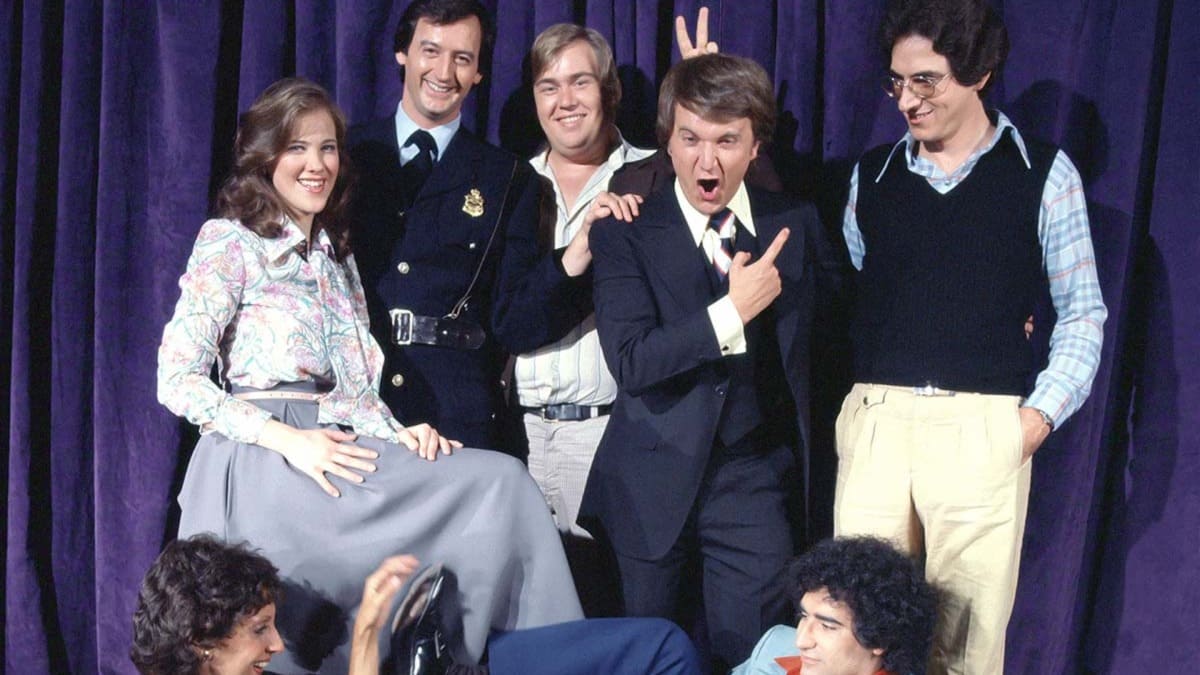
Running under 90 minutes, Hehir’s film breezily strolls through the history of Second City Television, which began as an improv troupe in Toronto that was an offshoot of Chicago’s Second City. Through archival interviews and present-day sitdowns, the SCTV cast, including Andrea Martin and Dave Thomas, reminisce about the Canadian stage show, their memories accompanied by wonderfully low-grade video footage from the 1970s. But soon, some of those unknown Canadian performers would be poached by Torontonian Lorne Michaels, who was starting a television show originally titled NBC’s Saturday Night, signing up Second City MVPs Dan Aykroyd and Gilda Radner.
To keep others from being stolen away, producer Andrew Alexander hatched the idea of making their own television show. And as opposed to Saturday Night Live, SCTV would not be live, giving the cast a chance to refine their prerecorded sketches. Also, SCTV would be organized around a central premise: Each sketch was a takeoff of something—anything—that you might see on television, all of it supposedly existing on the same fictional small-town Canadian TV station.
By naming this SCTV salute The Greatest Show You’ve Never Heard Of, Hehir is being playfully disingenuous. Comedy aficionados are well aware of SCTV, even if they’ve never seen a single episode. Whether it’s O’Hara’s passing or the SCTV-adjacent documentaries that have come out in the last 12 months—namely John Candy: I Like Me and You Had To Be There, which chronicled the many future Second City performers who first met on a production of Godspell—SCTV and its legacy are very much in the public’s consciousness.
But the documentary’s title is fitting, because it suggests SCTV‘s underdog appeal—which has nothing to do with the quality of the impersonations or the writing. Everybody knows Saturday Night Live. SNL is like Star Wars or Titanic or Harry Potter—it’s one of those big, popular, ubiquitous cultural totems that you and your buddies share because you all consumed it at a formative age. But there’s nothing cool about something that popular. What’s cool is finding something that nobody else knows about—it becomes your thing because you discovered it.
Tellingly, some of the famous SCTV fans Hehir collects speak rhapsodically about how hard it was to see this oddball show. You knew how and when to watch SNL, but SCTV was something unsuspecting fans stumbled upon by accident. Finding other people who had also discovered SCTV made you members of an elite club. (Conan O’Brien, who wrote on SNL from the late 1980s to the early 1990s, puts it succinctly: “If someone tells me, ‘Yeah, I watched SCTV, it wasn’t for me, I didn’t get it,’ I kinda don’t want to know ’em.”) “The Greatest Show You’ve Never Heard Of” is a brag: “I know about this awesome thing and you don’t.”
But even while celebrating SCTV, Hehir doesn’t shy away from the complicated shadow Saturday Night Live cast over the program’s roughly 10-year run. SNL‘s unsuccessful attempt to lure SCTV loyalist Candy is recounted, and Thomas’ ill-fated audition for SNL is also examined. As much as there was a rivalry between the sketch series, some of the Canadian cast members felt tempted to jump ship because, as Thomas explains, SNL “was the big time.” What was SCTV‘s draw—that it was quirky and niche, truly not ready for primetime—also left it feeling marginal. SCTV might have been cooler, but SNL was what everyone watched.
Those tensions between hipness and popularity—staying true to a proudly peculiar vision versus “selling out”—are the best part of The Greatest Show You’ve Never Heard Of, and those conflicting drives continued to play out in the programs that came after SCTV. One of Hehir’s expert voices is Bob Odenkirk, who wrote for SNL before co-creating the excellent HBO sketch series Mr. Show with David Cross in 1995. In between those shows, he also worked on the short-lived-but-much-adored The Ben Stiller Show. Both programs reveled in their edgy, sometimes postmodern humor—these young upstarts were the antithesis of SNL‘s more commodified, “respectable” comedy. In some ways, they saw their shows as a corrective, or an antidote.
“Everything that I learned at SNL that I never got to use when I wrote on SNL, I used to make Mr. Show,” Odenkirk told Variety. “At SNL it was very easy, especially for young writers, to get their ideas shot down very quickly by older writers. … When I went to Mr. Show and I was in charge over there with David Cross, I sort of made it a rule that you don’t shoot anything down. You have to talk about everything. You have to fully understand the writer’s idea before you let it go. So it was a good thing to learn what not to do from Saturday Night Live.”
That’s not an uncommon sentiment from those who have been on SNL and then found a better landing spot somewhere else. Tim Robinson, who started as a performer on the show before being switched to a writer, triumphed with I Think You Should Leave, which has incorporated some rejected SNL sketches. The Netflix show’s co-creator, Robinson’s old SNL writing partner Zach Kanin, recalled in The New Yorker, “The stuff we wrote [for Saturday Night Live] was mostly for the back half of the show, the way Lorne puts it together.” Such comments—and the fact that I Think You Should Leave is decidedly odder and more combative than SNL—naturally implies that it’s a better show simply because Robinson is no longer being held back by the staid, sleepy SNL machine.
For decades now, new sketch shows have been perceived in the media as a response to the NBC program. In Living Color was hailed as “the Black SNL,” touching on aspects of the culture that the predominantly white SNL didn’t understand. (Discussing the two shows, In Living Color castmate Tommy Davidson boasted, “We beat their ass every time.”) Mad TV was seen as a grungier, crasser version of SNL. The Kids In The Hall, also featuring a Toronto comedy troupe, was more surreal and transgressive, its male performers often performing in drag. And even if a particular show isn’t necessarily trying to compete with SNL, it nonetheless finds itself having to talk about Michaels’ long-running program. Key & Peele‘s Keegan-Michael Key and Jordan Peele were asked to address controversy regarding SNL‘s lack of diversity both in front of and behind the camera. In a sense, all these shows—whether via the public’s perception, the media’s treatment of them, or even how Hehir pits SCTV against the iconic NBC program—are not fully defined by their originality but, rather, how they are different from Saturday Night Live.
Of course, some comedians consider it a badge of honor that their shows are nothing like SNL. Tim Heidecker of Tim And Eric Awesome Show, Great Job!, one of the pinnacles of anticomedy, was asked about moving into the mainstream as his style of humor became more accepted. Heidecker took exception: “I don’t think we’ve moved anywhere near the mainstream,” he retorted. “I mean, we’re still on our little cable channel at 12 o’clock in the morning.” Later in the same interview, he noted, “[W]e’re not like Saturday Night Live, where we have this broad team of writers and performers that we’re trying to create this mass appeal type of comedy.” Heidecker was proud to be on cable doing strange bits that would never work with a conventional live studio audience. Some sketch programs are great precisely because a lot of folks just won’t get it. Cherishing such programs is a way to separate yourself from the boring normies.
When it started, Saturday Night Live was a hip and edgy show—a counterculture program attacking American conformity—that eventually became a beloved institution. But cutting-edge comedians abhor being “beloved,” and, likewise, journalists and fans consistently seek to anoint new sketch series as the next big thing. But eventually, Mr. Show, Key & Peele, and all the others fell by the wayside. SNL is still going. Watching The Greatest Show You’ve Never Heard Of makes you realize how remarkable it is that we haven’t just had SNL for more than 50 years but, also, more than 50 years of programs that have worn the crown of the anti-SNL.
In the documentary, Hehir includes newspaper clippings of reviews from back in the day in which critics favorably compared SCTV to SNL, setting the stage for a half a century of future critics doing the same thing with subsequent programs. Like all the other anti-SNLs, part of SCTV‘s allure is that it didn’t last. So many of SCTV‘s alumni went on to have incredible careers, but SCTV has lost none of its cachet because it didn’t become SNL—it didn’t go on forever. It’s the Velvet Underground, not the Rolling Stones. It’s Andy Kaufman, not Jerry Seinfeld. Things that endure are commendable, but we often prefer things that don’t—they remain perfect because they didn’t get old or tired or familiar. The cycle continues. Each Sunday morning sees someone proclaim that SNL UK is way funnier than the original SNL. Any sketch show worth its salt is eventually proclaimed to be better than Saturday Night Live. But whether they know it or not, they’re all following in SCTV‘s brilliant, silly footsteps.


 Keep scrolling for more great stories.