Sektori isn’t shy about wanting to achieve this lil’ slab of fast-paced shooter Nirvana, either, with its marketing copy threatening to “transport you into a new state of consciousness.” But the more time I spent with the game, the further I seemed to get from the much ballyhooed “flow state.” Because nothing can fuck up a reactive game trance quite like thinking like “Hey, did the build choices I made five minutes ago screw me out of being properly optimized for this boss fight?”
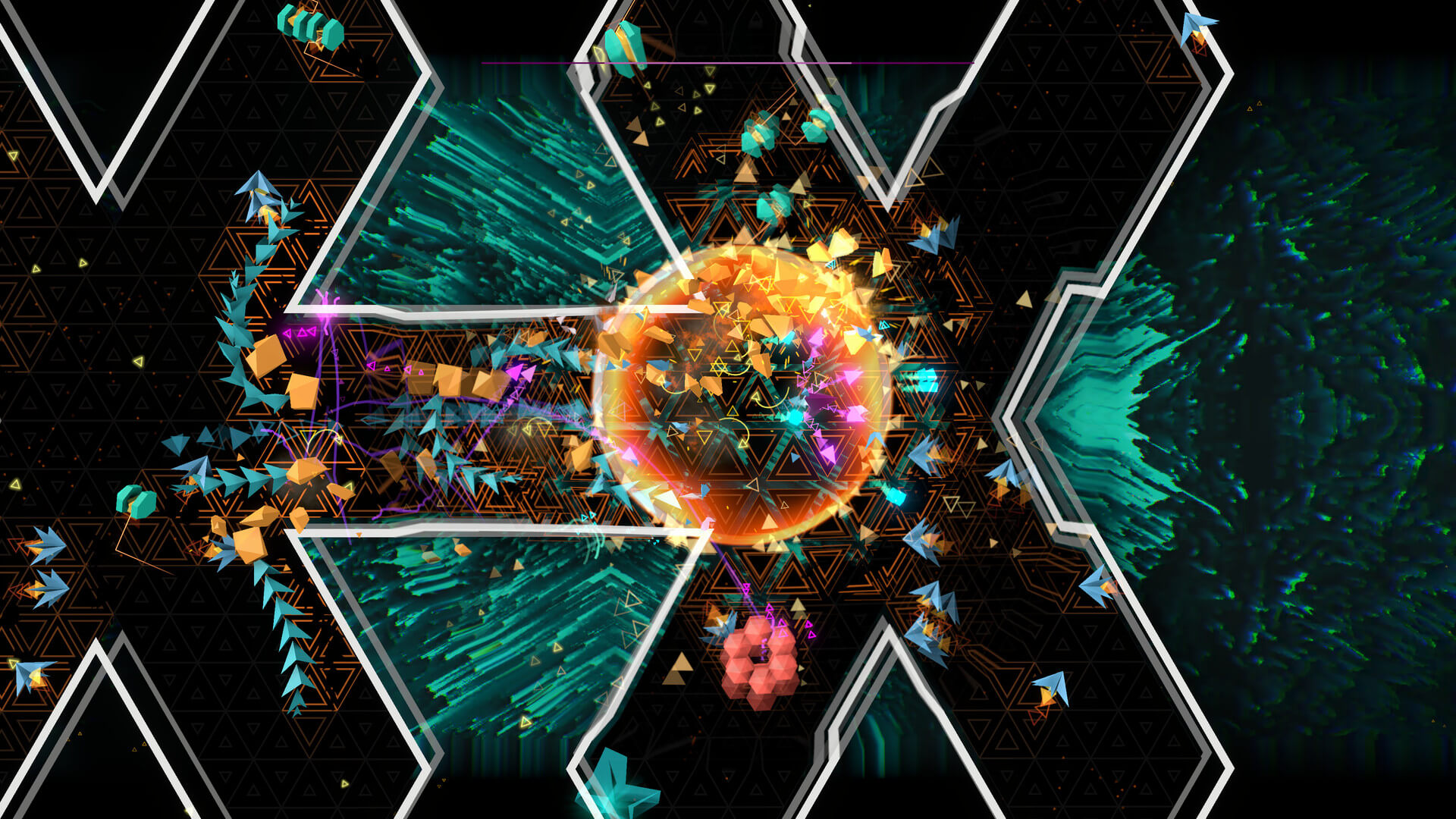
Which is to say that Sektori has a pretty heady layer of decision-making gameplay that operates over the top of its core move-and-shoot-and-then-move-again-because-a-brand-new-wall-is-about-to-spawn-there-oh-shit-space-snake play. At its most base level, players are incentivized to maximize kills (and the collection of the spoils generated by said shape-murders) in order to start spawning power-ups, which can then be spent to make a little marker climb a ladder of power-ups, starting with speed upgrades, and then intensifying into flashier (i.e., more lethal) upgrades. If this was the full degree of the game’s mental overhead—really just a slight variant on the old Gradius power-up system—I could probably hang, even though I’ve felt plenty of pinches of anxiety over whether I’ve been balancing my missile and blaster upgrades properly.
But this evolution system then runs into two other tweaks to Sektori’s take on the old Geometry Wars formula. The first is the addition of periodic boss fights that go extremely heavy on bullet hell patterns of attacks, shots, and obstacles, each of which requires having its own strategy loaded in my brain in order to get out of alive. And then there’s an even more complex layer of upgrades where the game offers up a wide array of run-shaping powers in the form of choosing cards from a deck, because it’s 2026 now, and every game has to have deckbuilder mechanics in it somewhere by law.
None of these systems is a real problem, when taken in isolation. But, of course, Sektori isn’t working in isolation: It’s working in claustrophobic, scream at you, put a hundred enemies on the screen at a time cohabitation, meaning that you’re managing your shield counts and your upgrades and trying to figure out if the card you just picked is going to get you killed—some of them temporarily debuff you in exchange for better powers, see—and also shooting roughly 1,000 enemies per second. It’s a lot, is my point—and, more importantly, it’s a lot of work for the ol’ head meat to be doing when it was expecting to be dozing idly in the backseat while hands and eyes did all the heavy lifting.
None of which is to say Sektori is a bad game, unless you’re comparing it directly to a 22-year-old Xbox Live Arcade game that has achieved nostalgic perfection in my ailing memory. (Did you know they sold Geometry Wars for five dollars back in 2003? Madness; a standard the entire history of digital games distribution has failed to live up to.) But it is a game that feels beholden to two conflicting impulses, and impacted by the inevitable friction that produces. On the one hand, it’s a game that wants to have some brain to it: You’re making some pretty serious cost-benefit picks every second you’re interacting with the upgrade system, and that pressure carries a thrill that gives the game more staying power than it’d otherwise have. On the other, it wants to put you into mindless vibes mode, as your hands and eyes chew through the brightly glowing murder-candy. There are probably players out there who instantly figured out how to do both of these things at once, instinctively managing their Sektori builds while letting the reflex fibers twitch. For me, though, the “state of consciousness” it works to transport me to still just has too much dang consciousness in it.


 Keep scrolling for more great stories.