With a storyteller as beloved as Jane Austen, the bar for adaptations is higher than most. There are numerous versions of Pride And Prejudice to choose from, but Sense And Sensibility remains a little less loved. Director Georgia Oakley’s new version of Austen’s story is steeped in tea-stained sepia and earth tones, managing to hit its marks but not sweeping anyone off their feet. Rather, it’s a restrained tale of romance and passion that could have used a bit more of the latter. Fans of the source material may be satiated by this dutiful adaptation, but it won’t set many hearts aflutter.
After the death of their patriarch, the Dashwood family are in a bind. Left with only a paltry allowance and their estate handed off to the eldest son with his own family, mother Mrs. Dashwood (Caitríona Balfe) and her daughters Elinor (Daisy Edgar-Jones), Marianne (Esmé Creed-Miles), and Margaret (Bodhi Rae Breathnach) are destined to be displaced. By chance, a distant cousin, Mrs. Jennings (Fiona Shaw), offers a cottage on her estate, and the family heads there to avoid the consternation of Fanny (Stacy Martin), their relative who can’t wait to take ownership of the family estate and who doesn’t approve of her brother, Edward (George MacKay), growing close with Elinor. Now a world away in Devonshire, Elinor must nurse her own withheld passions while Marianne attracts the attention of two bachelors: the stately Colonel Brandon (Herbert Nordrum) and the wily Willoughby (Frank Dillane).
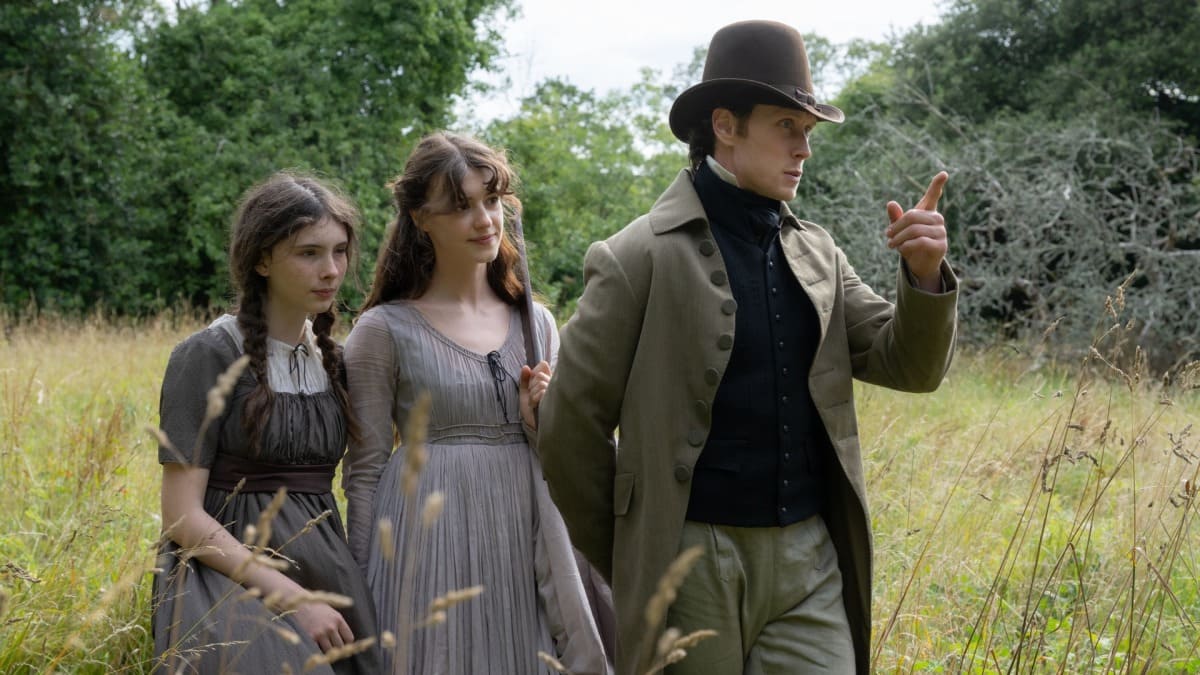
Oakley and screenwriter Diana Reid’s adaptation of Sense And Sensibility has a very different visual style than the sunny Ang Lee adaptation of the ’90s. Instead, Oakley and cinematographer Arnaud Potier utilize an antique-looking color palette with rich yellow lights, woody interiors, deep oak-green forests, and grassy windswept landscapes. The movie looks like it was based on an oil painting rather than the book, and its images have a darker edge. This darkness sometimes overtakes the characters, burying them in the shadows, but other times, Oakley’s painterly compositions make excellent use of the spaces between characters; in a shared moment between Marianne and Colonel Brandon by a grand fireplace, the two seem to exist inside of a warm bubble of their own making, with Brandon finally opening up about a secret he’s kept from her.
Oakley’s feature debut, Blue Jean, was also a period piece with a distinct color palette (that of the 1980s), but while the visual coordination is still there, some stylistic choices detract from the moments that are so carefully composed, making the film look more like a high-end TV production than a lavish film. There are a few awkward shots that look clunky or slightly off-frame, like a close-up of Edward and Elinor that cuts off the tops of both their heads, or CGI candles that clearly look fake.
While adaptations of Austen stories have varied over the years, her memorable characters remain the important elements to carry on. Playing sisters with two different approaches to love, Edgar-Jones and Creed-Miles each perform dutifully, but it’s Creed-Miles who soars as the passionate sister who doesn’t suffer fools and wants an interesting partner just as driven by conviction as she is. In this adaptation, she’s a wild child, an untamed spirit with loose hair who stands outside in the rain to drink its water. She’s also the one with the most chemistry with her suitors, melting into Willoughby’s charms and defiantly challenging the Colonel’s solemn worldview. Perhaps because Elinor is the more restrained sister, Edgar-Jones fades into the background of her own story, unable to stand out until the film’s climax. Her chemistry with her on-screen counterpart, MacKay, is so faint as to be missed entirely.
MacKay himself follows in the footsteps of Hugh Grant from Lee’s film, with a touch less bumbling and a bit more of a stiff upper lip to how he handles these romantic feelings he’s not supposed to indulge. Meanwhile, Nordrum brings an imposing presence to the Colonel, adding to his broody mystique. That tough edge comes in handy when he challenges Willoughby to a duel in a moment that never made it into the ’95 version. Ever the cad and the literary blueprint for fuckboys, Willoughby lives up to his toxic reputation, brought to life by Dillane’s slimy performance.
In Oakley’s uneven Sense And Sensibility, the story of two sisters feels imbalanced. As Edward and Elinor’s romance fizzles, Marianne’s dilemma feels heightened, and her character’s wild spirit leaves her vulnerable to heartbreak in a way that Elinor simply can’t match. For every classical touch, like composer Roger Goula’s violin-driven score, there are other distracting additions like ridiculously over-the-top dance choreography in scenes that should be about the main characters falling in love with one another. In trying to put her own stamp on this beloved story, Oakley forgets to focus on the emotional subtleties of the characters’ heartaches, which is crucial to capturing what has made Austen’s work resonate through the ages.
Director: Georgia Oakley
Writer: Diana Reid
Starring: George MacKay, Daisy Edgar-Jones, Esmé Creed-Miles, Herbert Nordrum, Frank Dillane, Caitríona Balfe, Bodhi Rae Breathnach, Fiona Shaw, Stacy Martin
Release Date: October 16, 2026


 Keep scrolling for more great stories.