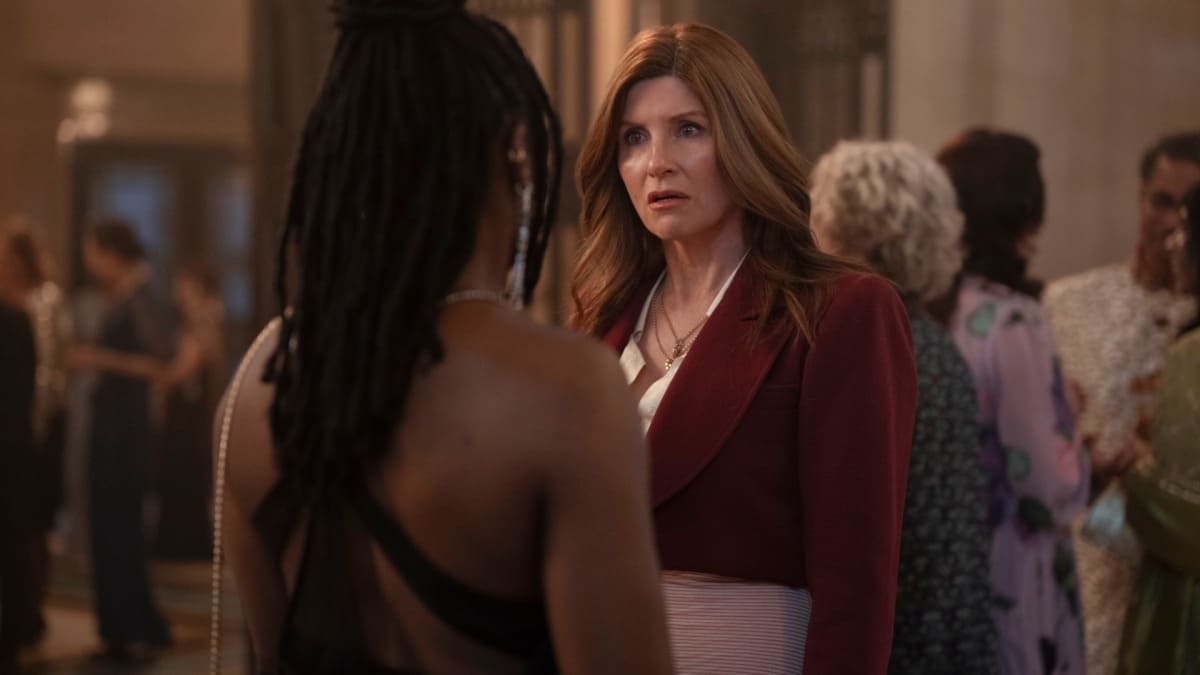
SH: Just me going out on a limb and asking people and them very kindly saying yes. With James Norton it was weirdly the same as Damian Lewis [who appears in the premiere episode]—I’ve met them both at Wimbledon. That’s such a middle class answer for you [Laughs.], but I’ve met them both at Wimbledon and we both sort of said, “Oh, I like what you do” And so I felt like I at least could do that. But for the most part, it’s just having this gut feeling that people are going to be great and asking them if they’ll come on board for the ride.
AVC: Switching gears a bit, one of the things that we’re told about aging, especially as women, is that one of the benefits of getting older is that you have less tolerance for nonsense. You know, getting older means “giving no fucks.”
SH: Yeah.
AVC: Something that I love about Alex is that she clearly still does care. She still cares about being desirable. She still wants to be in an exciting relationship, which is maybe not what people…I mean, certainly Sam doesn’t seem to think sometimes that that’s what she should be going for. Alex is going against the grain in a sense. Is that the root of her problems? How do you think that affects her or her actions?
SH: Yeah, but she’s also had a lot of disappointment in her life and she’s had a bad marriage, and so she feels like she wears that time that’s passed very heavily. She does feel like the universe owes her a favor or two. And why shouldn’t you hold out for that person that stimulates you intellectually and you fancy? Why can’t you hold out for that? I mean, I think women especially often don’t think they’re worthy or there’s that sort of, “Oh, well, [we’re] lucky to get any kind of anything,” and fuck that. I really do think that she has got a very complicated relationship with age, with her own holding onto her desirability, which is more like what the magazines tell you is desirable or she hasn’t got to that place where she’s comfortable in her own skin and I really want her to get there just like I want to get there. But I think that reaching for this ideal of there being a partner out there for her who is intellectually her equal and who makes her laugh and who she fancies is just…I mean, we should all be aiming for that.
AVC: Alex’s relationship with Sam is just as fascinating as her relationship with Patrick, because, especially by the end, it’s a lot more fraught than I think the best friend relationship typically is in these stories. How would you describe Sam and Alex’s relationship?
SH: Well, I think it’s very complicated. I think Sam at the start of this series has everything and Alex kind of has nothing. She’s got this marriage with a man she loves and fancies, and she has this agency that she’s built over decades. She’s got a seemingly together family life. Alex has a son with massive issues and a broken marriage, and she works for [Sam]. So she’s in a more deferential position, and yet they’ve known each other for years and they have each other’s backs and they care about each other and they have a fucking laugh together, but it can turn like that.
I noticed that some of my working relationships with women that I adore were complicated in that way because either I was their boss or employed them in some way, and it just made the dynamic incredibly complicated, so therefore I thought it really interesting. And I never wanted them to be—I can’t think of what the word is to describe it, but for it to seem like frenemies. I didn’t want it to be like that at all. I just wanted it to be a very complicated friendship. And there was a certain thing in one of the original scripts that I ended up taking out, but it was Alex saying, “I think I get on best with Sam when things aren’t going great for me. She can relate to me more when I’m in a position where things are shit.” And it is a little bit that. The imbalance there is because Sam is the boss and [she pays Alex], so of course it’s going to be complicated, but I loved it for that reason, and I think it felt really sparky and fun to be around.
AVC: Yeah, it’s like they are there for each other, but it’s not as simple as in other romantic comedy stories. I also found the relationship between Ruari and Alex unique, both in TV more broadly right now but also within your body of work, because this is the first time that your kid in the show is a main character. And there’s this wonderful moment in the seventh episode where Ruari gets this dig in at Lorcan, and he sends Alex this look like, “That was for you.”
SH: [Laughs.] Yeah, I know.
AVC: Do you have a sense of what their relationship is going to be like if there’s another season? Because at the end, we see that symmetry of her climbing into bed with him the way he climbed into bed with her in the premiere, and she’s now looking for comfort from him.
SH: That is exactly it, really. And I think it does happen with your relationships with your adult children, is that sometimes you really do need them. And especially because she’s a single parent, they only have each other. But at the same time, what would happen three minutes after is he would tell her to get out of the bed. So I wouldn’t try and rose-tint the relationship too much. It’s still a mother and son, and they still won’t understand each other, although they’re both going through very similar things. But he’s at a place where he’s lit up by love and she is broken. But I don’t think it will change their dynamic moving forward other than the natural thing that happens with parents and children in that sometimes it reverses and it’s very weird, but god, I mean, I’ve done it. I’ve kind of leaned on my kids and then thought that’s too much. And then sometimes I think you still got to be that very solid person for them. If you are too vulnerable, it’s too vulnerable for them. But I think sometimes allowing them to see that vulnerability is okay. I think that’s a good thing.
AVC: I think a lot of people see your shows as representing different stages of life, but that’s just one framing. I’m sure this is something you’ve had in mind while you’ve been working on them, but looking back 20 years after your first show debuted, are you finding new connective threads between them? Do you find yourself thinking, “Oh, I just realized this is what Sharon and Eva have in common?”
SH: Yeah, yeah. I mean, constantly. And I think it makes sense that those threads are there because they are–it’s me, I am the thread that connects them all. And sometimes I think, actually, I’d like to lean into it a bit. I’d like it to almost be, if you know all the shows, you’ll recognize that this is a kind of reference to that, or this is a little Easter egg. And it’s funny because I always thought it would get harder the longer you’re in this business to write about real life because it is such a weird world. But in actual fact, as long as you keep living, you’re going to have stuff to write about.
I think some of [the characters] are stronger than others. Eva is a completely different person to Donna and who she was in Pulling, but, you know, with time. I mean, I’m so different to who I was when I was in my early 30s. It’s interesting. There’s way more that unites us than divides us across the board. That’s the thing, it’s why I feel less scared writing now because I think, well, if this happened to me, a version of it has happened to someone else and people will relate. And I think that’s the main thing that connects them, is that it’s just honest portrayals of what it is to be in that period of your life.
AVC: In interviews for the show, you’ve described the current TV landscape and acknowledged that it’s very different from what it was like when you first started developing shows. Even in just the last six years, it’s changed considerably more. As a performer and a writer, how hospitable would you say the environment is right now? Do you think a show like this from someone else will be green lit a year from now, two years from now? Or are we going to see people taking fewer chances?
SH: Oh god, I don’t know, but I think that it’s a really important question because it’s an odd time out there and really you feel like the safe things to do are adapting IP or a remake of something or a formulaic kind of ratings getter, and therefore there’s less of an opportunity for the auteur to try something new and have a go. And I just pray that these kinds of shows continue to get made. And honestly, not just for my own employment, but just for society. We can’t just homogenize everything and we can’t just think about things in terms of commerciality and commerce. Otherwise, art is just going to go out the window and no one will really learn anything anymore. I mean, the thing is you want to entertain, but you do want to, or I certainly do in my shows, I have something to say, and I think it’s relevant. And so yeah, I don’t know the answer to your question, but I’m nervous about it. I don’t know. I hope.
AVC: As I covered the show, I did find myself thinking about what a big swing from a female creative looks like versus what it looks like for men, and who is allowed to try again and who gets to hear that interesting failures are always better than things that are just mediocre.
SH: Yeah, exactly. Exactly. I mean, who gets to fail and try again is a really interesting one, and obviously heavily weighted in favor of the male creative. I think it also just does put a fire in your belly. Sometimes you need more than just a fire in your belly, but I think if we’re all just honest and vocal about this, and also within my company, within Merman, I just try and push for interesting stories that aren’t necessarily the obvious choice and to work with female creatives more often than not. I think there is a kind of responsibility there as well to put your money where your mouth is.
Youth season one is streaming on HBO Max.