It’s easy to see why fiction about blood sport continues to captivate: After all, we live in a late-stage capitalist nightmare world where human life is regularly devalued, so it isn’t hard to see why desperate folks might risk it all for money. Also, Squid Game was really popular, so even the suits can get on board with bankrolling more of these. As its blunt name would suggest, the currently airing anime Shiboyugi: Playing Death Games To Put Food On The Table is very much in this mode. Beyond its commentary on economic exploitation, this series gets in more subtle digs as well, doubling as a sharp meta-commentary on anime’s general obsession with fan service.
Adapted by Studio Deen from a light novel series of the same name, the show follows Yuki, a 17-year-old girl who does, in fact, play death games to put food on the table. Set in a hellish world where participants can sign up for broadcast contests to earn cash, these challenges are made up of anything from murderous escape-the-rooms to mazes filled with killer dogs and anti-personnel mines. As for the survival rate, about 70% are likely to get through a given game. After all, if they killed everyone, how could they deliver regularly scheduled programming?
These trials are very much a spectator sport, and as a result, an unseen audience haunts the periphery. Many of the details on who is participating and how they’re presented give away the intended demographic of this in-world program: The show seems to be put on for the satisfaction of men. All of the contestants are women—in some cases, girls, like with Yuki—and while their ages aren’t usually specified, most seem to be between their late teens and mid twenties. After being knocked unconscious by a drug, they’re dressed in clothes clearly meant to appease the audience: French maid outfits, wedding dresses, and in the latest episode that’s set in a bathhouse, just towels and bathrobes.
If the focus on dressing up photogenic young women didn’t make it clear what’s happening here, the process of “preparing” them for the games is even more objectifying. In what’s called the Preservation Treatment, their blood is replaced with a sort of fluffy stuffing, making them more durable while ensuring the viewer isn’t subject to “excessive gore” when they’re inevitably torn apart. Between this and the outfits, they’re essentially transformed into living dolls; dehumanized toys to be broken via spinning saw blades and hidden explosives. And then there’s the emotional manipulation. Everything about the games is engineered to generate compelling “storylines.” Because there isn’t a single winner, collaboration is rewarded upfront, leading to genuine bonds between the participants, before later stipulations, like a limit on how many can pass through the exit, drive them to betray each other. At the end of the day, cruelty is the point, delivering manufactured drama meant to amuse invisible but omnipresent spectators.
While this works as a general commentary on how women are objectified and turned against each other in reality TV and media writ large, these observations feel even more barbed in the context of anime. The medium has deservedly earned a reputation over the years for being filled to the brim with fan service meant to titillate male audiences. This type of framing is so prevalent that it’s borderline the norm for shows to have random shots focusing on butts and cleavage, contrived scenarios where a guy “accidentally” falls on top of a woman or walks in on her changing, and so on. These moments can be found in everything from more explicitly romantic material to action series meant for teen boys; almost no genre is safe.
To name an egregious and frequently cited example, there’s Fire Force, a Shonen Jump action series about superpowered firefighters. While the show has great animation and some intriguing mysteries, the author of the source material included a controversial character, Tamaki. Her special power, “Lucky Lecher Lure,” makes it so that she ends up in contrived and sexually suggestive situations where her clothes fly off, or she is groped due to “bad luck.” It’s the thinnest excuse imaginable to use these lazy tropes, and like other shows that do this, it comes across as much more trashy than sexy; these kinds of decisions make it difficult to take these stories seriously.
Even many series that sexualize their characters for a specific purpose often fall into these voyeuristic visual framings. My Dress Up Darling, a show about cosplaying, is a great example. Sometimes its risqué shots are meant to represent the attraction between its central pair, like when a photoshoot in a hotel takes an unexpected turn. But then, this approach breaks down when the camera ogles Marin while she’s alone, something that happens a lot in the first season, making it feel like these moments aren’t geared toward her love interest but the audience. It stands out all the more because of how well her inner monologues come across otherwise. Again, the issue isn’t that shows like this have sexually suggestive material at all, but that it’s framed from the perspective of a Peeping Tom and that it objectifies teenage girls, making it clear that the only point of these scenes is to appease a specific kind of audience.
While anime certainly isn’t the only medium plagued by leering cameras, this presentation is probably so common because many of these series are cynically aimed at a particular group: “socially inadequate otaku.” Though they’re far from the only anime watchers, these lonely dudes are still seen as the “default” spenders by many of the production committees that greenlight these shows, leading to more adaptations tailored to this demographic.
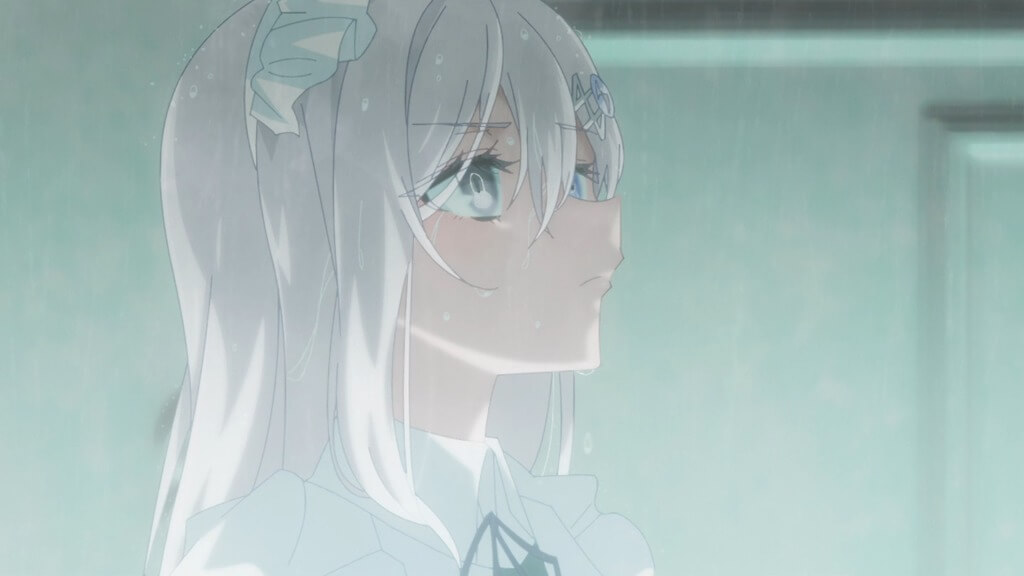
Where Shiboyugi differs is that while it acknowledges this demographic as the intended viewer of its in-world games, it doesn’t indulge in awkwardly angled upskirt shots, questionable bodily physics, or other surefire male-gaze signifiers that would demean those participating in these deadly contests. Instead, the camera provides emotional context for what they’re going through, building both empathy and terror. At times, there are languid wide-angle shots where the world seems to freeze, or close-ups of glittering eyes, forcing us to stew in these women’s dread. Some of these moments are presented with cold objectivity, meant to reflect Yuki’s attempts at emotionally distancing herself from the gruesome tragedy she’s surrounded by, before heartbreak breaks through the walls she’s built up as the framing becomes more frantic.
The slow camera work gives us time to think, both about the horrible situations these participants are going through and why anyone would engineer something like this. When the players gesture at cameras or speculate on the intentions of those who created these games, it draws attention to the faceless viewers making this all happen, the ones gawking at these “performers.”
If there’s a common factor among most fan-service-oriented anime, it’s that they’re written to be easily digestible, to provide a sense of straightforward gratification. The audience isn’t supposed to question the tired tropes or contrivances; they’re coddled. By contrast, Shiboyugi is anything but an easy watch. As these desperate participants are killed by Jigsaw-like traps, it’s impossible to avoid thinking about the unseen monsters who created these circumstances for their own benefit. If many anime are designed to offer the viewer pure escapism, this one does the opposite. It holds up a mirror.


 Keep scrolling for more great stories.