In the horror aisle, nestled between the classics and disreputable trash promising a fun night with your friends huddled before the muted television (so your parents don’t hear the shrieks), was one of the most indelible images to ever adorn a VHS cover: Santa Claus’ hand reaching up out of a snow-topped chimney, holding not a sack of presents but an ax. It was an image that became cropped and splotchy on TV, but still represented a film intensely derided for its ruinous influence on kids, those susceptible to the silly movie violence of costumed maniacs. The lurid image of Silent Night, Deadly Night‘s original poster and home media box—so blasphemous, in such audaciously bad taste, so obviously intended to spur controversy and put butts in seats (or tapes into VCRs)—remains imprinted on the minds of horror lovers. To this day, Burt Kleeger’s artwork, an image of ludicrous menace and macabre amusement, is still notorious. In fact, an entire franchise—gradually becoming incoherent and twice listlessly rebooted—has attempted to ride that image and the controversy it provoked to success. And yet, despite the outrage that unholy image and film initially stirred among suburban moms and righteous film critics, by the first sequel, no one cared anymore; the rage sparked by cinema’s most famous killer Santa was a one-time-only sensation.
Still, Silent Night, Deadly Night has the reputation as not merely a movie, but an affront. Those who know it, know its distastefulness first and foremost. Few know there is a whole series of these movies. Silent Night, Deadly Night made $2.5 million on a $750,000 budget in its truncated release and caused a sensation in 1984 (the year Gremlins and Temple Of Doom traumatized kids and inspired the creation of the PG-13 rating). It very briefly beat A Nightmare On Elm Street at the box office, because Wes Craven’s film debuted on far fewer screens. But despite the profits, more people were angry with Silent Night, Deadly Night than actually saw it. Citizens Against Movie Madness, an assemblage of Reagan-era moms with morals, gathered cultishly in front of theaters and brandished signs adorned with “Save Santa” and “Santa is NOT a Murderer!” After it hit video stores, parents continued to expound fears that Silent Night, Deadly Night was turning kids into psychos, which almost certainly made more kids rent it surreptitiously. The film found eternal life as a taboo, even as horror got more graphic and Silent Night, Deadly Night felt tamer and tamer.
Directed with some low-budget skill and much sincerity by Charles E. Sellier, Jr. (who created The Life And Times Of Grizzly Adams) and penned by Michael Hickey (who helped with the restoration of Vertigo), the notorious holiday slasher opens with a couple getting murdered—the husband shot, the wife sexually assaulted and throat slit—by a thug in a Santa outfit. Their young son, Billy, watches from the side of the road, crouched in leafless brown branches. His little brother Ricky remains strapped in in the back seat, too young to comprehend any of it. The boys are sent to a Catholic orphanage, ruled with old-school tyranny by Mother Superior (Lilyan Chauvin), who refutes Sister Margaret’s (Gilmer McCormick) attempts at using therapy to help Billy deal with his trauma. Mother Superior believes in pure punishment, a kind of modern, holy Krampus. Billy’s harrowing experiences are intensified by a woman of God, who will never understand him, or what horrors her lack of empathy will inspire.
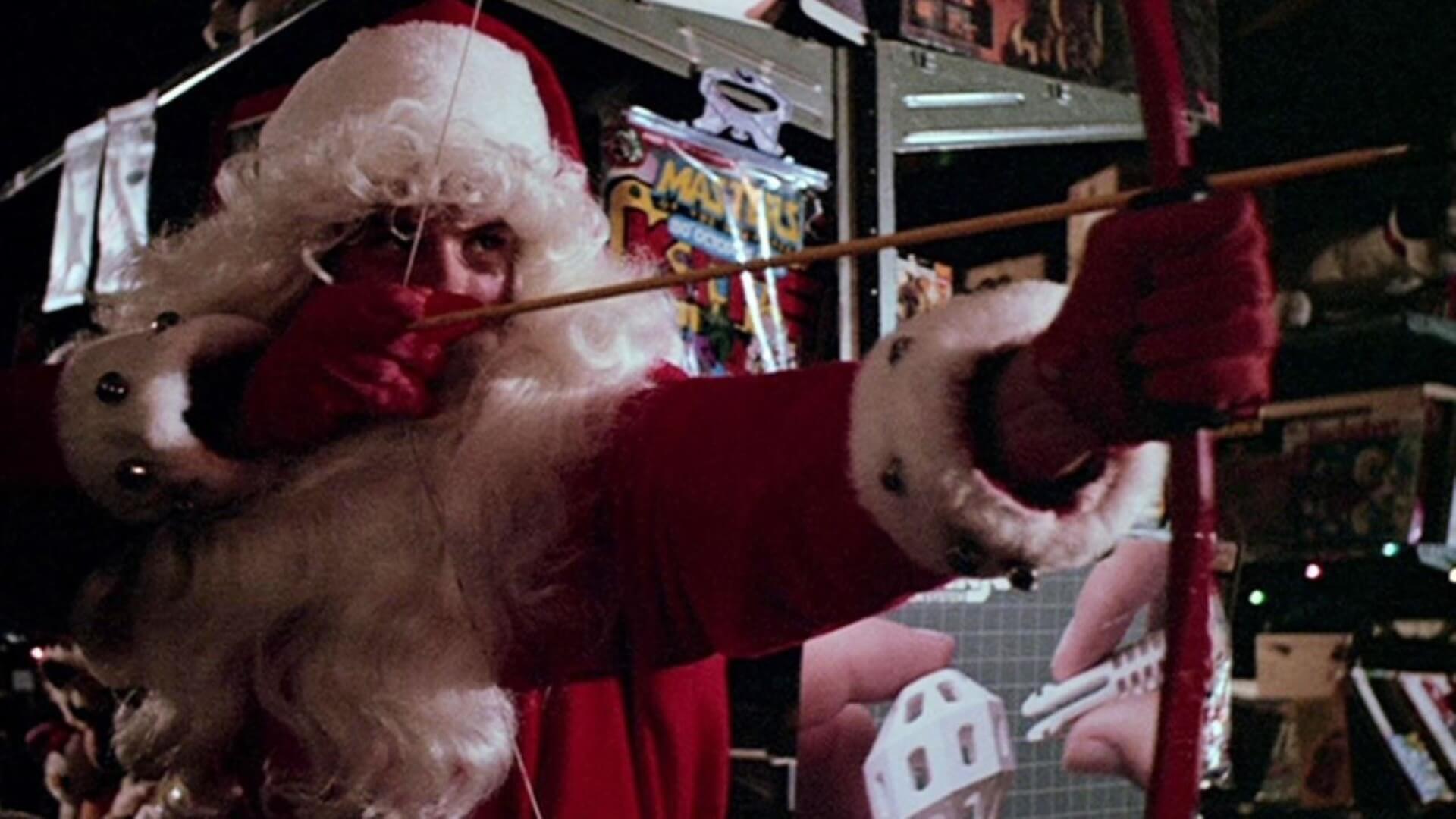
The most shocking thing about Silent Night, Deadly Night, though, isn’t its violence (six minutes were purged to acquire an R rating, so the remastered Scream Factory version is the one to watch). Rather, it’s the effort the film puts into establishing and exploring the psychological depths of its Santa-dressed killer—a broken boy not born violent but made naughty. This comes to a head when 18-year-old Billy (Robert Brian Wilson), with help from Sister Margaret, secures a job hoisting and stacking boxes in the back of a toy store. When he is forced to don a Santa costume and cradle present-hungry kids in his lap, and then witnesses a lubricious encounter between his coworkers, he snaps. He kills everyone in the store—by ax, by arrow, by strangulation via Christmas lights—and heads off to arbitrarily murder young people behaving salaciously on his way to the orphanage where he learned his catchphrases: “naughty” and “punish.”
’80s slashers have a tendency for silliness, stupidity, and mean, gross violence. Many took the wrong lessons from Halloween and perpetuated them, sometimes to undeniably fun results. Silent Night, Deadly Night lacks the visual eloquence of John Carpenter, and the genius of Tom Savini’s make-up, but it does include some unsettlingly lovely images, like a topless woman (scream queen Linnea Quigley) artfully impaled on antlers, mounted on a wood-paneled wall behind Santa-clad Billy wielding his ax. And yet, none of Silent Night, Deadly Night‘s scarier, bloodier, better-made contemporaries ever conjured an idea as genuinely nasty as a priest dressed as Santa (a deaf priest, for added amorality) getting shot by a cop in front of a gaggle of orphans. These parentless kids, playing in dirty snow, are spritzed with blood, likely suffering the kind of trauma that defined Billy—and the kind of trauma that parents hysterically feared upon the film’s release.
Before Silent Night, Deadly Night came out on November 9, 1984, it got better marketing from freaked-out adults than its team could’ve ever purchased. On November 4, during a football game between the Green Bay Packers against the New Orleans Saints aired on WITI-TV in Milwaukee, a commercial for the film caused an uproar. “It was absolutely disgusting,” Kathleen Eberhardt, mother of two, told The Milwaukee Journal in a front-page story. In the resulting panic, New York TV station WPIX moved the film’s commercials to late at night, and stations in Albany and Boston canceled their ads totally. The Boston Globe killed the film’s newspaper ads of the Santa-with-an-ax poster; a theater in the Bronx pulled the film after just one week, and theaters in Montana refused to show it at all. Producer Ira Barmak had to buy back the distribution rights after Tri-Star took the film out of circulation; Tri-Star also retreated from deals with RCA/Columbia and HBO for home media.
For its re-release in the spring of 1985, and ever since, Silent Night, Deadly Night‘s publicity and ads—for screenings, for home media—have focused on the initial controversy from 1984, garnering more attention from kids who just had to see what all the fuss was about. The controversy went mainstream, and the film was chastised more than watched. Gene Siskel called it “sick and sleazy and mean-spirited,” and one of the two most “contemptible” films he had ever seen, along with Meir Zarchi’s brutal, artless I Spit On Your Grave. Siskel proceeded to list the names of people involved with the film, a hissy fit almost as petulant as his treatment of Betsy Palmer when Friday The 13th came out in 1980.
In 2012, FilmLinc Daily spoke with Michael Hickey, Michael Spence, and producer Scott Schneid. Schneid, progenitor of the killer Santa idea (its original title was Slay Ride), said, “…this was the time of the original Friday The 13th and Halloween, and this concept just struck Dennis and I as being potentially incredibly visual and franchisable…spawning potential sequels a la the Friday The 13th series and Halloween series. The idea of us taking the Santa character and inverting or subverting it, whatever you want to say, seemed to us that it would appeal tremendously to the teenage demographic out there—the most rebellious creatures on the planet are teenagers—and felt they would just love the idea of blood on the snow and the psycho Santa.” They wanted the film to become a seasonal classic.
“Not for one second during the conception, development, or leading up to the release of the film,” Schneid said, “did I think…that there was going to be any kind of backlash against this project. It came out of that early to mid-eighties plethora of genre/slasher movies. I just thought it was going to be another one intended for the R-rated teenage audience.”
The moral indignation, you might think, would have made a sequel desirable, another film for moms to pre-hate and teens to flock to; but Part 2 was much cheaper (a $250,000 budget) and far less successful (a paltry gross of $154,000). The sequel’s controversy has to do not with the filthy concept or inclusion of truly offensive material, but the flummoxing choices the filmmakers made: The full first half of the film sees a now-adult, now-crazy Ricky (Eric Freeman) tell a psychiatrist about his memories, conveyed as a clip show of original film. All the filmmakers wanted to do was remind viewers of the initial hate-inducing controversy. People did hate it, for a different reason, and few paid to see it.
By the third film, there was no more controversy because so few were even watching anymore. This, and the next two films, were all direct-to-video releases, and (somehow) far better than their theatrical counterparts. The third film, an intelligent psychological slasher with clever frugal style, is the last in the series to have anything to do with the original. The absence of controversy-fueled interest led to the abandonment of Billy and Ricky, but not the franchise or its iconic title. By the fourth film—Initiation: Silent Night, Deadly Night 4, an audacious, Lovecraftian Brian Yuzna body horror about witches who plan on enacting a nefarious plot during the Christmas season—the Silent Night, Deadly Night subtitle is fastened on like a gaudy piece of plastic jewelry, just to play off and up the controversy from 1984.
But it’s the fifth film, 1991’s The Toy Maker, and its star, Mickey Rooney, that best explains the reality of moral panic around the first film. Rooney was part of the crowd up in arms around the original film, at the time writing an open letter railing against it. “How dare they!” Rooney wrote about the inherent evils of “Santa Claus with a gun.” While the actor ended his screed with “The scum who made that movie should be run out of town,” it took less than a decade for him to become that very scum in a sequel which uses Christmas in perhaps even creepier and more sacrilegious ways than Billy’s killing spree. The Silent Night, Deadly Night controversy—both for those raging against it and those looking to capitalize on it—was always fleeting, always ephemeral, always more concerned with cash than with children.


 Keep scrolling for more great stories.