What if a misguidedly progressive regional theater company staged a musical about Anne Frank in which she and most of the other people hiding in that attic were “reimagined” with new races and/or sexuality, Hamilton-style? That’s the puckish premise of Slam Frank, and through that lens, the musical takes ideas around colorblind casting and historical reinterpretation in theater to satirical extremes.
In September, the musical officially debuted at the Orpheum Theatre, where it’s proved successful, with its run recently extended into next year. Slam Frank has drawn plaudits, condemnation, and general debate. Various critics and audience members have derided or praised it as “anti-woke,” as antisemitic, as Zionist or anti-Zionist, and much more.
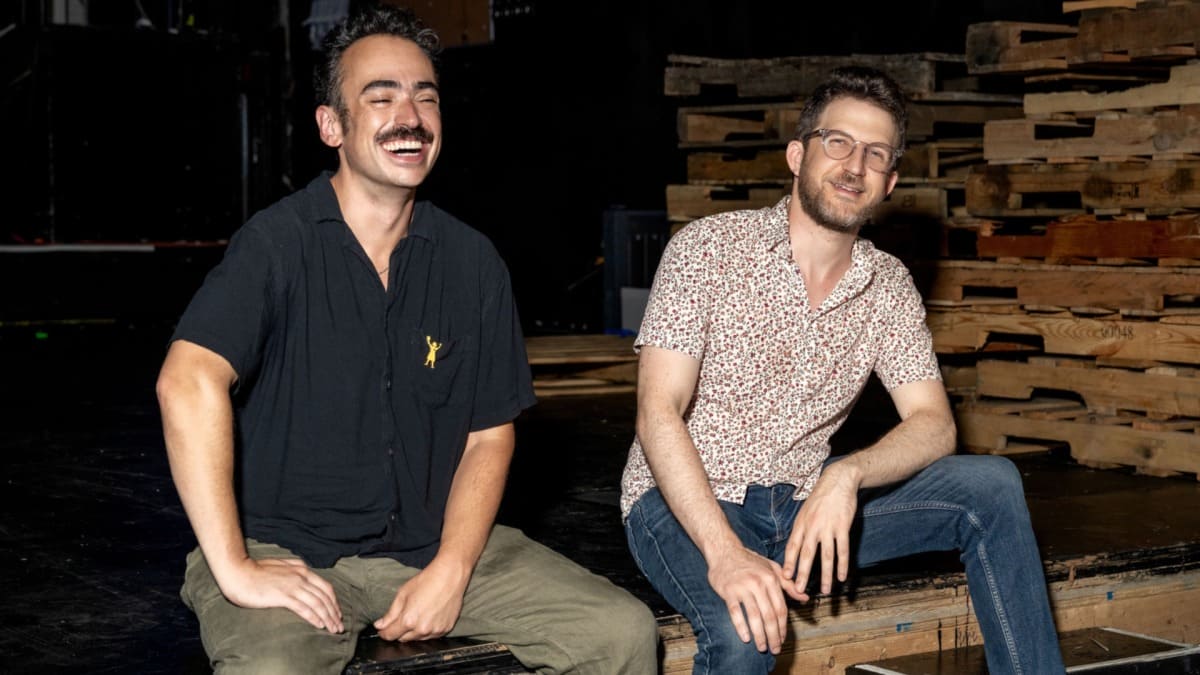
Shortly after Slam Frank’s run at the Orpheum was extended, we sat down with Fox and co-writer Joel Sinensky over Zoom to discuss the show, the controversy, diversity efforts in theater, and more.
The AV Club: The show’s promotional material heavily features a tweet from 2022. Were you following that controversy at the time, or did you find it later?
Andrew Fox: That’s kind of a convenient half-truth of marketing. We needed a shorthand to communicate the tone and intention of the musical, and the Twitter thread was the easiest thing to latch onto. It was more a series of things in the ether. There was that thread. There was a production of a play about antisemitism that got shut down by the Black Student Alliance at a liberal arts college in the northeast. There was this company in the U.K. that announced a production of Romeo And Juliet where the Montagues were Nazis and the Capulets were Jews. All these things where the rules of identity politics would get strange when applied to Jews. Because Jews are the exception to this rule, they provide a great test case for interrogating how we approach identity and how we tell stories through that lens. The source of that tweet isn’t necessarily what interested me. What interested me was all of the responses to it.
AVC: Do you think that’s similar to the sentiment that undergirds the dynamics of colorblind or diverse casting in theater?
AF: It’s tough to say, because Slam Frank is built to be three-dimensional. It’s not really a message piece. There’s this David Baddiel book, Jews Don’t Count, and sometimes critics of that book will hear that our show is in dialogue with it and think we 100% agree with it. Baddiel’s premise is that the trouble with identity politics is that when it comes to Jews, progressives forget to apply those rules. I think that’s half true, but in our show, we also interrogate the opposite side, which is that sometimes when people try to apply these rules to Jews, they suddenly realize, oh, that’s a dumb rule.
Joel Sinensky: I think a lot of people look at our show and think it’s a message piece, or that it’s projecting a certain political belief, or that we’re attacking Hamilton and that kind of casting. And we both love Hamilton. I saw it a second time last year and sobbed for the whole second act. They think we’re taking a black-and-white position, but the show really is designed to not do that.
AF: I think…[laughs] this is going to be the douchiest answer, but there’s this concept in ayahuasca medicine work where you’re interrogating your own story and get inside of it and get reminded that it’s just a story. And that allows you to crack it open and get a new idea, but then that idea itself turns into another story, and you’re constantly turning over these stories, trying to get to some sort of truth as if there is a single truth. Structurally, our play is trying to do the same thing. It’ll take an idea and say, “Well, this is ridiculous,” then we turn it over and go, “But what if it’s not ridiculous?” Then we push it a little further and it becomes a new idea.
Alex Lewis, Jaz Zepatos, Olivia Bernábe, Rocky Paterra, Austen Horne in Slam Frank (Photo: Shawn Salley Photography)
AVC: What’s an example of how this plays out?
AF: There’s this sprawling sequence where Anne Frank is struggling with her identity, and her abuela pulls her into a flashback to her childhood in the barrios of Frankfurt. She relives her family’s struggles in the barrio and then their journey through the German jungles to become immigrants in Amsterdam, the assimilation process, and the erasure of her identity. One of the big ingredients we’re playing with is how ridiculously stupid these historical reimaginings can be. We’re looking at what’s clearly a gas station in Texas, and this guy says in a thick Texas drawl, “Hello thar, this here’s the Netherlands! You best speak Netherland here!”
But in making a farce out of how ridiculous it is to compare living through the Holocaust with being a Latino immigrant in the American Southwest, the necessities of storytelling require us to take the journey of this character seriously. And we end up having this sequence that is incredibly moving that ties the experience of the Frank family to the experience of Ellis Island immigrants and Latinos in the Southwest. It ends up becoming an emotional, moving portion of a ridiculous sequence. As we were writing it, the play constantly asked us to take something we were ready to make fun of and actually take it seriously, to ask ourselves, “Was I correct to judge that the way that I did?”
AF: I haven’t. When Stan Zimmerman announced that remounting, the internet tried to pit us against each other, and I was like, “Oh, hell no.” I sent him an olive branch, and we ended up corresponding and found that our experiences of putting on these plays were so similar. I think that’s something a lot of our fans don’t necessarily understand. Whether it’s with this or Midnight, they’ll be like, “How can you be friends with the creator of a show that is aesthetically and ideologically so different from yours?” Well, Putin and Zelenskyy have more in common with each other than with their own people.When you’ve created a work of art, when you’ve had to carry it across the finish line, dealing with death threats and institutional barriers and people misunderstanding you, when you look across the aisle at somebody who’s been through the same thing, you can’t be like, “You’re doing something different than me, so I hate you.” It’s “Man, it’s tough out there. Am I right?” We love Stan, and he’s been such a supporter of ours. He’s seen our show twice now.
AVC: It’s interesting to hear you describe it this way. If, in making fun of the idea of reimagining a text with different identity markers, you then see actual resonances, does that make you question the project? You’ve affirmed there’s no overriding message, but does it make you rethink the jokes, your standpoint, or your approach?
JS: I don’t think it does, because these layers are inherent to the piece. Like Andrew said, there are sections where we are pushing to create real emotional resonance within this absurd satirical context. To me, that doesn’t undercut the absurdity. It all grows on top of itself. One doesn’t negate the other.
AF: Perhaps this is an incorrect assumption, but I think that had we written a non-musical play, people would recognize that it’s a playground, an experiment. I think because it’s a musical, people expect it to have a prepackaged message. I think musicals are seen—often correctly—as a reductive, two-dimensional art form. If I wanted to get a single message out, I wouldn’t write a play; I would write a tweet or essay, and that would be it. A play is an experience. The experience of Slam Frank is part roller-coaster, part dominatrix session, part acid trip of: How do we tell stories? How do we contextualize history? What is identity? And what the f–k b-llsh-t have we been doing for the past 15 years?
JS: Andrew and I came at this material from different experiences. Often, when people are writing about a subject, they’re trying to figure out what they think about it. Andrew and I don’t always think the same way about different subjects. The show is an interrogation of these subjects and in many ways our own positions, and our feelings evolved as we wrote it.
AF: My incredibly informed, correct views would interact with his wildly ignorant, I would say stupid, views about the world, and they arrive at a synthesis.
AVC: What’s an example of this synthesis in the show?
AF: I would have these big, heavy ideas that were difficult to convey or I was wildly unskilled at conveying. When trying to explain how I wanted the play to be set, I’d say, “It’s now, but it’s not now. It’s then, and they’re in the present, but they’re in the past.” It would be enormously frustrating for him. Then he would get high and write a scene where the characters themselves are trying to figure out what the f–k I was saying. And that’s where we got the recurring gag of the characters trying to have a conversation with the audience and getting confused—“Which today are you talking about?”
JS: There was a certain incoherence to some of the concepts we were dealing with, and it became a theme of the show: the incongruence of the way theater can recontextualize history. The characters themselves get confused about the context of their own reality, which adds to the acid trip energy of the show.
AF: Additionally, I’m a fluent native speaker of woke, and Joel is not. So sometimes I would feed in those kinds of lines, and Joel would have to interact with them. I think the most blatant example in the script is when Mrs. Van Daan becomes a feminist, an academic Judith Butler type, and she says, “Sure, the Allies may defeat the Nazis, but through what assemblage of counter-hegemonic labor shall the scaffolding of our interlocking systems of oppression be rendered obsolete?” And then Joel’s line is Otto’s response: “I don’t understand anything you just said, but you’re right.”
Cast of Slam Frank (Photo: Shawn Salley Photography)
AVC: Circling back to the show reacting to, as you put it, “What the f–k b-llsh-t have we been doing for the past 15 years?” You mentioned a Black student group protesting a play about antisemitism. What college and show was this? And what other shows, or events, or things you’ve seen working in theater influenced the show?
Fox: I don’t remember the specific play, and at this point, with so much time between now and then, I’d be wary of misremembering and misreporting.There were a lot of strange, strange stories. For example, The Marvelous Ms. Maisel was a very Jewish show. And every season, they had more dictates from on high to get more diversity in the writers’ room. And in practice, that meant they had to keep firing Jews and replacing them, on a show all about Jews. Now, I’m not out here saying we need our special stuff too. It was just an interesting irony.
The things in theater, particularly … I remember a Jewish actress I worked with was told, “Well, you had your moment with the Holocaust” by a very progressive person. I would witness people saying to someone whose parents had immigrated as Jewish refugees from the collapse of the U.S.S.R., “You have no idea the generational wealth of your white privilege.” There are also a lot of stories people in the industry have told me that I can’t tell, because it’d be clear who it was.
[Note: We emailed Fox via his representative prior to publication of this piece to ask for verification of the claims about the Black Student Alliance and The Marvelous Mrs. Maisel. Below is the statement Fox shared.—Ed.
“I appreciate Dan fact-checking these assertions, which is something I probably should have done myself instead of relaying half-remembered secondhand anecdotes.
I certainly don’t see Slam Frank as a Jewish grievance play or as some “DEI is bad” piece. What I was trying to convey with those anecdotes — perhaps unsuccessfully — was that at that moment in time there was a murmur in the zeitgeist about where Jews fit into these questions, and that was a jumping off point for us to interrogate the nature of identity politics from a new and novel angle.
While I can’t know for certain what was happening in my head while Joel and I were writing Slam Frank, I believe David Cote’s review & analysis of Slam Frank rings more true to me than more narrowly-focused pieces. For me, it was never an opportunity to write some petty screed about media jobs, but rather an opportunity to explore the vulnerabilities & contradictions of tribalism and identitarianism.”]
JS: [jokingly] You’d be killed. A general thing we were reacting to was a feeling for 10 to 12 years that you had to be careful about what you presented in art and cautious about not saying the “wrong” thing. It felt very aesthetically conservative. When we first had a script and didn’t have any support, we sent it around to theaters and got rejected by everybody. A sensitivity reader soundly rejected it. One of their critiques was that it sidelines and silences the one Jewish character, which is the point. I think that’s very endemic to this feeling of what stories you’re “allowed” to tell. I think that in the last few years, that energy has loosened, it hasn’t felt as strong. We were reacting to this feeling of non-artists and non-creatives being doctrinaire and judgmental about what art should be presented, when to me, the whole point of art is that you can explore unsure, gray areas.
AF: People claim to be advocating for greater representation, but what they actually mean is “favorable representation of how I want other people to see me.” In the girlboss era, there was a clamoring for better roles for women, but we kept seeing wildly two-dimensional roles—women who were without flaws, without the things that make people interesting. What was Captain Marvel’s greatest flaw? She didn’t know how amazing she was. Meanwhile, you go back to films from the 1940s, and you not only have a greater percentage of major female roles relative to now, but you also have a wider variety of personality types and struggles. The irony of identity-politics-driven art is that the goal is not three-dimensional humans, but to make the loudest advocates online feel good about what you made.
AVC: Do you think this manifests in theater because it’s so beholden to those kinds of audiences? Or is it more of an expression of the general conservatism of institutions, which tend to be risk-averse?
AF: It’s a little bit of everything. Certainly, our institutions became rigid—ideological, or fearful of rebuke, or sometimes both. What also happened is the same thing that happens in every industry, which is that people look at a success, misgauge why it’s successful, and try to reproduce superficial aspects of it. Hamilton was a success because it was a groundbreaking, thrilling, artistic tour de force by a group of geniuses who struck on an idea that was so ridiculous and yet so perfect. All the right people were working on it, and it took huge swings and told this fantastic story with incredibly deep themes and a ton of nuance. Now, instead of seeing that, other producers saw the marketing end: “Look at all the diversity, look at all the hip-hop. We’re taking a story from the past and telling it this way.” Diane Paulus looks at that and goes, “Oh, let’s make the Founding Fathers into Black women. I’m going to have a hit.” And she makes the revival of 1776—which, spoiler alert, sucked. It’s a clear formula. Some were successful, some weren’t.
JS: The fear of saying the “wrong” thing is never the right mindset for creating art. I think that’s been dominant in recent times. Some of it is economic, based on the consolidation of corporate entertainment. There are all these investors and all this money, and they want whatever’s the least risky. So a combination of practical, institutional, financial, and corporate reasons, and this more subliminal cultural shift are why a lot of commercial entertainment has not been that exciting. It’s all about not upsetting people, versus trying to excite them.
AF: I think literature is the canary in the coal mine. Readers said they wanted diversity, and then when they got 50/50 male and female representation, [publishing companies] kept going, and now it’s at, I think, 78% female. And [publishers] are going, “Why can’t we sell books to men anymore?” Well, for the same reason you have trouble getting a market share from any other group when you don’t have them represented. You made your own argument.
They also get afraid of Twitter or Bluesky and start bringing in sensitivity readers, who I would say are small-minded people who purport to represent a marginalized group. They will take your money and tell you what they want your art to be.In return, they won’t put you on blast on social media when your work comes out. I mean, we had an incident where a sensitivity reader literally tried to blackmail me. [They] explicitly said, “I can’t guarantee that I won’t go after you guys unless you bring me on to take a look at this.” And I’m like, “Wow. You’re literally your own metaphor.”
Amelia Louis Barr and the cast of Slam Frank (Photo: Shawn Salley Photography)
AVC: Within the play, the characters, through their obsession with their identities and righteousness, arrive at a sort of miniature dictatorship. Is that a hazard you see in the kind of thinking you’re satirizing?
JS: When you’re talking about the arc of history, the people who are telling the story decide the context and how to frame it. There’s a lyric in the last song, “It’ll always be clear who the real villains are.” Whatever moment you’re in, you’re like, “Well, clearly this is the real villain,” but then it can shift. Our show is about some of the dangers of being fully righteous and assured that you’re on the right side of history. That can lead to the dehumanization of the other.
AF: In the wake of World War II, the United States was unified against this enemy called fascism, and the story Americans told ourselves was that all of the evils we had to deal with here matched the evils there. We retold the story of Nazi Germany to have it fit the direction we wanted to go in as a country. Now, that caused a few problems. We also painted them as rubes. It was partly because they went after the intelligentsia, but, well, how did the Nazis get access to all those books they burned? It’s because they were students at the universities. They were disproportionately educated, relative to the population. You’ll see people today, with one movement or another, saying, “When have student protestors ever been wrong?” I’ll be like, “Well, there were the Nazi student protestors, and there were the student protestors of the Chinese Cultural Revolution.” Any movement in history, you can find a counter-example. I think there’s something incredibly dangerous about certainty, about painting yourself and the people who think like you as the good guys. I see it happen with any movement I’ve ever become a part of. It’s just a countdown to all of them becoming self-centered douchebags.
AVC: You’re adamant about there being no overt message to the show, but this does feel like one, this idea of righteousness being misdirected. Do you think that’s fair to say?
AF: It’s certainly an organizing principle, or at least where the show arrives. The ambiguity is which side we’re applying that to, or which issue. Part of both the frustration and the fun of the analyses and reactions is who people think we’re talking about. Depending on what you believe when you come in and what side you believe we arrive at, you can reach very different conclusions from other audience members about who we’re referring to.
AVC: That ambiguity is very deliberate. Do you consciously avoid “picking a side,” or is it built into the process?
AF: It’s not a matter of avoidance. To repurpose a word, we embraced an ethos of inclusivity. We wanted the show to be like a sculpture, where it exists as a whole thing, but you can approach it from any angle. For example, I never wanted to write that type of joke we saw in most 2010s comedy, where you must agree with my viewpoint to laugh. If we have a ridiculous version of an ideological principle that evokes laughter, it has to be absurd on its face. Then on the internet, leftists will say we’re ridiculing the neoliberals, centrists will say we’re ridiculing the left, leftists will say we’re ridiculing them from the inside, and other leftists will say we’re right-wing provocateurs.
One of the takes that blows me away is that there are a few groyper Nick Fuentes fans who are like, “These Jews are calling out the other Jews for the ways they dilute the white race,” or something. While it frustrates me at times, I think the fact that different people can take [such different things] out of it is so much more inclusive than getting a shitload of people in the audience who are all required to agree with you on everything before paying $800 for a f–king ticket to your garbage.
JS: If someone is confused about where we stand or what they’re supposed to take from the show, I like to say that the medium is the message. The experience of watching the show—which may include some confusion and discomfort—that is the message.
AF: Let’s see if I get myself in trouble or if this gives you a money quote. An analogy that pops into my head is that when people do BDSM, sometimes they’ll try to contextualize it ideologically. They’ll be like, “When I get pegged, I’m actually reversing the gender dynamic and doing an act of feminism by blah blah blah blah blah and the patriarchy.” They can go on this whole rant, but it’s like, buddy, I think maybe you just like getting pegged. And there’s nothing wrong with that!
It’s about going to the theater and experiencing something for what it is and loving or hating it, instead of sitting there like a lot of professional thinkers do and going, “So is this saying the left or the right? And is this like a critique? Why is she saying the Jewish prayer there? What does this mean?” I think it can be a very self-flattering and facile way of engaging with the world, to constantly try to come up with a smart thought about what side everything is on so you can judge whether it’s correct or incorrect.
JS: Some people just like to get pegged.
This interview has been edited for length and clarity.




 Keep scrolling for more great stories.