A bit like Battle Line on steroids, Space Lion: Divide and Conquer is a battle royale with up to five players fighting to capture flags in the middle of the table by deploying units from their hands of just seven cards. The game comes with five unique armies with their own card decks, special powers and tokens, and “lion” units, along with an automa deck that allows you to add as many AI factions as you want, representing the same five armies in the regular game. It’s a fairly easy game on the surface, with all of its complexity coming in how you play the seven cards of your chosen faction. I respect the amount of work and creativity in the design, but ultimately this didn’t get over the finish line for me.
In Space Lion, each player represents a faction fighting in outer space across three battlefields. Those three fields include a battle against each neighboring player plus the all-hands-on-deck scrum in the center; in a two-player game there are just three battlefields between them. Players play up to four cards in total to all three sites per round, and the goal is to amass the most victory points after four rounds by gaining medals through victories at battlefields (and, sometimes, through card effects).
The cards are numbered 0 through 6 for their battle strength, and each one has some kind of text on it that explains what else they can do. Some have a “lead” action, which you invoke if you play the card face-up, thus also showing your opponents what you’ve played. Some have a battle action, which comes into effect during the battle itself and can easily turn around the results at that particular field, such as making any opposing card of power 5+ into a 0. And some have a discard action, which you use by playing it to your own player board rather than to one of the three battlefields, gaining resources or some other power that will help your armies out in space.
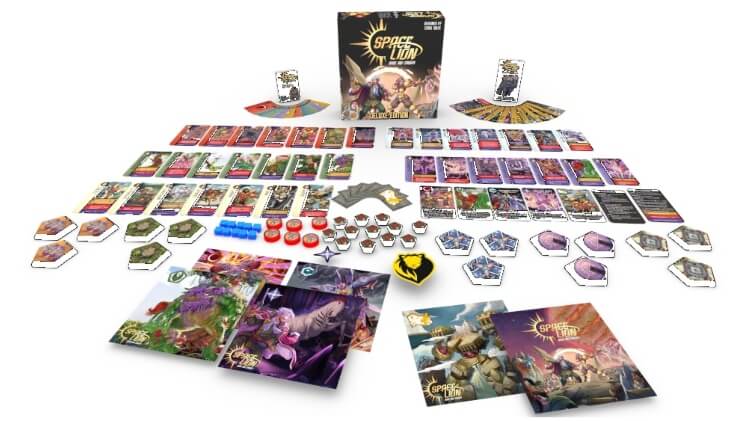
Players go around the table playing one card at a time until everyone passes or has four cards out at battlefields. Then the starting player for that round chooses which battlefield to resolve first, which can be one in which they don’t have any units deployed. The players at that site use any powers on their cards, and the player with the higher strength wins a medal, which is worth one victory point. The starting player then works through all of the battlefields, one at a time, as some cards will affect subsequent battles or can even be moved to a different field after their original one is resolved. Some cards return to your hand at the end of the round, while others are “destroyed”—including any cards played to a battlefield with another card present—and become unavailable for two rounds.
There are a lot of rules buried within Space Lion because almost every card has some sort of unique action or power, often more than one. This wound up wearing me down because of the number of times I had to look up a term or try to find an answer online just to play a simple two-player game. The rulebook does have a two-page glossary that covers the main terms, but the text on the cards is terse—I assume to preserve space and make sure the font wasn’t too small—and as a result there are still a lot of card actions that I at least found to be unclear.
The five armies in the game are all different in pretty fundamental ways, so your experience playing each of them will vary widely, and you can find the army that best suits your style. For example, the red army is a heavy military one, going for strength over finesse, while the green army gets to place kudzu tokens that make some of its units “persistent,” meaning they stay put after the round rather than returning to your hand or to your board. You also can tweak your chosen army in each game with your choice of lion: You get to replace one of your seven base cards with the matching lion card, a more powerful version of the card at the same strength.
I like many capture-the-flag games, including Battle Line, Air Land & Sea (probably the best comp I have for this game, although that game is wonderfully simple), and Riftforce. Space Lion designer Chris Solis is clearly trying to do something much more ambitious here, and this could easily be a platform for future expansions with new armies; he’s also used the same framework in the earlier game Pocket Paragons and last year’s The Massive-Verse Fighting Card Game, both of which are two-player games that take about 10 minutes to play. It makes sense that he’d want to try something grander, and Space Lion’s ambition and scope are admirable; it’s just a little too fiddly on the table to be all that fun.


 Keep scrolling for more great stories.