Resident Evil leaves the door open for more traditional, game-centric sequels

Zach Cregger's singular series reboot isn't quarantined by its downer ending.

Resident Evil leaves the door open for more traditional, game-centric sequels

Spoiler Space offers thoughts on, and a place to discuss, the plot points we can’t disclose in our official review. Fair warning: This article features plot details of Resident Evil.

From the first announcement of Zach Cregger’s Resident Evil reboot, he’s been adamant that his film will not be “obedient to the lore of the games” and instead will “tell a story that feels authentic to the experience” of playing them. As Cregger spent the final weeks leading up to release pleading with gamers to give the film a chance, those same fans missed the second part of his intent: To tell a story on the periphery of the games. He succeeded, delivering a film that not only serves as a sideways companion to the first three Resident Evil games, but one that could also serve as a prequel to a more traditional take on the franchise. Gone is the sprawling sci-fi soap opera of the Spencer family, of Albert Wesker, and of Chris and Claire Redfield’s reunion. But that doesn’t mean these couldn’t eventually happen. While it might be game over for Bryan at the end of the movie, Resident Evil leaves things at the moment of open-door calamity, when containing the outbreak becomes impossible.

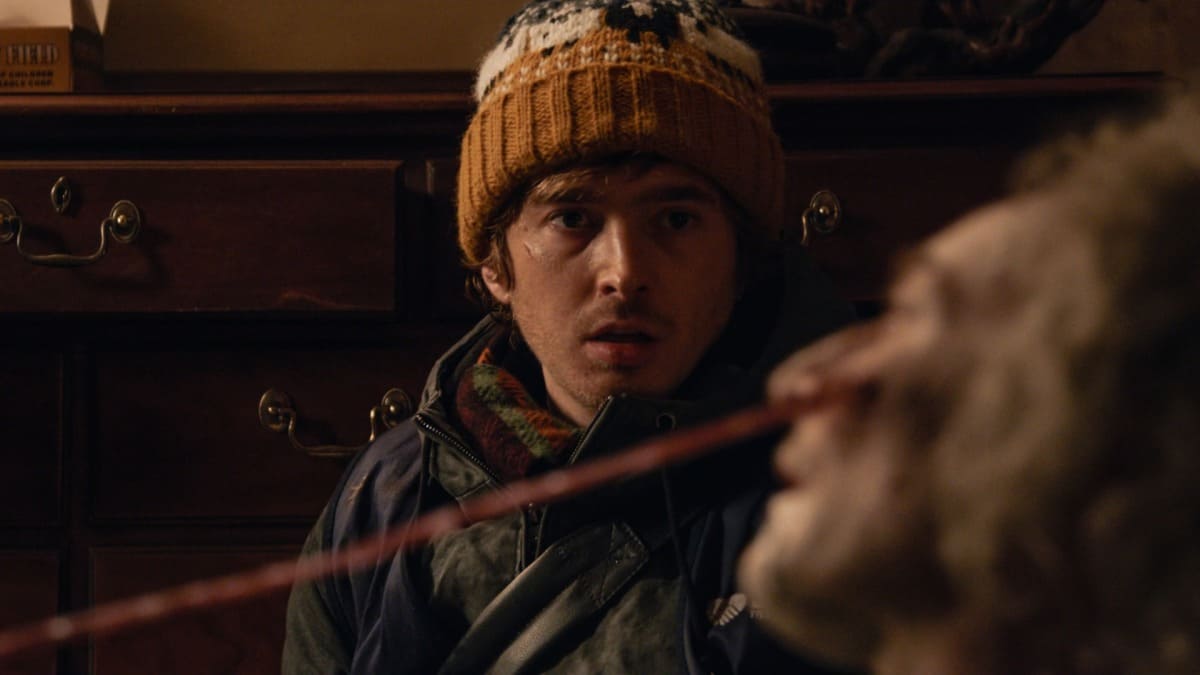
For his version of Resident Evil, Cregger follows medical courier Bryan (Austin Abrams), a self-described glorified Postmates driver who sucks at guns—the kind of underappreciated worker who might’ve been labeled “essential” during the first days of the COVID pandemic. He’s a far cry from the S.T.A.R.S. of the game or the superheroic Alice (Milla Jovovich) from Paul W.S. Anderson’s Ozzfest-infused take on the series, though plenty of elements from Resident Evil‘s games pop up throughout the new film. 

There’s First Aid Spray in the barn, a typewriter in an office, and a distinct lack of bullets that will surely trigger some gamer PTSD. Structured like most Resident Evil games, the film moves from mundane horror settings through subterranean layers before landing in a pristine white lab, where keycard fetch quests and mixing the right chemicals are paramount. There’s even the inevitable exposition dump, which comes halfway through, when Umbrella Corporation scientist Paul (Paul Walter Hauser) and special-ops soldier Maxine (Kali Reis) pick Bryan up and give him a ride downtown. These two characters tell non-players everything they need to know about the gist of Resident Evil‘s plot: An evil corporation lost control of a virus, and now they need guys with guns to clean it all up. 

The difference is that Bryan isn’t a typical Resident Evil hero. He’s one who (kind of) survives the night by sheer luck, bolstered by his determination to get a signature for the Umbrella Corporation’s antidote he’s carrying over his shoulder. Until the very end, that is. Much like fan-favorite character Leon Kennedy in Resident Evil 4, Bryan has a ticking clock in Resident Evil: He’s been infected and needs a cure to stop the spread. Like many players before him, he fails. Instead of a “You Are Dead” chyron, though, Bryan transforms into a monstrous beast with a giant claw hand and a big red eye popping out of his shoulder, like Resident Evil 2‘s William Birkin. In the climactic battle between Bryan and the Umbrella lab rats who must vaccinate him, you can practically hear the audience scream, “Shoot him in the big red eye!” Alas, Monstro Bryan survives to eat another day as the choppers, presumably loaded with S.T.A.R.S. operatives ready to take their shots, swarm around him.

Cregger’s previous horror features, Barbarian and Weapons, end on notes that ask how people can move on from these experiences. Resident Evil is much more apocalyptic, rolling the credits as the virus infects what remains of Raccoon City’s human population. “I wanted to construct a story that could live in the world of Resident Evil and kind of be on the periphery of the events of Resident Evil 2,” Cregger said, “where Raccoon City is having its big night, but tell just another story that could be happening in parallel.” 

It recalls The Fellowship Of The Ring co-writer Philippa Boyens’ response when asked about Tom Bombadil’s absence. “If you look at the edit, we don’t know that they didn’t go into the Old Forest. We don’t know that they didn’t meet Tom [Bombadil],” she said on the film’s making-of featurette. “We just don’t mention it. It’s left untold, is how I like to conceive of it.” Who’s to say that across Raccoon City, while Bryan clears sewers and scales elevator shafts, Jill Valentine isn’t putting her lockpick to good use? Cregger’s version doesn’t negate the wider, more faithful Resident Evil universe. The chance to tell a more straightforward adaptation, hopefully with Cregger’s immersive visual style and biting humor, is still on the table.

There are still plenty of stories to tell, even ones that use characters from the games. After Bryan’s final transformation, he drops the single syringe of antidote from a great height, making this film an apparent one-and-done. There’s no reason to continue following him. That is, unless this Resident Evil follows the footsteps of Resident Evil 2 and a woman—perhaps the girlfriend who may or may not be pregnant with Bryan’s child—comes to Raccoon City looking for him.

 
Join the discussion...
Keep scrolling for more great stories.