Movies used to have games. For roughly 25 years almost any action, sci-fi, fantasy, or kids film released by a major studio arrived alongside a video game—and often several different games, individual titles custom-built by different development teams for arcades, computers, and whatever consoles and handhelds were popular at the time. There’s a whole weird subgenre of ‘80s and ‘90s games named after R-rated movies and then marketed towards kids who theoretically couldn’t watch them, including one inexplicably based on Oliver Stone’s Best Picture winner (and profound bummer) Platoon. Hell, you’d need one of Stone’s conspiracy boards to keep track of all the different games based on Tim Burton’s first Batman movie and their related studios, publishers, and platforms.
Despite their ubiquity, very few of these games were actually all that good. Typically that was a result of tight schedules with hard deadlines, along with the belief that the movie’s name will sell the game, so, uh, why bother? And game studios were also often limited in what they knew about a film they were adapting, leading to games that didn’t always reflect a movie’s plot or aesthetic. The best-received movie games tended to be ones that were either made well after the movie had been released (like the series of Star Wars platformers released in the early ‘90s) or that focused tightly on a specific scene or concept from a movie—like the dogfighting in the original Star Wars arcade game, or the four minigames found in the Tron arcade game (the rare movie game that’s better than its inspiration). A movie license didn’t guarantee success; some of these games flopped, some sold extremely well, some supposedly got buried in a landfill in New Mexico. But when one hit it could be incredibly lucrative, and awareness was ensured by the movie marketing, so they remained a constant, steady part of the game biz for almost three decades. And then, with an increasingly bad rep causing increasingly soft sales, they largely stopped getting made around 2010 or so.
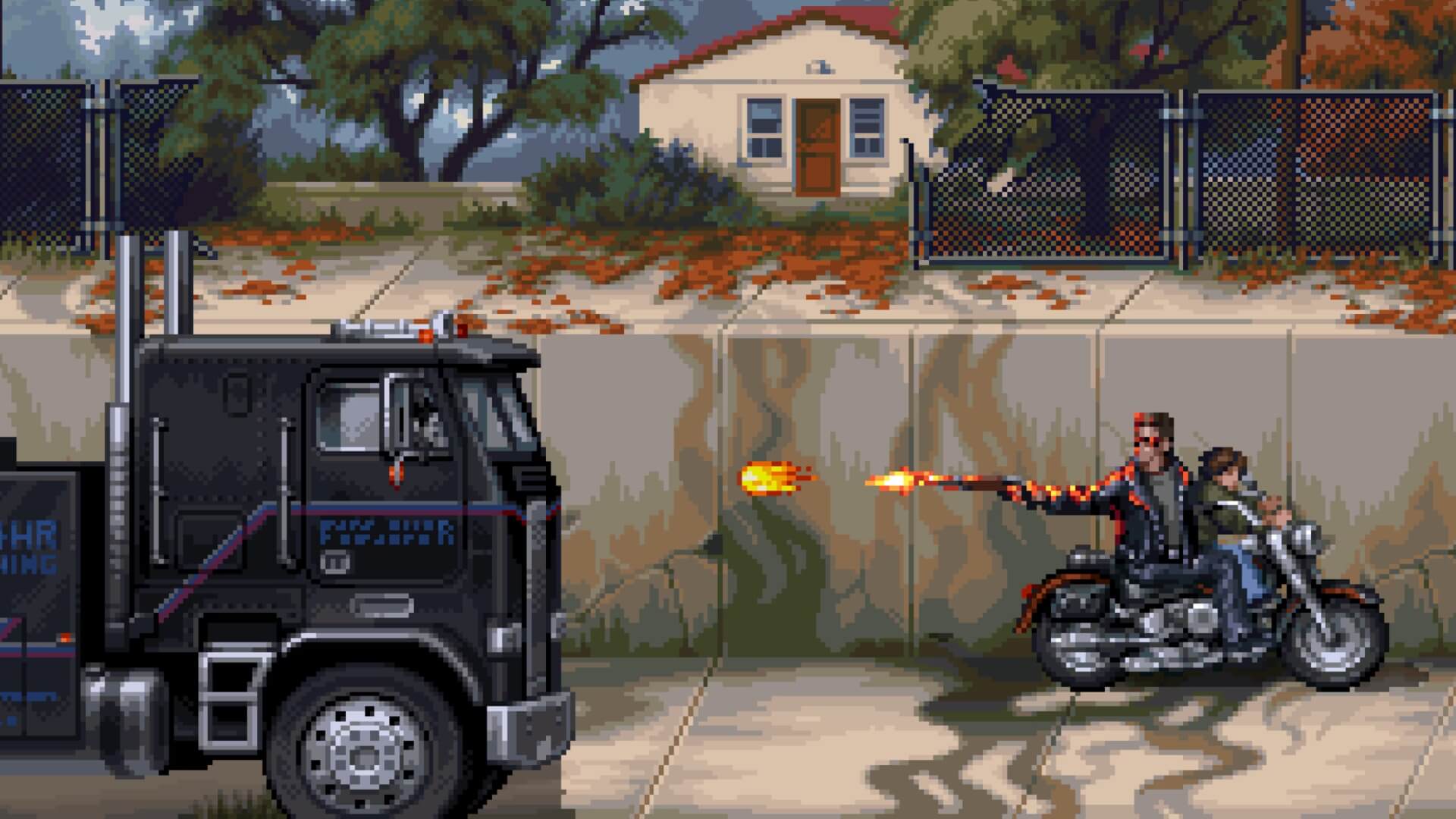
If more of those games were as good as the brand-new Terminator 2D: No Fate (out now for PC, PlayStation, Switch, and Xbox), perhaps this practice never would’ve ended. Bitmap Bureau’s game translates 1991’s mega blockbuster Terminator 2: Judgment Day into a tribute to the arcade games of that era, breaking the film’s plot into a dozen levels that reflect a handful of genres that kept the quarters flowing around the time the movie was released. Mostly a run ‘n gunner that evokes Rolling Thunder, Contra, and Gunstar Heroes, it briefly turns into a car action game during the chase through the Los Angeles River and a Double Dragon-esque beat ‘em up during the biker bar brawl. (In a fantastic touch, that fight is soundtracked by Dwight Yoakam’s “Guitars, Cadillacs” and George Thorogood’s “Bad to the Bone,” just like in the film, and complete with recognizable background characters from the scene, like the woman dancing at the jukebox and the cowboy-hatted barfly.) It’s proficient at everything it tries, and genuinely feels like it’s from the era it evokes; if you told people who didn’t know better that it really was released in arcades 35 years ago, they’d have no reason not to believe you.
Faithful adaptation isn’t what makes No Fate interesting, though. Instead of just recreating the vibe of an early ‘90s arcade game, it also represents an alternate direction for movie tie-ins by letting players change the story at two different critical junctures. If this had come out in 1991 it would’ve been like a precursor to Bioware RPGs and their litany of choices. By diverging from its source material No Fate engages with it at a deeper level than the movie games of old, interrogating the movie’s themes and letting players question the actions of its characters in a way that doesn’t happen when you’re just following the script. It also clearly marks it as its own independent work, and not just an interactive regurgitation of James Cameron’s blockbuster. If movie tie-ins had been more permissive in letting players change the story, perhaps they wouldn’t have disappeared so thoroughly.
You have to complete the story mode once to unlock this option, so even if you haven’t seen the movie you’ll still know how its version of this story ends. If you take the time to replay it, though, and decide to send Sarah Connor down different paths, you’ll find a few different conclusions. It’s somewhere between the wishcasting of fan fiction and the alternate endings on a Blu-ray bonus menu, given at least a little bit of weight by the officially licensed digitized likenesses of Linda Hamilton, Edward Furlong, and Robert Patrick. And it represents not just different variations on this one movie, but an alternate path the entire concept of movie tie-in games could’ve taken if they hadn’t vanished.


 Keep scrolling for more great stories.