Sitcoms made under Tina Fey’s Little Stranger banner don’t short audiences on jokes. Shows like 30 Rock, Unbreakable Kimmy Schmidt, Great News, Girls5eva, and now The Fall And Rise Of Reggie Dinkins share various DNA strands but invariably allow the writers to stretch their comic world wherever their outsized comic leads inspire them to go.
It’s a fruitfully elastic reality where grounded emotions and real-world concerns are built on Silly Putty, so that an aging girl group can deconstruct music business sexism while occasionally banging their shins against an invisible grand piano and an indeed unbreakable former child kidnap survivor processes unthinkable trauma in an impossibly illegal New York City apartment with painted dirt floors and cardboard walls.
In the sitcom Fey-verse, nothing is as important as the jokes, though. The Fall And Rise of Reggie Dinkins has, in just its first two episodes, set its sights on issues like America’s hypocritical embrace of professional sports gambling, the trap of celebrity entitlement, the public’s hunger for the blood of entitled celebrities, and more. But it’s also a laugh machine where conflict sparks absurdist asides like the esteemed Rutgers University so indulging its legendary football hero’s malapropisms that its staid Frank Stein lecture hall was renamed Frankenstein Hall just to keep Reggie Dinkins happy.
Reggie Dinkins’ briskly premise-setting pilot ended with the three main characters on the same page for their own reasons. Reggie promised to abandon his top-down management of filmmaker Arthur Tobin’s documentary about his career, the two similarly disgraced former award winners instead teaming up to tell the unvarnished truth about Reggie’s gambling-inspired downfall. Meanwhile, Reggie’s ex-wife and aspiring sports super-agent Monica declared her plan to set aside suspicions that Arthur’s goal was to humiliate her childhood sweetheart and current meal ticket.
Of course, there’s a lot of room on a blank page, and “Nittany Means Big,” which was written by Phil Augusta Jackson, sketches out the still-wide spaces separating the three partners’ plans. Reggie may have promised nothing but the truth, but for him that means greeting Arthur’s arriving cameras with the spectacle of him preparing a wholesome family breakfast in a tuxedo. Reggie has also cribbed another 30 Rock joke strategy to excise any missteps like him burning his enormous breakfast turkey by playing un-clearably expensive music on his phone. (The ensuing “Beatles” track—presumably written by Mr. Fey himself, Jeff Richmond—plays out to the grudging Arthur’s giddy delight, signaling that the series once more exists in its own alternate reality.)
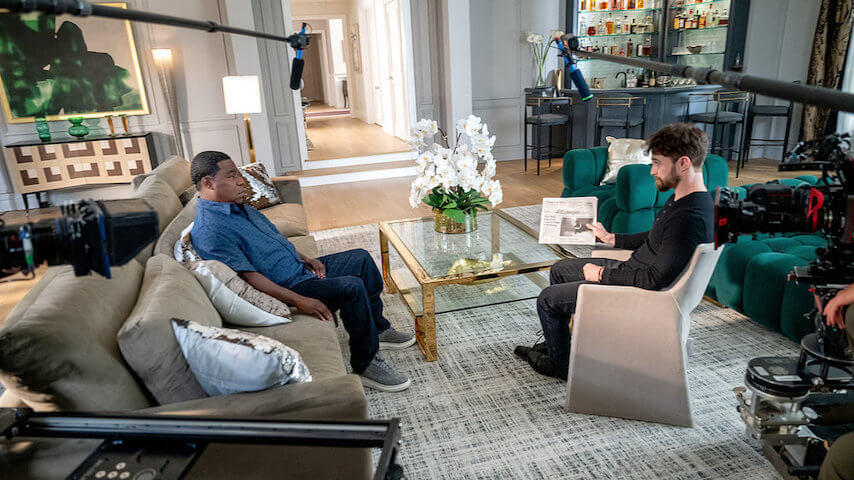
Arthur himself reveals that Monica’s initial assessment of him as a “a sneaky little travel-sized punk ass” (her unspoken words) might not have been entirely wrong. Daniel Radcliffe has the daunting task of playing Tracy Morgan’s straight man, but the actor, as he showed in his go-for-broke roles in the ambitiously loopy Miracle Workers, is more than capable of holding his own amid absurdity.
Playing the uptight British artist allows Radcliffe to revel in Arthur’s social stiffness (his effortful “my dudes!” greeting to Reggie and Monica segues to an immediate apology) against the filmmaking wiles he smugly confides to his unseen crew. (The way Reggie unexpectedly echoes the gloating Arthur’s use of the word “fingies” later in the episode is another signature Fey-verse touch.) The joke that Arthur’s self-satisfied jazz scatting assessment of his interviewing skills is cut short by his own cameraperson underscores how shaky his control actually is.
Erika Alexander’s Monica, for her part, has the trickiest role to play. A formidable enough woman to wait out the expectant Arthur’s attempt to shame her into a confessional (a gloriously extended silent stare-down) and do business with the man who threw her over for a younger, less complicated mate, Monica, in this second episode, is also the one to let slip that Reggie’s first, headline-grabbing feat of gridiron heroism wasn’t all it was cracked up to be.
As we learn, Reggie had a Michael Jordan-esque “food-poisoning game” in college, where he ran for 229 yards and three TDs while ostentatiously barfing into his helmet on national TV. Except that Arthur, through Monica’s careless finger (sorry, “fingie”) quotes and a deep dive into self-appointed Reggie Dinkins archivist Rusty’s memorabilia collection, discovers the truth: Reggie’s public illness was caused by a prank gone wrong. Reggie led his Rutgers teammates to disastrously steal opponent Penn State’s very real Nittany Lion mascot, resulting in him swallowing a gallon or so of Pennsylvania river sludge as he swam to safety.
Like Reggie’s gambling, this revelation signals just how dark The Fall And Rise Of Reggie Dinkins seems prepared to go. Just as the pilot maintains that Reggie’s bets were all on himself to succeed, this initial pinprick to the star’s inflated legend similarly suggests that Reggie Dinkins isn’t so bad. A subplot about Reggie’s bafflement at wife Brina’s sudden silent treatment is resolved by Reggie’s realization that his lifetime of unconditional adulation has made him thoughtless (and very, very bad at apologies).
It’s another feint toward the show’s teardown of wealthy celebrity privilege, with the clip of Reggie’s 2005 on-air mea culpa for getting caught gambling amounting to the ever-familiar (if Tracy Morgan-flavored) “I’m sorry if I offended you” cop-out. (Reggie, as is his way with everyone in his life, immediately presents the female journalist interviewing him with an expensive purse.)
Retreating into his signature defensiveness upon learning Arthur has found out the truth, Reggie launches into a tirade as self-serving as it is essentially on point. Accusing Arthur, Reggie booms, “The only thing this country loves more than a hero is tearing one down!” even as he indicts leagues for suddenly embracing the billions in gambling revenue they once viewed as anathema to pro sports’ integrity. Reggie quoting Gladiator in regard to his plight is self-serving hyperbole (trusty Rusty helpfully IDs “Are you not entertained?” for the cameras), but he’s not wrong in a world where we absolve our hometown sports figures for anything—as long as they keep risking their safety to thrill us. Arthur’s comeback hinges on leveraging our collective lust for tell-alls about those we once showered with our unstinting love and loyalty once they’ve lost their usefulness.
All in all, The Fall And Rise of Reggie Dinkins has charged into its first two episodes with the expected assurance considering who’s involved. Tracy Morgan is playing yet another spoiled, out-of-touch, vaguely unstable superstar, but nobody does that better. Reggie’s desperate efforts to understand how his forgiveness strategy “non-apology plus lavish present” stopped working is Morgan mining familiar turf, sure. But since he brings back gems, it’s tough to argue. When he starts his real apology to Brina with an elaborate sports metaphor and gets lost (“All I was ever taught to do was to run forward, unless I had to go lateral or backwards to evade a defender. Or a flea-flicker…”), his impatient “It’s coming—let me cook!” distills Morgan’s unique greatness to its essence.
Stray observations
- • Like the nonexistent Beatles track, this episode’s reality insists Penn State actually totes a real lion to every game.
- • Bobby Moynihan’s Rusty is truly the best best pal a needy millionaire like Reggie could ask for, just as Moynihan is a perfect foil for SNL pal Morgan. If Reggie’s a loose cannon, the barnacle-loyal Rusty is the cannon precariously strapped to its back. After Rusty rides Reggie’s outrage to a wild-eyed, on-camera threat to murder viewers, Reggie pleads, “Where’d you go? Come back!”
- • When Reggie imperiously snaps, “TV off,” it’s Rusty who, with an apologetic look to camera, actually clicks off the remote.
- • Rusty also falls immediately for Arthur’s “wait them out” interviewing trick, bursting into tears and impromptu rap-rock dis tracks.
- • Arthur reveals that Monica was a “Quincy Magoo scholar” at Rutgers, apparently named for the school’s most famous alumnus.
- • Alexander’s glare in response to Arthur’s smug “I respect a contemplative queen” is transcendentally Monica.
- • Arthur finally catches Monica off guard by touring her old, un-gentrified playground, which was landmarked (by the New York Parks And Rec Department) because Nas lost his virginity on the seesaw…after the release of Illmatic.
- • Radcliffe and Alexander’s wary banter is great. “I talked to your cousin.” “The nurse or the bitch?” “I couldn’t get in touch with the bitch, but…”
- • Although he hasn’t had the most to do as yet, Jalyn Hall makes Carmelo’s knowing navigation of his father’s erratic love promisingly funny, as when he happily reveals his parents divorce netted him a working crossbow. (“I was five!”) And his musical “No no no no noooo,” in response to Reggie’s late-episode inconvenient enlightenment is just right.
- • “After the whole gambling thing, I begged for forgiveness and what did it get me? Time’s Man Of The Year.” Cut to Time‘s cover including the subhead “(But Like When We Gave It To Hitler).”
Dennis Perkins is a contributor to The A.V. Club.


 Keep scrolling for more great stories.