Audiences want real movies, real big

The hottest tickets in town are for sold-out IMAX 70mm shows. We went to the experts to find out why.

Audiences want real movies, real big

Since the impressive opening weekend of Christopher Nolan’s The Odyssey, dedicated cinephiles and curious onlookers alike have filled auditoriums across the country to see Matt Damon make his way home again. But some faithful film diehards will say there’s only one way to see The Odyssey, and that’s in IMAX 70mm, a format so specialized that it’s only available in 41 locations worldwide. It’s a scarcity that has inspired pilgrimages to these scarce few theaters, sometimes in the dead of night to get one of the last seats available at a 3 a.m. screening. It’s become the social event of the summer for the Letterboxd crowd who are eagerly checking out the various formats the film is available to watch (and logging it on a digital punchcard), but there are also plenty of late shift workers and culture vultures who are just curious to see what the fuss is all about. Dozens of videos and news stories document these moviegoers’ odysseys to watch Nolan’s new movie, invested in the unique experience of watching one of the summer’s biggest movies in as big a way possible.

Part of the fanfare around The Odyssey is that Nolan’s film is the first feature-length Hollywood film shot entirely in that format (Wings Of Courage was the first narrative short back in 1995). Rather than blowing up the image to that size or shifting the aspect ratios between action and dialogue scenes, it’s all natively shot in that towering 1.43:1. Taylor Umphenour, a projectionist with over 20 years of experience playing IMAX film, is splitting his time showing The Odyssey between the Alex Theater’s newly restored 70mm projector and Universal Citywalk’s IMAX 70mm screen in Los Angeles. He explains that the format captures much more visual detail than what we normally watch at the multiplex.

“With IMAX 70mm, you’re getting an image area in terms of projected film that’s three times the size of conventional 70mm film and 10 times the size of 35mm film,” Umphenour tells The A.V. Club. “Light bounces off the actor’s face, exposes the film that goes into the camera, and that physical negative is then used to make a contact print that we then put into the projector to project for you. It’s first generation. The clarity that that brings, the analog color is something that is completely immersive. It’s an incredible experience. I’m seeing people leave the theater deeply moved by the film and totally transported by the format.”

“It’s not a bunch of pixels, and that’s why a lot of people actually are returning to film,” Greg Ciaccio, VP Post Production at IMAX, tells The A.V. Club. “Our format is obviously the highest end of that, and it’s not for the faint of heart, but those that drive Ferraris know that that’s one of the nicest cars out there. It’s the same kind of thing. You get this really elegant, beautiful image that’s also full of film color and high resolution.” 

The mechanics of shooting on film are different from shooting digitally, and so is the projection. Digital projectors haven’t caught up to the output capabilities of the IMAX 70mm projectors, so the image quality, details, colors, and shadows are higher than even standard 4K projection.

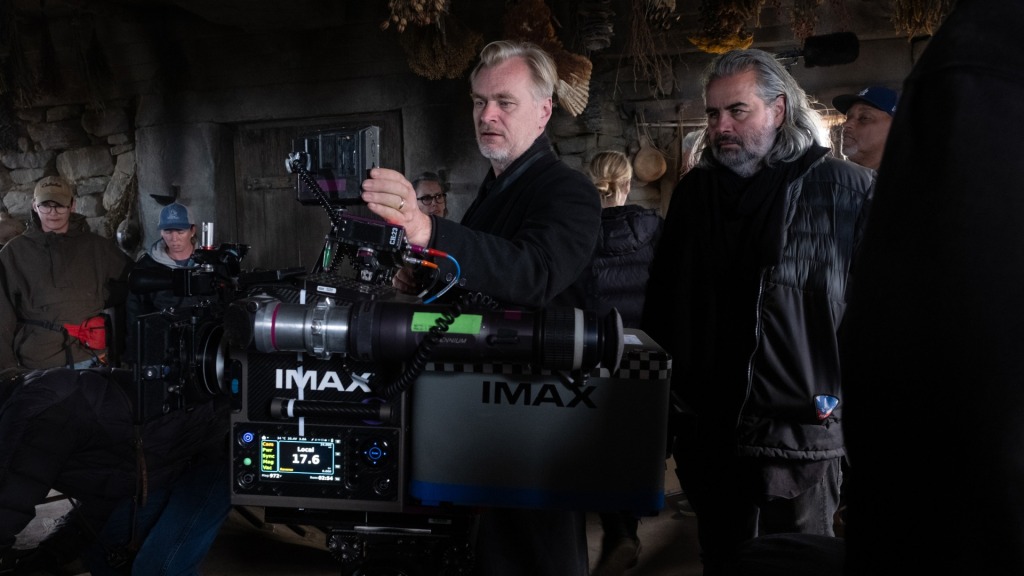
Nolan began experimenting with IMAX 70mm as far back as The Dark Knight, and became an evangelist for the format’s capabilities. Part of The Odyssey‘s marketing outreach pitched audiences the novelty of seeing it in this premium format—the way it was meant to be seen, which, despite the memes, isn’t on an Apple Watch or Game Boy. Promotional videos feature behind-the-scenes footage of how Nolan and his crew met the challenges of shooting with reels of film that could only capture three minutes of action at a time. Months ahead of the film’s release, Nolan led veteran news anchor Scott Pelley through the process of making a movie on this bulky format, using a “blimp” to cover the noisy camera to drown out the noise that would interrupt dialogue, setting up mirrors so that the actors could perform with one another, and cutting film by hand the way it was done for most of the medium’s history. Ciaccio points out that the Keiley Camera, at a spry 55 to 60 pounds, is manageable enough to be handheld, capturing what a more traditional 300-pound rig couldn’t previously film in the format. 

When a filmmaker decides to go the IMAX route, Ciaccio says that the company joins in pre-production, seeing the project through to when it hits the screen, keeping technicians on set to handle the large film format and assisting theaters whenever technical issues arise. “To be honest, I never thought in this year, I would be working way more in film than I ever did in my life,” Ciaccio says. “It’s a nice return to the original craft. Because it’s expensive, because of the process, you need to make sure you’re buttoned down as much as possible. If you know that this is something that’s challenging, you’re going to be very intentional and your actors are going to come completely ready to go, because they know that as soon as they hear that camera turn on and you hear that, you know that’s money.”

Despite the boom in demand for IMAX 70mm screenings, theaters won’t be able to add them into their multiplexes so easily. Some theaters are simply not big enough to accommodate an IMAX-sized screen, and there is a finite amount of projectors and vintage equipment to go around. “These are very complicated systems, which is just a function of the analog dynamic,” explains Umphenour. “When you’re projecting an analog film print, you’re by definition dealing in the mechanical world, and you’re dealing with hundreds of moving parts that all have to be perfectly tuned and calibrated and synchronized together so that you can have an outcome that is going to be what people deserve when they come to those shows.” 

There’s also the matter of the trained projectionists who can handle the delicate mechanisms and the 11 miles of giant film. “When I train people and I talk to people about this, the projectionist is that last crew member to take the vision and deliver that to the audience in the way that they deserve to experience it,” Umphenour says. “There’s a lot of discipline that goes into doing this and doing it consistently well, but it’s also very rewarding because it’s a very special thing, particularly now.”

The combined novelty of the rare format, the studio-driven awareness campaign about watching the film in this way, and the social media FOMO around this extremely limited viewing option has created a wholesome cinematic craze not seen since the summer of Barbenheimer. “It’s not something that you can just go see anytime you want,” Ciaccio notes. “Everyone around you in that theater is having a communal experience. You all know that you’re here to see something special and hear something special. They do feel like this collective. You’re there at three in the morning, you think everybody will be ready to fall asleep, but in all the accounts and reviews I’ve read, people are so excited to be there at any hour, really.”

Whenever the sun sets on The Odyssey‘s sure-to-be-historic theatrical run, big event tentpoles that make use of the higher image quality, screen size, and surround sound won’t be going anywhere. After all, Dune: Part Three is on the horizon. While the theatrical locations are limited in their ability to expand, audience demand can keep movies in these premium formats on screens for far longer than usual, as seen in the staying power of last year’s Sinners and One Battle After Another. “We want people to see the movie. We want people to see the format,” says Umphenour. “It’s funny because I know that there’s been so much demand for tickets in this format that people have become frustrated that they want to see it or they want to see it again. But we want them to see it as much as they want to see it.”

 
Join the discussion...
Keep scrolling for more great stories.