Two historical Christian musicals are in theaters, but only one seems to have faith

Despite their surface similarities, David and The Testament Of Ann Lee present opposite views of religious belief.

Two historical Christian musicals are in theaters, but only one seems to have faith

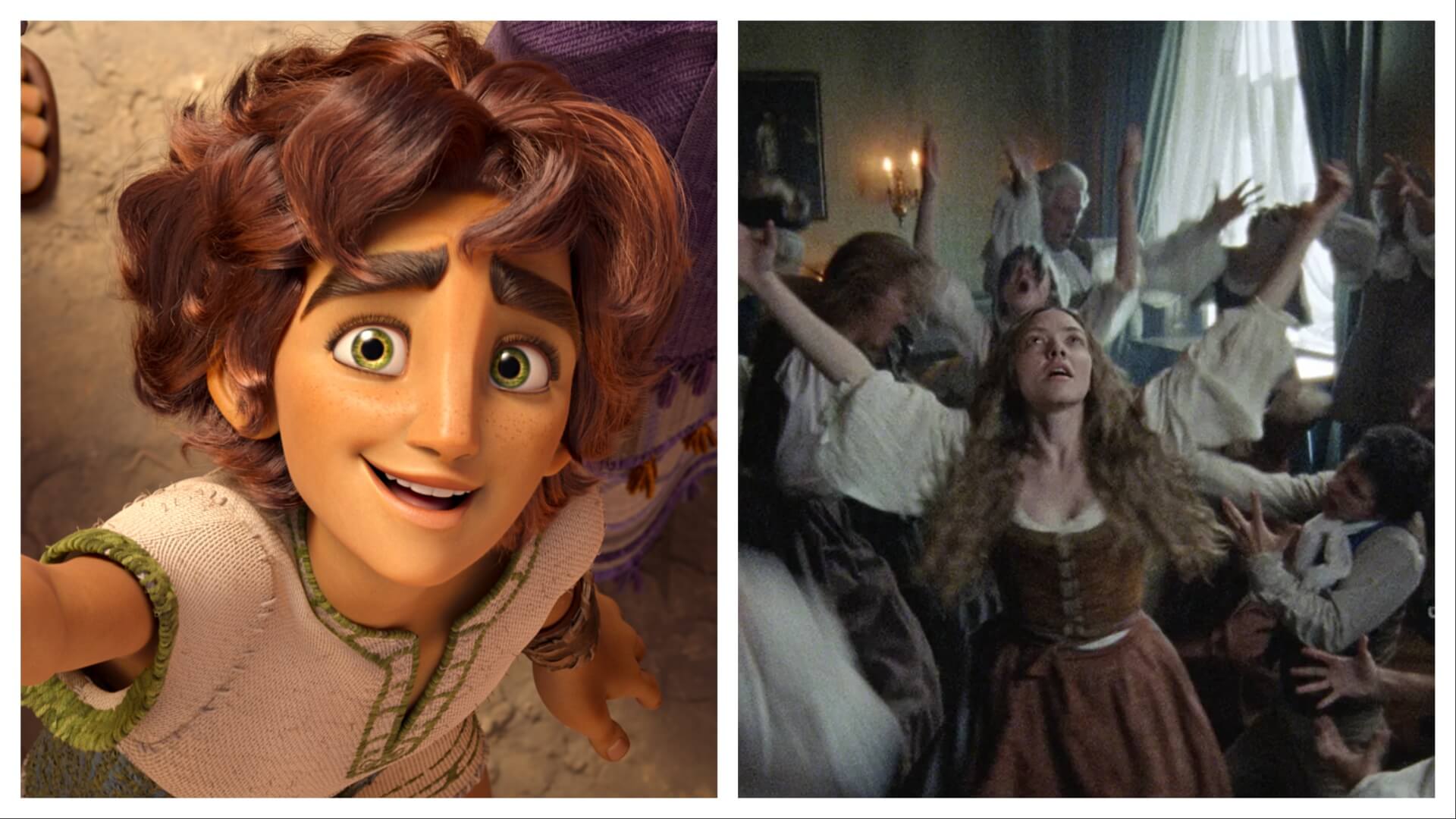
The Testament Of Ann Lee picks up where 2009’s Antichrist left off: a wave of innumerable women saunter through the woods in a beautiful, haunting, mysterious manner. But the singing women of Ann Lee are less threatening and more imperiled than those ascending and descending in menace upon Willem Dafoe. Where Antichrist‘s flood of women—walking plainly, without faces, shaking the woods around them through sheer numbers—find exactly what they’re looking for, Ann Lee‘s women are few and far between. As they walk in dance like the Shakers they are, they bear the signs—scarred visages and plucked-out eyes—of a life lived in pursuit of something ultimately unaffirmable despite their devotion: faith. Joining the film in theaters is David, the animated musical adapting the biblical story of the boy who defeated Goliath, freed his people from the Philistines, united the tribes of Israel, and reigned King. The film takes an approach to Christian history that, in its supernatural nature, aligns more with the fabled bent of Antichrist than the beleaguered Ann Lee. In doing so, it strips faith of its purpose. 

David is the second animated release from Angel Studios this year, which represents a larger Protestant movement to depict crowd-approved, faith-based stories that make Christian viewers feel good, no matter how unreflective of their experience. And it’s only growing. Their first 2025 film, The King Of Kings, made $80 million at the box office, a number bound to dwarf the earnings of secular indie Ann Lee. (David, after one weekend, has already made $22 million.) 

In an unintentional and unconventional showdown for the ages, the R-rated Testament Of Ann Lee and family film David will compete for space in American movie theaters at the same time in an incredibly niche category: musicals about historical Christian figures. They couldn’t be more disparate. One is made by a nonbeliever (Mona Fastvold) who respects her subjects enough to depict religious belief—in all of its tragedy, purpose, and hope—without demeaning it. The other is made by staunch believers (Phil Cunningham, Brent Dawes) who can’t help but demean religious belief by insisting upon its perpetual validation—a falsehood about faith that, if true, would render it worthless. Faith isn’t required to believe in what’s visible and tangible. That’s merely observation.

In David, faith is affirmable and easy, because miracles abound. Religious devotion is made simple and clear, presented didactically as a fabled iteration of piety. Ann Lee details the supposed miraculousness of its lead in the opening narration (“Ann Lee, a miraculous person, was born in Manchester in the year 1736…”) but makes a point to testify to the lack of miracles that occurred around her, the lack of teleological affirmation in her faith journey. In Ann Lee, the nature of faith rings true, in that she and her followers must keep it to their final days without corroboration. Which movie, then, accurately reflects a faith experience derived from the human condition? Which truly seeks an understanding of purpose opposed to inculcating one impervious to questioning? 

Faith is a chimeric experience for the visionary Ann Lee (or Mother Ann, as her devout followers call her, in recognition of their denomination-identifying belief: she is the Second Coming Of Christ, in the form of a woman). Belief is a great hope that can’t be confirmed or achieved and, thus, necessitates faith. On the flip side, David champions faith through miraculous affirmation. In that sense, both films embrace a mythology. David‘s chimera is the miracle; Ann Lee‘s is the concept of a miraculously affirmed faith. But it’s the faith-based film that delegitimizes its own pursuit and casts religious devotion in a light that couldn’t be less relevant to the human experience. If the stories and experiences of David are what Christians should hope for, their lives will look more like the tragedy of Ann Lee’s than the triumph of David’s. And who would yearn for the horrific life of Ann Lee? 

If this is what people of faith have to hope for, then what hope is there in faith? It’s the courage, the endurance, the persistence of Ann Lee through trauma and mundanity that gives the faithful something to hold onto, the closest thing to a miracle that can actually exist: faith in spite of divine affirmation. She personally experiences divine affirmation, but her eschatological views are never confirmed for her community. Quite the opposite, in fact: The Shakers are pillaged, beaten, and jailed and must hold strong if they mean what they say. One gets the sense that David and the Tribes Of Israel would only make it halfway through an Ann Lee-esque experience before abandoning the faith entirely.

While the Shakers’ devastating devotion is reflective of a real faith experience, there’s little to aspire to in Ann Lee and her attempt at a Utopian religious society, other than the perseverance and determination she possesses, detached from faith. Despite her transcendent visions, Ann Lee loses her four children, her husband, her home, her mind, and nearly her entire community. Fastvold makes clear the damage done to individuals and communities when faith is observed to the cultish degree of Ann Lee (or mindlessly adhered to, in a common, modern, Angel Studios kind of way).

Fastvold’s film exemplifies the tragedy of extreme religious devotion as a waste of some of humanity’s strongest and most impassioned people, who in the contexts of human rights or pursuits of law, justice, politics, education, or organization, could’ve been the next Gandhi or MLK, imperfect figures whose faiths were malleable and adaptable enough to take shape around the goal of humanitarian pursuits over inhumane religiosity. Cunningham and Dawes, on the other hand, don’t exhibit a single sticking doubt or ambiguity in their pursuit of extreme devotion through David.

As dueling musicals, the films’ vastly different depictions of faith are best exemplified through their approach to song. For both parties, singing is a profession of faith, but for Ann Lee and the Shakers, the more radical and impassioned their worship, the more violent their consequences and the more staunch their belief. Whether they’re breaking noise ordinances that piss off their neighbors (and, more importantly, the ruling, ecclesiastical Church Of England they want to differentiate themselves from) or spreading their neverending worship across the new American northeast, song results in suffering: prison, deportation, raids, church-burning, killing, and the like. There’s an exigence, a real meaning, to the worship songs of people living out that faith.

For David and his followers—who are enslaved by the Philistines that dwarf them—singing somehow inspires fear in their captors. In contrast, their songs are less passionate, more generic in what they profess, and somehow lead to the enemy’s sudden retreat, guaranteed by miraculous events surrounding their emancipation that parallel those that save them after David defeats Goliath. For the Israelites, sheepishly singing “I will not be afraid” stops swords mid-swing, dissolves the chains around their ankles, and is enough of a faith expression that the words themselves become a miraculous weapon to disarm their enemy.

There’s a weakness of spirit in David‘s songs, an empty simplicity and errant lack of praise that, up against the zealous fervor of Ann Lee’s worshipful community, asks the question: Which of the two parties actually finds meaning in their faith? Who—the Shakers or the Israelites—actually exhibits faith? That’s not to say the Shakers are an enviable breed. Their zealotry is nothing short of cultish. But there’s no questioning their faith, regardless of how one feels about it, or the meaning they find in life through God and song. 

The weak defeat the strong plenty throughout history, that’s no miracle. Angel Studios’ depiction of David slingshotting a rock square into the center of Goliath’s skull from a hundred yards away certainly assures us that it could happen. But the rest of Goliath’s giant army stands armored and poised to attack after Goliath’s death, a surefire impending loss for David. But the sudden arrival of David’s non-militant village people—with sticks for swords and pots for helmets—as an unconquerable force is pure miracle, played as Christian history that believers should find inspiration in. 

In contrast, even the alternate title to The Testament Of Ann LeeThe Woman Clothed By The Sun, With The Moon Beneath Her Feet, a direct quote from Revelation 12:1, which depicts a Mariological figure birthing the Son Of God in agony in the face of a Satanic dragon before retreating to a mythological wilderness (much like Northeastern wood the film opens on)—offers more to chew on scripturally and theologically than the entirety of David’s fundamentalism. As most venerated Bible scholars will tell you, of the Christian faith or not, the tales of Old Testament scripture are not to be read so literally. David likely existed, was King, and other such essential facts that give the stories a historical angle. But said tales’ grandiosity and instructiveness have been forged by the fire of Angel Studios-like storytellers over thousands of years, making them into fables.

If miracles rescued people from their darkest despair, their most hopeless moments, it would be easy to believe. There would be no need for faith. Who wouldn’t sign up for that existential protection if it were a certainty? That’d be like not having health insurance. But without something as obvious as miracles, the concept of faith must embrace ambiguity, doubt, and reality in order to exist. David and Ann Lee might tell dialectic stories of the religious experience, but, ironically, they inspire the opposite of their makers’ worldviews when it comes to finding meaning in faith—one shows admiration for its perseverance and lifelong difficulty, while the other presents it with certainty, a crutch that dismantles the concept of faith altogether. 

Keep scrolling for more great stories from A.V. Club.
 
Join the discussion...