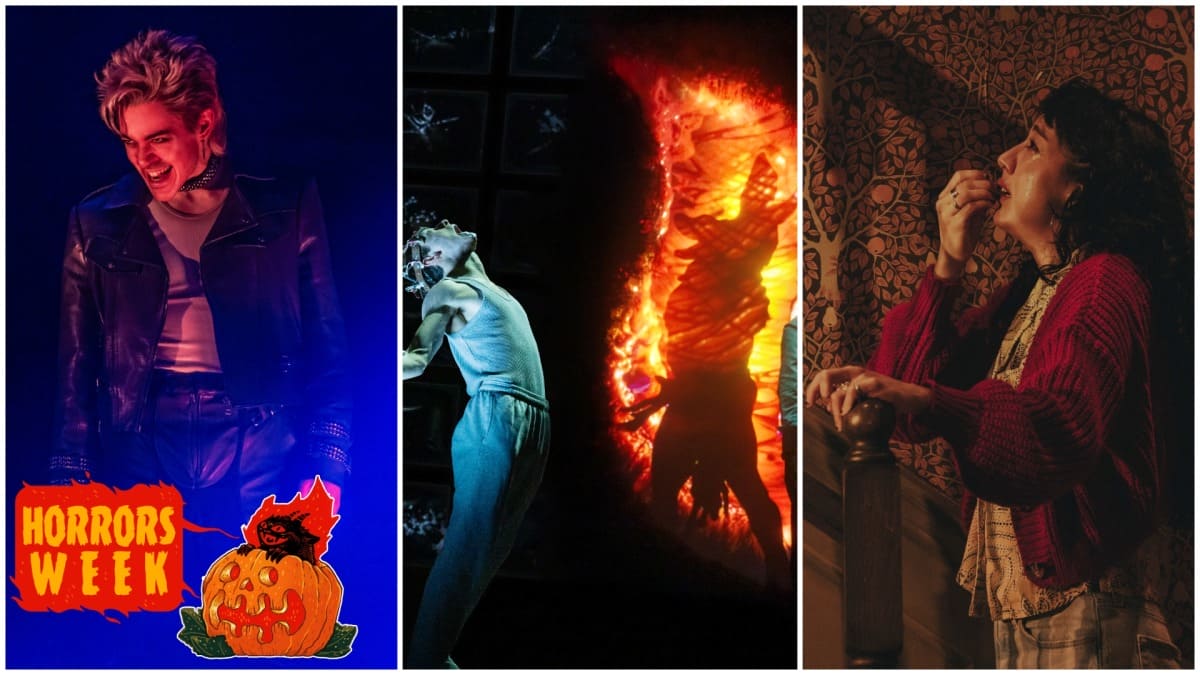
Live theater has never been scarier

Artists both behind the scenes and on stage walk us through how they make the vampires, monsters, and ghosts that make up the current theatrical landscape all feel real.

Live theater has never been scarier

If you go see The Lost Boys at the Palace Theatre, you can expect to see a bunch of die-hard teen fans wearing facepaint and costumes reminiscent of the vampires that populate the show’s ensemble. This was true back in May, before the show became the one of most Tony-awarded new musicals of the year, and their presence has only grown throughout October. “We’ve had truly a wild amount of people dressing up for this,” says Ali Louis Bourzgui, who won a Tony for his supporting performance in The Lost Boys this past spring. First there was New York Comic-Con, and then, with Halloween approaching, fans showed up even more enthusiastically. “One day, I looked out, and the entire front row was people dressed up as all the characters in the show.” 

The fandom around The Lost Boys, based on the cult 1987 movie, is certainly unique; its subject matter less so. In 2026, theater got scarier. We’re not talking about economic models or stunt casting—the literal subject matter of theater is more interested in horror than ever. The 2026-27 Broadway season kicked off with Paranormal Activity, which arrived in New York after successful runs in London and Chicago. Stranger Things: The First Shadow reached Broadway last year after a run in London’s West End, and, next week, 2:22: A Ghost Story will officially open in downtown Manhattan after successful runs in the U.K. and Los Angeles. 

Of course, artists going to the horror well for a stage show is nothing new. The Rocky Horror Show and Little Shop Of Horrors, which both yielded beloved film adaptations and are currently running in New York, drew from the campy horror of sci-fi B-movies. Sweeney Todd, based on a penny dreadful about a barber who murders his clients and bakes them into meat pies to sell to an unwitting public, remains perhaps the most disturbing subject matter for a Broadway musical ever. An attempt to adapt Carrie into a musical in the 1980s was such a misfire that its title became synonymous with “flop” before more successful revisals hit the stage in the 2010s. But it’s hard to imagine a time when horror fans had as many options on stage as they do right now. What stands out about these plays and musicals, too, is how genuinely scary they are. 

The secret to a good portion of that success is Chris Fisher, an illusions designer and director who has worked in the theater for the past 10 years and is responsible for the illusions in Paranormal Activity, Stranger Things, and 2:22. “Anyone can go and buy a magic trick from a magic shop and try and perform it, but the way you get the most out of magic is how it’s presented and how you weave it into the storyline,” Fisher tells The A.V. Club. “That ultimately means working pretty much with every single discipline on the stage, as well as the actors.” The actors may be the ones performing a vanishing act, as they do in Paranormal Activity, or a physical transformation, like they do in Stranger Things, but it’s Fisher and his work with costume, lighting, set, and sound designers that provide a crucial element in helping audiences suspend their disbelief. 

Fisher got his start on stage designing the illusions for Harry Potter And The Cursed Child back when it opened in London in 2016. Since then, he’s worked on everything from the 2022 revival of Company to Back To The Future to recurring collaborations with the Royal Shakespeare Company. Obviously, every production requires something different. For Paranormal Activity, that meant grounding the show in reality in a way that he wouldn’t for, say, a musical about time travel. “I think that’s the exciting thing about this, is that it’s played for reality,” says Fisher. Stranger Things is about monsters, and Harry Potter is about wizards, but Fisher concedes that paranormal activities might be real. “Sometimes, it’s more of an experiential thing than watching a horror movie because you’ve taken the glass away and you’re there. It’s there in front of you. That’s why I love live theater.” 

While Fisher does embrace some state-of-the-art technology in his work—he cites a particular illusion involving a car in Paranormal Activity—he’s skeptical to point to it as the reason for the current success of these shows. Personally, he’s more willing to embrace classic magic tricks dating back to the 19th century and the skill and artistry they require. “I feel very much that at the moment people are wanting to go and be thrilled, wanting to go and be scared,” he says. “I can see more coming in.” Seeing Paranormal Activity on Broadway, which follows a new, different story from the film series, this definitely seems to be the case. Throughout the show, you’re also listening to the audience hoot and holler and scream as if they are really in the haunted house. Sometimes, the screams of horror seem almost indistinguishable from screams of delight.   

This element of the performance is crucial to the artists both on stage and behind the scenes gauging if their trick is working. “I think of it like a comedian doesn’t know how good his jokes are until he puts them in front of an audience,” says Fisher. Part of the process of creating these shows is watching them, listening to the audience’s reaction, tweaking things in tech rehearsals the next day, then putting them back on stage and doing it again. It also points to why these shows might play in so many cities before they make it to a New York audience. With Stranger Things, “we spent quite a long time studying what makes a good jump scare, and timing is critical,” says Fisher. “It’s how long you leave the anticipation of the scare. And, actually, you can leave it a lot longer than you’d think, because that just draws people in. They almost have that moment of, ‘Oh, nothing’s gonna happen.’ Bang! Then it happens.” 

And some of these illusions are good enough to still spook actors who may have been performing them for months. “I still notice new things, and sometimes, I get scared,” says Victor de Paula Rocha, who portrays future Vecna Henry Creel in the Stranger Things prequel The First Shadow. He understudied the role and performed in the Stranger Things ensemble before stepping into the lead part earlier this year. “I’m not going to lie, almost two years in, I get frightened on stage,” de Paula Rocha says. As Stranger Things fans know, the series is not afraid to be kind of gross or loud or to kill off children or animals. On that front, it’s no different on stage. 

But for an actor, it’s not just working with all the effects that come with putting horror on stage. Performing a story about the unnatural, every night, is physically demanding. For his part, de Paula Rocha has to embody a character who’s both somewhat possessed and a scientific curiosity eight times per week, for hours at a time. “It’s a lot of soreness, a lot of physical therapy,” he says. “I felt really sick for a while… It was a shock, a little bit, to the body. It wanted to reject it at first.” However, “There comes a point where your body is just kind of, like okay, so this is what we’re doing now. We’re sweating buckets, we’re doing this.” As far as the audience’s embrace of this show and others rooted in the genre, de Paula Rocha says, “Broadway is changing. We’re pushing the boundaries of what can be done in a live theater.” 

Bourzgui has different challenges in The Lost Boys, which is still full of jump scares but with a good helping of camp, music, and comedy, too. “I think where [horror and musical theater] converge is the fact that [they’re both] are very heightened,” he explains. “People are able to, like, believe in the fact that we’re vampires, because they’re already believing in the fact that someone can start singing at any moment, you know?” 

The Lost Boys uses plenty of fake blood and some tricky lighting to fake out its audience, but director Michael Arden wanted to also let the audience “use their imagination,” says Bourzgui. “Even in a lot of the moments where we’re becoming more of the monster, the audience does a lot of the work for us in sort of imagining that.” At the same time, The Lost Boys has plenty of stunts and flying vampires, which presents a different challenge. “We have so many marks that we have to hit exactly right, especially for the flying,” he says. If he’s even an inch off from David’s mark, “when I take off, I’ll start swinging. It’s such a specific science.” 

But for all the elements of fantasy and the supernatural across these shows, Bourzgui posits that the reason for the audience’s embrace of them lies in the horror of the real world. “I think something that horror has always done is let an audience see a group of people get into a terrifying situation and then those people have to try to get out of it,” he says. “There’s almost a political lens in it, in the fact that we’re in such a dire time in our country where a lot of us feel really helpless and like we are in the middle of a horror movie. So there’s something really nice about going to see a piece of art where things are literally terrifying, but the show and the protagonists usually fight their way through and make it to the other side.” He points out that The Lost Boys and Stranger Things are both properties rooted in the 1980s that center on a group of young people fighting monsters. “It’s a great allegory for young people deciding to band together and fighting for themselves in a country that is not there for them.” 

 
Join the discussion...
Keep scrolling for more great stories.