If you go to either of the plays that writer Eliya Smith has staged in New York this year, there will not be a screen in sight. Of course, plenty of live theater exists without screens, but most of it is not so concerned with the internet as Dad Don’t Read This and Two Girls are. Dad Don’t Read This follows four teenage girls hanging out and playing Sims in a bedroom in Ohio circa 2013; Two Girls is focused on the memory of an infamous shock porn video that ends with 1 Cup. But more than anything, these plays are about people and growing up and the memory of a pre-algorithmic internet. “I’m not coming from a place of, like, ‘I want to figure out the internet and stage an answer to it,'” says Smith. “It’s more that I have a sort of fascination with adolescence as a starting point, and for me and for us, that included experiences like this.”
By “us,” Smith isn’t just talking about her audience. She developed these two stagings with the collective called Goat Exchange, which was founded by Chloe Claudell and Mitchell Polonsky, who co-directed Two Girls; Claudell stars in the play with Julianna Sass. Claudell and Polonsky both worked with Smith on Dad Don’t Read This, too, with Claudell directing and Polonsky as the sound designer and production manager. (That cast was led by Amalia Yoo, who will appear in this winter’s production of Spring Awakening.) “We all have a shared language from working together for a while,” says Claudell. “It sort of produces something that we can all envision, even when it doesn’t exist yet.” She says that she finds it difficult to define the through-line of their work from the inside, but compares it to the Supreme Court’s definition of pornography: You know it when you see it.
From where I’m sitting, the through-line I see between these two works is the story of young people connecting within—rather than despite—an ascendant internet culture. “Most peoples’ experience of 2 Girls, 1 Cup, I think, was not, like, finding it and watching it in isolation,” says Claudell. “It was hearing about it from other people. It’s a collective thing in some bizarre way, which sort of parallels the experience of watching theater.” In Two Girls, which runs at the Cherry Lane Theater in lower Manhattan until November 29, that parallel is made more explicit (even if the video’s content is now significantly less so). Smith’s script is constructed verbatim from interviews she conducted asking people roughly her age what they remembered about the video; most seem to have been in middle school when the clip went viral, and some clam up and become embarrassed when asked to talk about it.
“So much of this play is about the experience of the people that I’ve interviewed when they were just beginning to have opinions and feelings, but also didn’t totally understand what was happening, and the way that sticks with you forever,” Smith says. “Our generation being the first online porn generation—I have no answers about the way that has shaped us and then the world that we go on to shape, but I’m certain that it has shaped us. And I think the play is asking some of those questions.”
We are well past the days of Dear Evan Hansen and internet culture being a novelty on stage. (As Smith quips at one point, “We live in a post-2 Girls, 1 Cup world.”) Two Girls isn’t even the only play of the season interested in the intersection of sexuality and online culture; Else Went’s Degenerates is an extremely contemporary look at hyper-online incels. But the characters in Smith’s plays live in an age where the internet was “something to observe and interact with,” as Sass says, as opposed to something so enmeshed with personal identity. Polonsky adds that having access to shock videos online used to be a novelty. “It’s almost like how I imagine people were when they watched the first movie of the train coming into the station. That’s what we were like,” says Polonsky. “And now you watch movies and you forget that that level of access shouldn’t be taken for granted.”
Claudell offers a different point of comparison for Smith’s writing: “Jane Austen wrote Northanger Abbey about this girl who’s experiencing Gothic literature, and interacting with her life as, like, a piece of Gothic literature. She’s writing about somebody being formed by this new style of writing. We’re interested in these new things that shape us as we are being shaped, you know?”
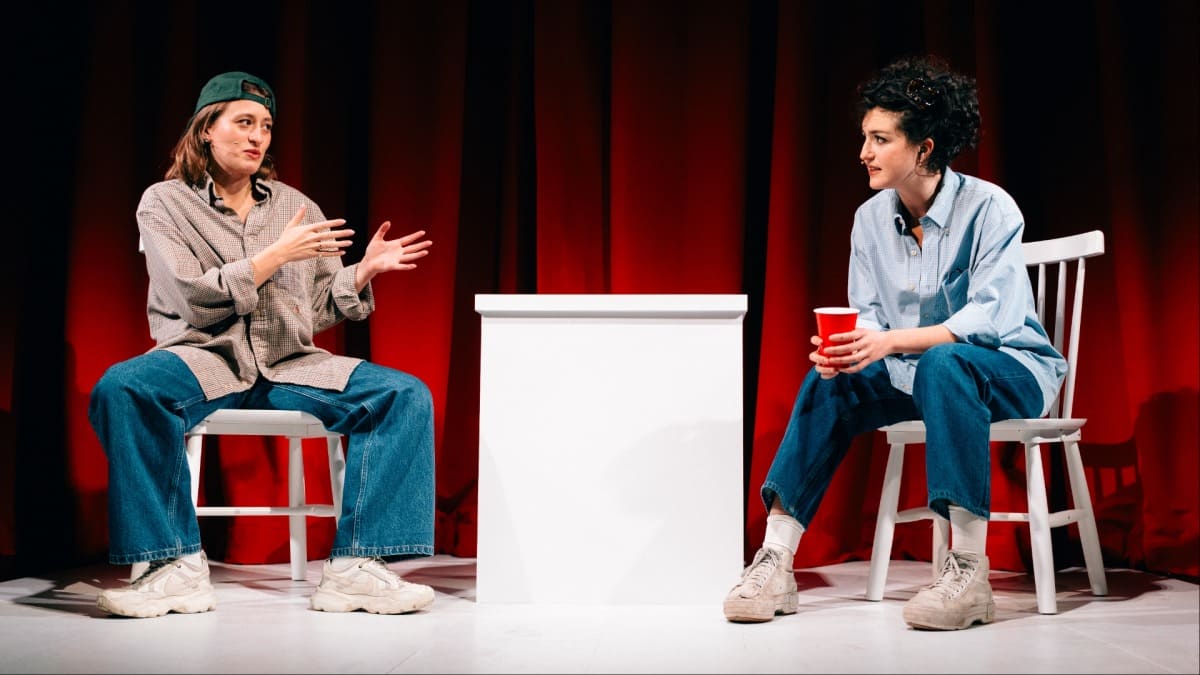
The humanity of live theater—of watching flesh-and-blood performers just feet away from you—makes it an intriguing medium for these kinds of stories. Both Two Girls and Dad Don’t Read This have theatrical flourishes, but they are largely centered on people having conversations. As Sass puts it, “The source text is a quintessentially online thing, but in the room and in the playing of this piece, is entirely human.” There are no screens on either stage—for some obvious reasons in Two Girls, but there was some discussion about including screens for the Sim-focused DDRT. Claudell explains, “We chose consciously not to see a screen to allow the content to be communicated through their words, or to allow the audience to have their own imaginative life.”
This method has also attracted a wide range of audiences, including a good number of people who hadn’t heard of the original 2 Girls. “We’ve had middle-aged moms who had no idea what it is,” Smith shares. “The play is an investigation, and so if you bring in a lot of cultural knowledge and baggage, that’s great. If you bring in nothing, that’s also great.” Adds Claudell, “We’ve been really gratified by the responses of, like, moms who didn’t know that this was something that their kids grew up with.” And the internet might be far different now than it was 15 or 20 years ago, but using theater to interrogate the human condition will remain timeless. “I hope that some 15-year-old right now is in their bedroom, looking around at the way the internet is impacting their friends,” says Smith, “and I hope that they’re cooking up a play that they can write in a few years.”


 Keep scrolling for more great stories.