D+

Saudi Arabia breaks into the Lifetime market with murder-mystery Unidentified

Moments of cultural specificity add novelty to a terribly tedious criminal investigation.

Saudi Arabia breaks into the Lifetime market with murder-mystery Unidentified

The Saudi film production landscape is bigger than ever, this year courting Rise Of The Planet Of The Apes‘ Rupert Wyatt to wrangle a starry blockbuster epic rooted in the country’s history. If Desert Warrior is an attempt at a Hollywood tentpole, Unidentified is a Lifetime original—a broad, morbid, hokey episode of Law & Order: Riyadh focused on the lives that women subtly mold around conservative custom and tradition in Saudi Arabia. It makes sense for Haifaa al-Mansour (Mary Shelley), the country’s first and still most notable female director, to tackle this kind of story, but any insight she may have into the secrecy imposed upon women by her nation’s culture, or the kind of underestimation that such a male-dominated world can lead to, is mired in stiff drama and undercooked mystery.

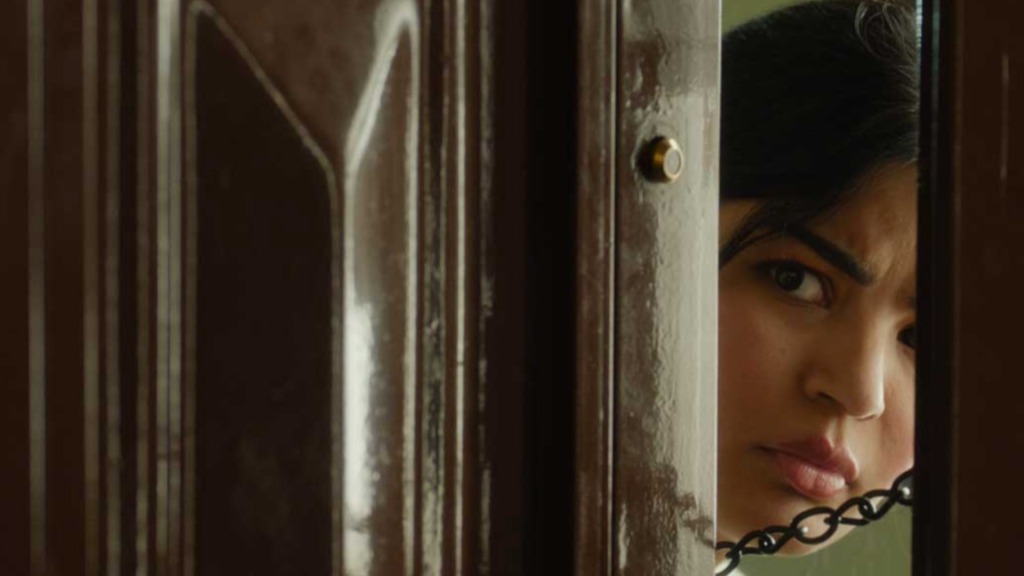
The premise promises something larger than a simple murder case, as Nawal Al Saffan (Mila Al Zahrani, reuniting with al-Mansour after The Perfect Candidate)—a secretary constantly listening to a “true crime makeup” influencer while digitizing files at the police station—seems to boast something the hapless masculine officers around her lack. Her association with this phenomenon, the overt feminizing of grisly killings by juxtaposing them with beauty tutorials, initially seems to offer some subversive backstory and plenty of detailed potential for this serious take on Only Murders In The Building. Her knowledge of press-on nails, for example, offers something of a lead for a case. But al-Mansour and her co-writer husband Brad Niemann don’t inform Nawal’s character with anything especially specific, no special attention to macabre detail or unnaturally strong stomach that’s been conditioned by her media habits. We’re told she’s recently divorced, and that she’s also just lost her young child, but that’s how much of the film unfolds—told directly to the audience. The plot just happens to Nawal, starting when she’s tapped by her boss (Shafi al-Harthi) to look at the newly discovered body of a teen Jane Doe, found in the desert.

One can still stretch to find some depth in the novelty of a woman-driven investigation in this environment—the victim has been run down by a car, still a charged symbol considering that Saudi women got the right to drive less than a decade ago—but even with that effort, it’s hard to identify the point of Unidentified. As Nawal tries to figure out who this dead girl is and who might’ve killed her, it’s less a case of personal obsession than one of dead-eyed obligation. Nawal only seems drawn towards the case by the machinations of the script—whether that means being approached by a coy high schooler willing to chat or weathering a series of dull nightmares.

These two examples reflect the narrative and aesthetic choices that link Unidentified to made-for-TV schlockers for a stay-at-home audience. The cheap and soapy Hallmark and Lifetime flavor of storytelling, melodramatic yet style-free, coats the self-consciously feminine world Nawal navigates. The defensive school headmistress, hookah-smoking bad-girl, and clothing-store clerk who offer up information operate in a world adjacent to yet wary of the one where cops write off the deaths of young girls as family-committed honor killings. The offhandedness with which this patriarchy reigns in the sun-bleached capital city offers a glimpse at the condescension and danger that could drive Unidentified, the film just never actually does anything over the course of its investigation to make this angle as tense as the situation warrants.

Nothing in this murder-mystery offers anything as complex as the cognitive dissonance coursing through the content creators it initially references, people like Bailey Sarian, who gab about severed heads while detailing eyeshadow tips. Even the third-act pivot, which pushes Unidentified further into campy, confused daytime TV territory, can’t rouse an audience nodding off after a stakeless, thrill-free whodunnit. But it does help undermine whatever social message al-Mansour might’ve offered about the way women live and die in modern Saudi Arabia, without even tapping into the joyous tastelessness of some of its peers.

Director: Haifaa al-Mansour
Writer: Haifaa al-Mansour, Brad Niemann
Starring: Mila al-Zahrani, Shafi al-Harthi, Aziz Gharbawi, Othoub Sharar, Adwa Al Asiri, Abdullah Al Qahtan
Release Date: June 19, 2026

 
Join the discussion...
Keep scrolling for more great stories.