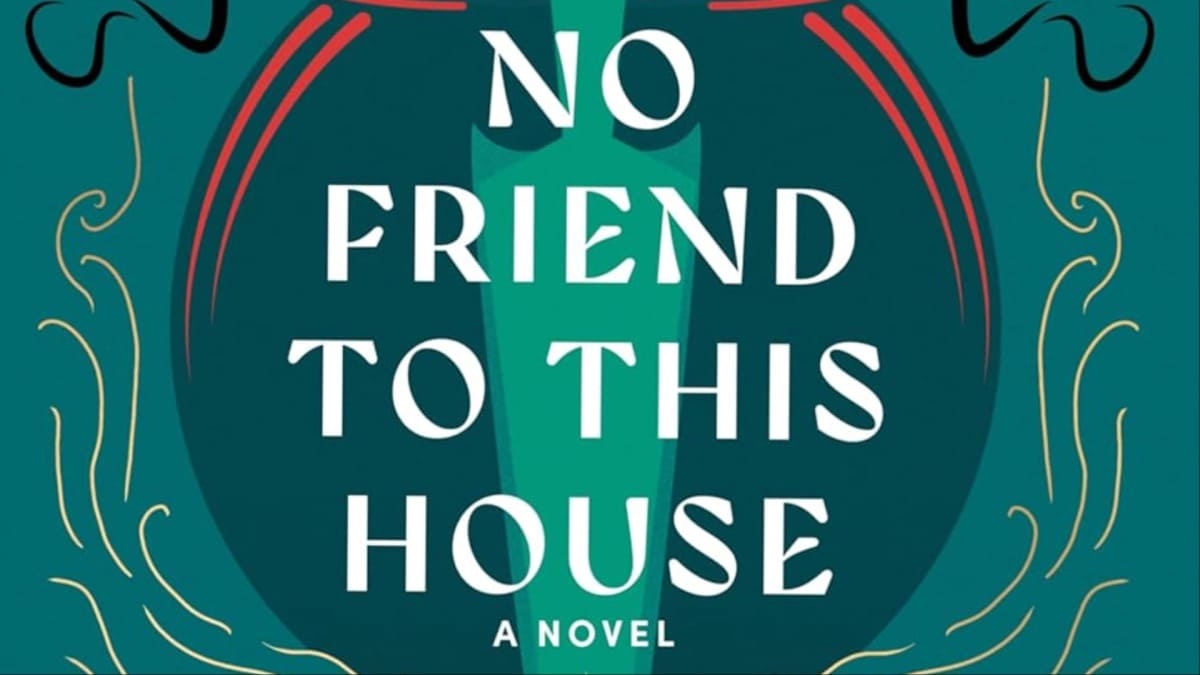
No Friend To This House by Natalie Haynes
It’s been a rough book week in the Baugher Milas household, which means that I must confess I only made it through one new title. (My shame is suitably immense.) At least, if I was only going to read one new book this week, the one I picked turned out to be a real banger.
Natalie Haynes will likely be a familiar name to anyone who reads much about Greek mythology. (A number that I suspect has gone up somewhat since the release of Christopher Nolan’s The Odyssey earlier this summer.) But for those who aren’t aware, she’s written half a dozen fiction and nonfiction books on the topic, from deep dives on goddesses (Divine Might) to female-focused retellings of classic myths, such as The Children Of Jocasta and Stone Blind. Her best is A Thousand Ships, a novel that uses over 40 different POV characters to retell the story of the Trojan War from the perspective of many of the female characters who are often relegated to the background of works written by men like Homer, Euripides, and Aeschylus. (These include, but are not limited to, Calliope, Briseis, Creusa, Polyxena, and Oenone.)
Haynes’ latest is technically a retelling of the story of Medea, the infamous princess of Colchis, who is most often remembered for helping the hero Jason steal the Golden Fleece and murdering their two sons after he abandons her for a new wife. But while Medea retellings are popular right now—both Rosie Hewlett and Eilish Quin have also both released good ones in the past couple of years—Haynes’ book is not just about Medea. In fact, she doesn’t even really appear until well into the novel’s back half.
Like A Thousand Ships, No Friend To This House is told through a series of multiple, steadily shifting perspectives, which once again put the stories of women (many of whom you likely haven’t heard of before) front and center. The myth of Jason and the Argonauts is deftly broken down into its composite parts: smaller, interconnected stories of abandonment, heartbreak, and loss that all eventually come together to build a tragedy. We meet Jason’s mother, Alcimede, whose weak husband keeps her from a throne. Theophane, who births the famous golden ram. Kleith, who is generally known for little more than her beautiful hair and the fact of her suicide. The literally nameless daughters of Pelias, who chop their father to pieces. Phrixus’ doomed sister, Helle.
But while this sprawling cast of characters—goddesses, marginalized women, and figures who play key roles in the voyage of the Argo or origin of the Golden Fleece itself—are all genuinely interesting figures in their own right, they also represent pieces of a larger, complex whole. The title of this novel is, after all, technically not a reference to Medea but to Jason, whose history of heedless, cumulative damage has, in Haynes’s telling, long been whitewashed in favor of blaming his wife for a far smaller number of heinous acts. To her credit, Haynes doesn’t shy away from the ugliness Medea is capable of. But if her portrayal of the infamous (and alleged) witch is perhaps a bit more sympathetic than most, the novel itself provides enough evidence that such grace has been more than thoroughly earned.


 Keep scrolling for more great stories.