Some half-serious otherworldly explanations were put forth, including “cosmic meat,” and a satirical suggestion that a planet had exploded, Krypton-style, and sent remnants of its fauna floating toward Earth. The only theory that seems to make any sense is vulture regurgitation. Vultures will often vomit in mid-air when startled or threatened—you try eating and running away at the same time—and are prone to vomiting when they see a fellow vulture doing the same. This peristaltic chain reaction seems far and away to be the likeliest explanation, although we can’t completely discount that a cow tried to jump over the moon and got sucked into a jet engine.
Strangest fact: Everything about this story is so strange, we couldn’t find anything to single out. So we’ll just mention that this story is a longtime favorite of “weird history” storytellers, including friend-of-the-Wormhole Charles Fort, who wrote about it in his 1919 The Book Of The Damned.
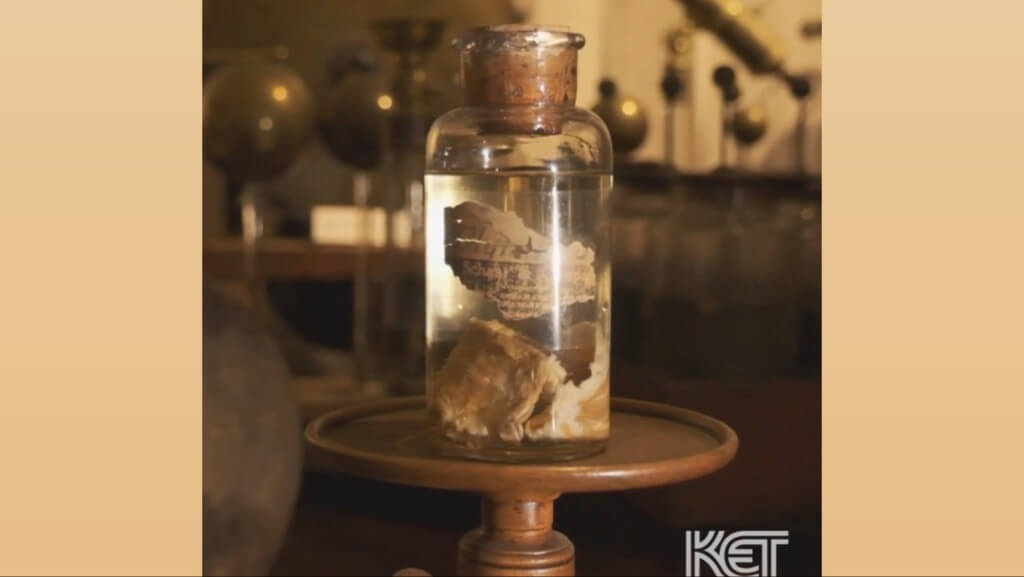
Thing we were happiest to learn: Much like Arby’s, we’ve got the meat. Not only were samples recovered and studied at the time, they were preserved. The Bath County History Museum has the last surviving chunk, as part of its Kentucky Meat Shower exhibit. (A 2025 festival for the 148th anniversary attracted 500 visitors and held a “mystery-meat chili cook off.”) Their sample was lost and then rediscovered in 2004 in storage at…wait for it…Transylvania University. While it seems like blood falling from the sky would be a natural subject of interest for Dracula’s alma mater, Transylvania U is actually a private liberal arts college in Lexington, so named because “Transylvania” (meaning across the woods) was the colonial name for heavily forested southwest Kentucky pre-statehood.
Thing we were unhappiest to learn: Much like Arby’s, everything about this is pretty off-putting. A witness at the time observed, “the smell was offensive to the extreme, like that of a dead body.” Scientific American reported that the meat appeared to be beef, but that “two men who tasted it judged it to be possibly lamb or deer” (horrified emphasis ours). Thankfully, someone took a more scientific approach than eating random chunks of meat that fell out of the sky (Kentucky, amirite?). The Newark Scientific Association’s analysis concluded that the sample they were given was, “lung tissue from either a horse or a human infant,” just in case that first quote wasn’t horrifying enough. Further samples were declared to be muscle and cartilage, suggesting that these were parts of a whole animal. At least, we’re going with “animal” when the alternative is “human infant.” Modern DNA analysis has proven impossible, given the age and condition of the surviving samples.
Best link to elsewhere on Wikipedia: The concept of “pop science” is well-known, as figures from Carl Sagan to Bill Nye The Science Guy have played an invaluable role in explaining complex concepts to the masses in a less scholarly but more digestible form. They also have counterparts on the liberal arts side of the fence, as “pop history” has sprung up in recent decades, emphasizing storytelling and personality over details and rigorous analysis. Wikipedia gives space for academics like Doris Kearns Goodwin and Stephen E. Ambrose, who have broken through to the mainstream, but the term seems a better fit for talented amateurs like Bill Bryson, Hardcore History podcaster Dan Carlin, and dare we say it, a column that recounts odd stories from Wikipedia.
Further down the Wormhole: The phenomenon of blood rain is an old one, usually seen as a portent of evil. It shows up in the King Arthur legends, as well as the Anglo-Saxon Chronicle, a collection of ancient English histories likely written in the ninth century. One of them, the “Worcester Chronicle,” is largely focused on the areas of Worcester and York, possibly because the two had the same archbishop, Ealdwulf. According to legend, Ealdwulf got into the religion game after he accidentally smothered his son, who was sleeping in his bed. By way of seeking absolution, he reopened an old monastery, and worked his way up from monk to abbot to bishop to archbishop. But he’s far from the most colorful Archbishop Of York, as nearly a millenia later, that post would be held by the wonderfully named Lancelot Blackburne, who came to the church via another unlikely route—piracy. We’ll shiver the Lord’s mighty timbers next month.


 Keep scrolling for more great stories.