We explore some of Wikipedia’s oddities in our 7,238,559-part monthly series, Wiki Wormhole.
This week’s entry: Gustave Whitehead
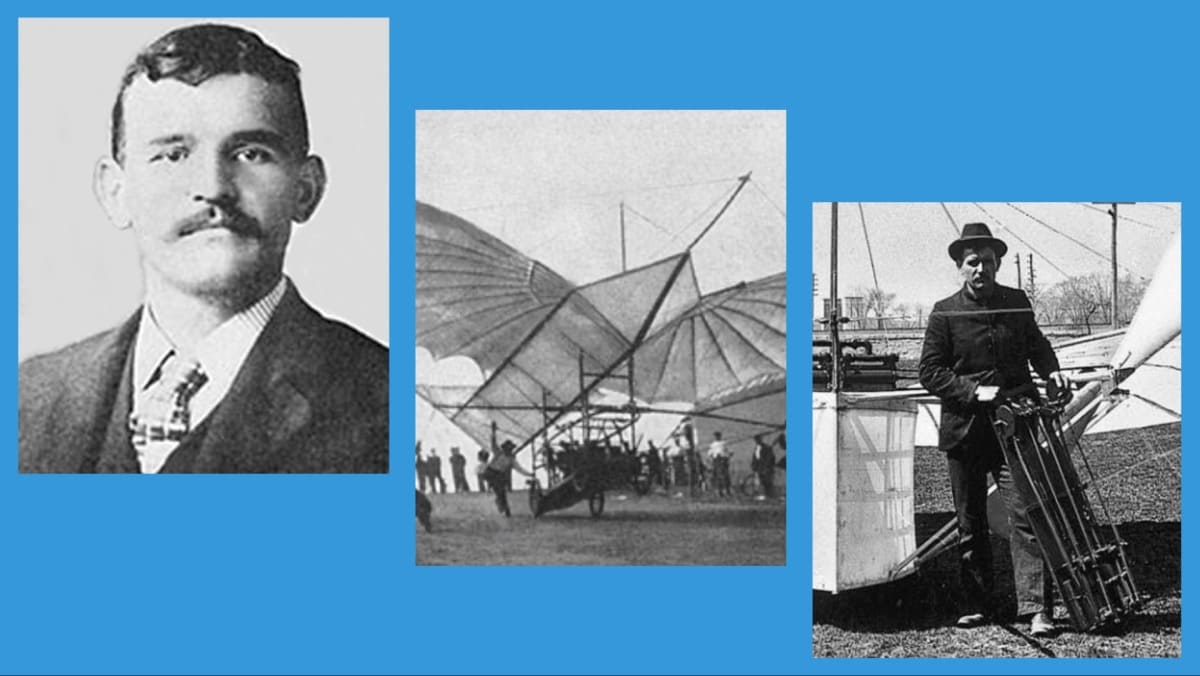
What it’s about: In 1903, Orville and Wilbur Wright made the first controlled flight of an airplane at Kitty Hawk, NC. Or did they? Newspapers in 1901 (as well as Scientific American) reported that an engineer named Gustave Whitehead flew an aircraft called No. 21 for about half a mile (2,640 feet), at a height of 50 feet, and landed safely. (The Wright Flyer reached an altitude of about 10 feet, and the longest of its four flights was 852 feet.) He continued to build aircraft (including a 60-bladed helicopter in 1911) until 1915, when, having failed to find fame and fortune, he took a factory job to support his family, later dying of a heart attack in 1927 at age 53.
Biggest controversy: There doesn’t seem to be a consensus on whether Whitehead’s story is true. Newspaper accounts conflict (the New York Sun reported on an unmanned flight by Whitehead; the Bridgeport Herald reported the same flight as manned); several eyewitnesses attested to seeing Whitehead’s plane in the air, but several people who knew him claimed he never flew, and people on both sides of the argument changed their story over the years. Even his wife Louise claimed that, while she sewed the material for the wings, she never actually saw his plane fly. There are reports that at least one of Whitehead’s flights was photographed, but no photos survived.
Strangest fact: Several modern aviators have tried to prove that Whitehead could have flown by not building a replica of No. 21. In 1986, Connecticut high school science teacher (and pilot) Andy Kosch built a replica of No. 21 from existing photos and blueprints, but used modern materials and “ultralight engines.” Kosch successfully flew 330 feet, but updating the technology seems to defeat the purpose of proving Whitehead’s original could have flown.
Along similar lines, a German pilot built an inexact replica using fiberglass and modern engines, and was chastised by the Deutsches Museum, who pointed out that the modern re-creation’s success gave no evidence that the original might have flown.
Thing we were happiest to learn: Besides the fact that Louise Whitehead’s middle name was Tuba? If Whitehead was in fact unable to get a plane off the ground, it wasn’t for lack of trying. By his own estimation, he had built 56 different experimental aircraft by 1901; in 1905 he was still filing for patents for an “improved aeroplane,” and it’s not disputed that he did fly gliders, and his unmanned helicopter did work.
Whitehead was indisputably a talented engineer; he displayed an airplane motor at the 1904 World’s Fair, but he took only enough orders to fund his own experiments. Air Enthusiast wrote at the time that his “ability and mechanical skill could have made him a wealthy man… but he was far more interested in flying.”
Thing we were unhappiest to learn: There may be a conspiracy to cover up Whitehead’s flight. Samuel Langley had succeeded in making several unmanned flights in the 1890s, and began working on a manned airplane he called an Aerodrome, with a grant from the Smithsonian, which he was the director of. As a result, the Smithsonian’s official policy was that Whitehead’s airplane was “fraudulent,” and that Langley, not the Wright Brothers, had built the first successful aircraft.
Feeling understandably slighted, Orville Wright refused to donate the Flyer to the Smithsonian, sending it to the Science Museum Of London instead. It wasn’t until 1942 that the Smithsonian recognized the Wright Brothers as the true first flight, and Orville agreed to donate the Flyer to the museum, where it remains to this day. However, in exchange for this, the institution quietly signed an agreement which required the Smithsonian to only recognize the Flyer as the first manned flight. Acknowledging Whitehead would violate this agreement, and would mean returning the plane to the Wright estate. (Shortly after this, Wright himself wrote an article in U.S. Air Services magazine, asserting that Whitehead was a fraud.)
Was Whitehead’s claim false? Or was the story suppressed by Orville Wright and the Smithsonian, and no one has had the credibility to challenge the “official” story? Wikipedia casts no judgment either way.
Best link to elsewhere on Wikipedia: One of Whitehead’s early failed attempts at flight involved building an ornithopter. For centuries before Whitehead (or the Wright Brothers, if you prefer), aspiring aeronauts looked to birds, and assumed a machine that flapped its wings would be the likeliest way to fly. Leonardo da Vinci studied birds in 1485 before designing an ornithopter (which didn’t work), and attempts go back as far as Abbas Ibn Firnas in the ninth century (although reports of his attempted flight only surfaced long after his death; historians assumed he was able to glide at best).
Further down the Wormhole: To add insult to injury, Wikipedia links to List Of Firsts In Aviation, on which Gustave Whitehead is not mentioned. The Wrights are there, of course, as well as the first animals to fly in a balloon (a sheep, duck, and rooster in 1783); the first person to die in a plane crash (one of Orville Wright’s passengers in 1908; Wright was also badly injured); the first non-stop balloon trip around the world (not until 1999); and the first flight from the U.S. mainland to Hawai’i (Albert Francis Hegenberger and Lester J. Maitland in 1927, as mentioned previously in this column).
The Aloha State has been a welcome destination for more than just aviation pioneers, but Ni’ihau, its second-smallest island, is less welcoming. Privately owned since 1864, the island is off-limits to outsiders apart from the family that owns it, U.S. Navy personnel, and government officials. However, they did get an unexpected guest in 1941, in the form of a Japanese pilot who crash-landed there after the Pearl Harbor attack. We’ll look at The Ni’ihau Incident next month.


 Keep scrolling for more great stories.