Without Blood, the sixth directorial effort from Angelina Jolie, consists almost entirely of a sordid trip down memory lane. The film opens with a farmhouse sitting on an idyllic pasture, the yellow sunlight preemptively drenching the scene in a nostalgic haze. A single father (Alfredo Herrera) plays in the tall grass with his adolescent son (Alessandro D’Antuono) and six-year-old daughter (Karolay Fernandez), but their romp is cut short when gunmen descend on the remote estate, claiming that they seek revenge for the father’s callous actions during an unspecified recent war. The man arms his son with a rifle and tells him to lock himself away in a room, while stowing his daughter under the floorboards and commanding her to stay quiet.
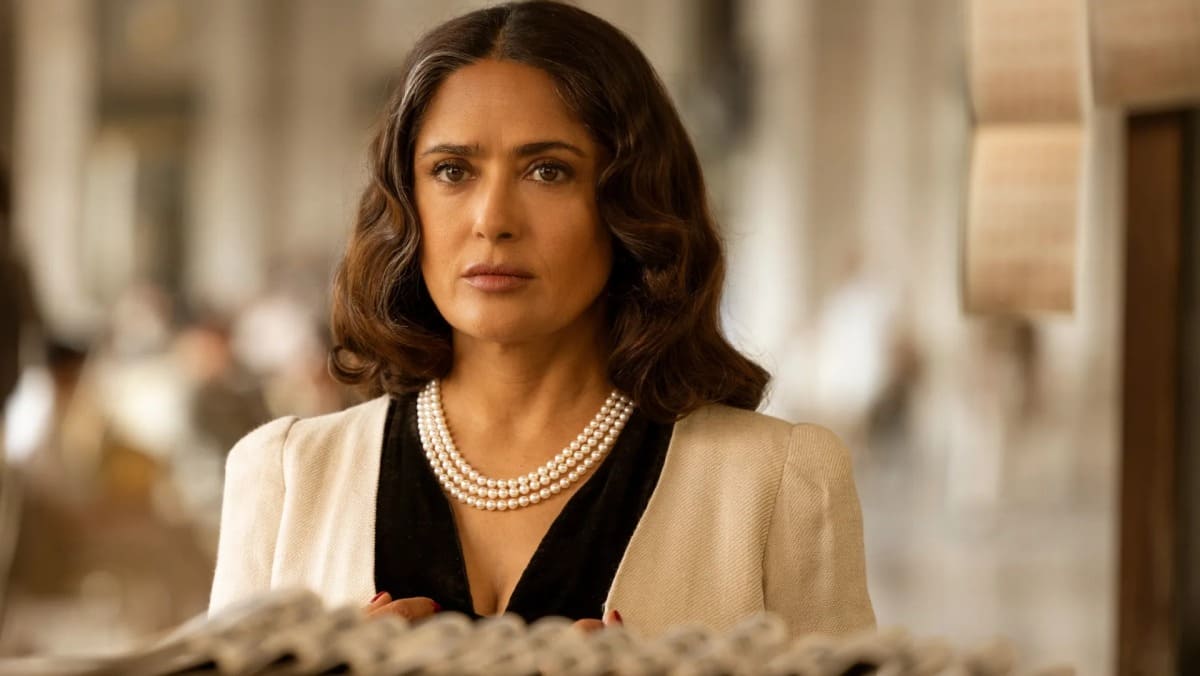
Naturally, what transpires causes unspeakable trauma—or, at least, it was unspoken until a woman (Salma Hayek) visits a newsstand in a random town square and invites the proprietor (Demián Bichir) to an upscale dinner. There’s little mystery as to why she has approached him: “I know who you are,” the man says shortly after sitting down, “and I know why you’ve come.” The little girl has grown into a chic older woman, gray elegantly streaking her dark hair. The man, whose long face and hunched posture hint at a life rife with regret, is one of the gunmen who antagonized her family all those years ago.
Over the course of the meal—which involves more chain-smoking than chewing—both parties recount their memories of that grisly day, now decades in the rear-view. They also share what their lives became after the event, as well as relevant rumors and urban legends that may well be scandalous truth or simple small-town conjecture. But the basic idea is that war and desperation can make people do unspeakable things—to each other, to themselves—and this violence is capable of stripping away an integral facet of our very humanity. Now sitting face to face, the victim and perpetrator of violence realize that they’ve been carrying their fair share of shame.
Adapted from the novel of the same name by Italian author Alessandro Baricco, the unnamed conflict that initially propels the story feels vaguely reminiscent of World War I, which would then place this fateful dinner sometime in the late ’50s or early ’60s. Yet for some inexplicable reason, the setting of the film, both in terms of place and time, is utterly irrelevant to the plot. There is no interest on Jolie’s part (or perhaps even in Baricco’s original text) to contextualize this fictional act of violence within a tangible sociopolitical climate, whether past or present. This reduces their conversation—and its insights into mental health, misogyny, and the bonding effect of shared trauma—into something of pure emotion, without the specificities that would help explain why their paths diverged so radically after that bullet-strewn encounter.
Jolie is attempting to emphasize that all conflict begets the same deplorable physical and psychological results across human history, but that doesn’t feel like a strong enough premise to base an entire narrative around. The most affecting films about the atrocities of war are successful because they show the unvarnished reality of the battlefield—films like Paths Of Glory, Apocalypse Now, and Come And See. No matter how close in time the filmmaker or audience might be to the conflict on display, there’s an innate power in confronting the blood and guts of the imperialist machine. It’s not pleasant to watch, but it sure as hell makes a convincing argument for why we should resent the political powers that allow combatants (particularly if they are conscripted) and civilians alike to experience such dire conditions. Jolie’s film almost posits that conversation alone can provide healing after enduring such horrors, which feels much too optimistic, especially for the current state of the war-torn world.
Not only does Without Blood not impart anything profound about trauma, or about how entire societies can atone for the toll these times of war take on its citizens, it was shot entirely within Rome’s Cinecittà Studios. Despite this, it unfolds almost entirely during an indoor dinner and doesn’t depart very far from the farmhouse and quaint town square settings, making one question why this couldn’t have been shot…pretty much anywhere else. This decision feels, if not straight-up indulgent, then totally unnecessary for a film that doesn’t even purport to be set in Italy at all, especially considering the cast of largely Mexican and Spanish actors.
We don’t know why Without Blood serves as the film’s title until the very last shot, and this revelation falls just as flat as the plot points that came before it. At just 80 minutes long before credits, the film recycles shots and event details—a damning reflection of just how slight it is. Jolie’s film isn’t just Without Blood, but without real perspective or purpose.
Director: Angelina Jolie
Writer: Angelina Jolie
Starring: Salma Hayek, Demián Bichir, Juan Minujín
Release Date: September 18, 2026


 Keep scrolling for more great stories.