With Women Of Action,Caroline Siede digs into the history of women-driven action movies to explore what these stories say about gender and how depictions of female action heroes have evolved over time.
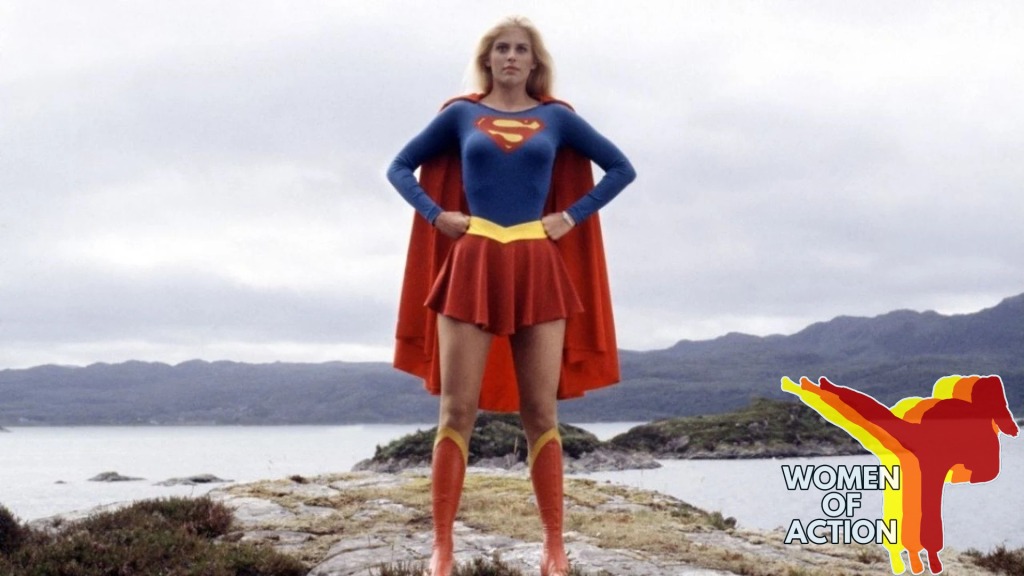
There have been plenty of bad superhero movies, but it’s rare that one is so poorly received that it not only staves off more female-led superhero movies for two decades, it also kills off an iconic comic book character for 20 years. Fairly or not, that’s the legacy of 1984’s Supergirl, the first and for a long time only big-screen female superhero in American cinema—at least until Halle Berry’s Catwomanarrived to extend that drought even further. Superman’s cousin Kara Zor-El had been a mainstay in DC Comics since 1959, but her series abruptly ended two months before her film’s release and then she was killed off in 1985’s Crisis On Infinite Earths crossover event, not to be revived until 2004. No matter how Milly Alcock’s new take on the character does this summer, it can’t be worse than that.
1984’s Supergirl both does and doesn’t deserve its terrible reputation. Released between the third and fourth installments of the Christopher Reeve Superman franchise, it feels like it was made from a script written in a foreign language and translated back and forth into English at least half a dozen times. The saga opens in the weird, cultish world of Argo City, where Peter O’Toole is asked to deliver buckets of dry exposition about transdimensional space and Omegahedrons, ostensibly to explain how the Guggenheim Museum-esque city survived Krypton’s destruction by hiding away in a pocket of “Innerspace,” although you’ve got to be pretty locked-in on comic book lore to understand any of that. From there, the film jumps to Earth where Faye Dunaway is introduced as the glamorous witch Selena, no further explanation given. By the time Kara (Helen Slater) is manifesting clothes and wigs out of nowhere with her Kryptonian powers, it’s clear that you just have to roll with whatever Supergirl is doing.
At its best, there’s some camp fun to be had in the story of Kara making her way to her cousin’s homeworld, disguising herself as an orphan named Linda Lee, and joining an extremely queer-coded all-girls boarding school. There’s even a terrific set piece where Kara soaks up the power of the yellow sun and tries out her new flying abilities in balletic fashion. But trying to actually follow the plot or character arcs of this movie feels a bit like what Kara tells O’Toole’s Zaltar when he asks if she knows six-dimensional geometry: “I know the equations. I just can’t see them in my head.”
The biggest problem with Supergirl is that it transparently doesn’t find a reason to exist other than because someone thought “Superman but for girls” might sell well. Producers Ilya and Alexander Salkind wanted the film to be a fresh start after the poorly received Superman III, but they failed to find a meaningful take on their central heroine. 1978’s Superman wanted to make you believe a man could fly. Supergirl wants to make you believe a girl can go to math class. It seems like director Jeannot Szwarc and screenwriter David Odell made a list of all the stuff they imagine girls like (Witches! Love potions! Softball! Stuffing their bras! Kissing boys!) and put all those ideas into one movie, with little regard for whether or not they made sense together.
Ostensibly, Kara hops in a spaceship to Earth because she accidentally sends the all-powerful Omegahedron flying out the window and needs to get it back before Argo City loses power and everyone there dies. But once she actually lands, the movie becomes a fish-out-of-water comedy in which Kara is a wide-eyed babe in the woods à la Splash, which came out the same year. It’s not totally dissimilar from what Patty Jenkinsdid with her much more successful take on another iconic DC heroine. Only where Wonder Woman balanced its woman-out-of-time comedy with the stakes of World War I constantly whirring in the background, Supergirl straight-up becomes a 1980s teen comedy for a while.
And that’s not a bad pitch for a young adult superhero story. It’s fun to watch Kara befriend her plucky roommate Lucy Lane (Maureen Teefy), sister of Lois; use her powers to deal with school bullies; and get a crash course on how to be an American teenage girl. It’s just bizarre to enjoy those comedic tangents when the stakes of the movie are that all the people of Argo City (including Kara’s parents!) are going to suffocate to death if she doesn’t get the Omegahedron back. Yet there she is, playing field hockey, crushing on a hot groundskeeper named Ethan (Hart Bochner), and eating fast food with Jimmy Olsen (Marc McClure, the only direct crossover from the Superman films after Reeve withdrew from a planned cameo appearance).
If that isn’t weird enough, the villain has nothing to do with either Kara’s Kryptonian origins or the school storyline. Instead, the witch randomly happens to come across the Omegahedron when it falls out of the sky into her picnic. (It doesn’t even come to her because she’s a witch, it’s just pure coincidence!) How or why magic exists in this world is never addressed, and because Supergirl can’t think of anything else for its two female leads to do, it makes them battle over Ethan’s affections: Selena gives the hunky gardener a love potion that’s supposed to make him fall in love with her, but instead winds up making him fall for “Linda.”
Given that Superman stories have always been steeped in romance, it’s not inherently a bad thing that Kara gets a love interest too. But where Clark Kent’s relationship with Lois Lane adds to the dimensionality of both characters, Kara’s Midsummer Night’s Dream-esque dynamic with Ethan doesn’t do anything for her. If the whole movie had just been a lighthearted teen comedy, the madcap romance might have worked. But as the superhero story bends towards high fantasy,it’s hard for the movie to find a cohesive tone. While Dunaway was dinged in reviews and singled out by the Razzies, the truth is she’s delivering the kind of campy, vampy performance the script asks of her. The problem is that the character just doesn’t make sense in this story. As Roger Ebert put it, “Why even go to the trouble of making a movie that feels like it’s laughing at itself?”
The mainline Superman movies had their tonal flaws too, of course, but what they had going for them was Reeve’s perfectly honed performance at their center. While 19-year-old Slater is a charming screen presence who gets one genuinely great scene, where Kara has to convince Zaltar to help her escape the Phantom Zone, the movie mostly just asks her to be sweet and doe-eyed, which doesn’t make for a particularly interesting heroine. There’s an early set piece where Kara seems unfamiliar with the concept of sexual harassment or the threat of male violence, which suggests that the movie might do something interesting with her alien perspective on Earth. But after that, her enemies include an enchanted backhoe, a shadow monster, and some haunted amusement park rides, which don’t ever add up to anything cohesive. Around the same time that The Terminator, Aliens, and even Red Sonjadefined their female heroes through action, Supergirl struggled to define its female hero at all.
Maybe the most interesting thing about Supergirl is that it doesn’t make a big deal about being the first female-led superhero movie—largely because the idea of live-action superheroes as a full-fledged genre didn’t really exist yet. Where Jenkins’ Wonder Woman took its glass-ceiling-shattering responsibilities very seriously in the cinematic universe era, Supergirl clearly wasn’t thinking that way in 1984, where it functioned solely as a sweet, lighthearted spin-off of the Reeve films. If Supergirl contains anything ahead of its time, it’s the sheer number of female characters in its story; something that wouldn’t become the norm in female-led action movies for decades. (If it even is now.)
Still, even Warner Bros. didn’t believe in the messy film in the end. After the Salkinds and Warners disagreed on whether to go for a summer or fall release date, the studio passed on the film entirely and it was picked up by Tri-Star. Released in November, Supergirl opened to middling reviews and a disappointing box office, which was enough for the Salkinds to sell the Superman rights to The Cannon Group, thus paving the way for the somehow even more disastrous Superman IV: The Quest For Peace—and the end of the Reeve franchise. Slater never played Supergirl again, although she did pop up on Smallville as Clark’s Kryptonian mom and The CW’s Supergirl TV show as Kara’s adoptive human one.
Though Melissa Benoist’s stellar small-screen work on that latter show now feels like the definitive live-action Supergirl, the 1984 film has its passionate defenders too—particularly among those who saw it when they were young enough that Kara’s childlike sense of wonder hit home. A 48-minute behind-the-scenes special suggests that the film was at least made with a lot of earnestness. The idea of Supergirl as a child of two worlds and someone perpetually living in her cousin’s shadow are thematically potent ideas for a superhero, female or otherwise, but the original Supergirl arrived too early in the history of superhero cinema to truly capitalize on any of that. Instead, it played it safe in a way that was more disastrous than taking a risk. As a new Supergirl approaches the theaters, however, it thankfully (hopefully) no longer feels like any one female-led superhero story holds the fate of all superpowered women in its hands.
Next time:Tomb Raider made Angelina Jolie an action star—and video game movies a hit.


 Keep scrolling for more great stories.