
The Long Kiss Goodnight asked if a female action hero could have it all
30 years ago, Shane Black wrote Geena Davis one of her greatest roles.

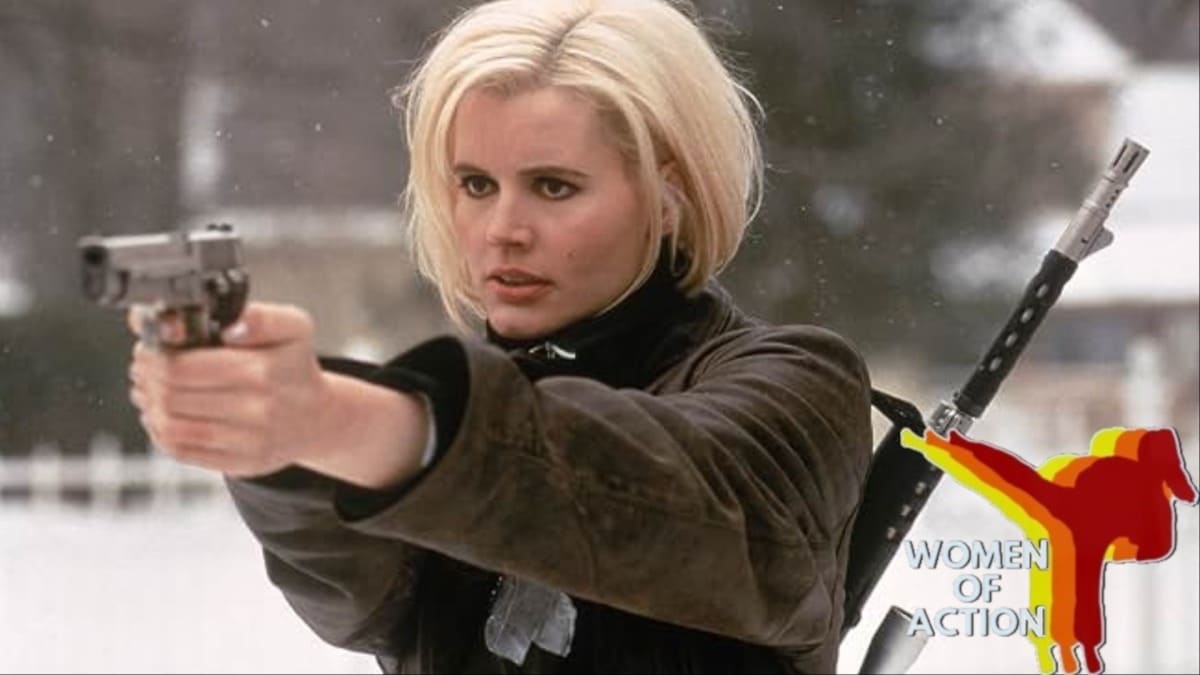
With Women Of Action, Caroline Siede digs into the history of women-driven action movies to explore what these stories say about gender and how depictions of female action heroes have evolved over time.
It’s no surprise that when Geena Davis and Samuel L. Jackson are asked about their favorite roles they’ve ever played, Thelma from Thelma & Louise and Jules from Pulp Fiction are near the top of their respective lists. What’s more surprising is the characters they rank above them: Samantha Caine and Mitch Henessey from The Long Kiss Goodnight. The largely forgotten 1996 secret-identity thriller emerged after a burst of female-led action movies in the 1980s, but before a similar burst in the early 2000s, and though it has its passionate fans, it struggled to connect at the box office and never found a second life as a cable staple. It’s mostly Jackson and Davis who are committed to keeping it alive by mentioning it as a favorite every chance they get. That mission feels particularly admirable on the movie’s 30th anniversary, when its story of motherhood and identity feels more relevant than ever.
From Aliens to Terminator 2: Judgment Day to Kill Bill, motherhood has long been a central thematic pillar of female-led action movies. But few have depicted it the way The Long Kiss Goodnight does. The movie opens with Samantha as a perfect suburban homemaker who bakes Rice Krispies treats, crafts papier-mâché Christmas decorations, hosts the neighborhood holiday party, and plays Mrs. Claus in the local parade. She’s a warm, playful, effortless mom any kid would dream of having. Who cares if some “focal retrograde amnesia” has left her with no memory of who she was before she woke up on a beach, two months pregnant, eight years ago? Does her life before kids even really matter?
Though I’m not convinced screenwriter Shane Black and director Renny Harlin actively set out to craft this metaphor, they wound up creating a movie about the identity struggles of early motherhood. Women who have rich, complex lives before having kids can find those lives subsumed by their children—not in an unhappy way (Samantha clearly loves her suburban world), but in a way that can still be jarring when they think back on the very different lives they used to lead. It’s like when a PTA mom suddenly finds herself craving the cigarettes she gave up years ago. If this were a drama, Samantha might simply go on a journey to reconnect with her old self now that her daughter Caitlin (Yvonne Zima) is firmly in her elementary school years. Because it’s an action-thriller, however, Samantha suddenly remembers that she’s actually Charly Baltimore—a ruthless CIA assassin who’d rather kill a guy with a lemon meringue pie than bake one herself.
The movie presents Samantha’s amnesia experience almost like a multiple personality drama. Samantha and Charly are basically two different people battling for control of one body; a kindly community member who loves her daughter and a fiercely independent career woman who claims she doesn’t see Caitlin as her own. The question is which one of them will win, or if there’s a way to integrate them both. It’s a concept that movies like Tully, Nightbitch, Die, My Love, and If I Had Legs I’d Kick You have only recently started to explore in a similarly heightened way. If Die Hard is a Christmas movie for divorced dads trying to reconnect with their families, The Long Kiss Goodnight is a Christmas movie for moms slowly losing their minds while trying to hold the holidays together for everyone else.
For his part, Black mostly talks about the script as an exploration of self-loathing and redemption. He sees Charly as an example of the dark side lurking in even the sunniest suburban school teacher, just as Mitch (Jackson) is an outwardly sleazy private investigator who secretly has a heart of gold. Still, Black was adamant that a female lead would make the story’s worlds-colliding conflict more interesting than if this were just another male spy thriller, even if the sexism of Hollywood made that choice an uphill battle. “People would tell me while I was working on it, whether it was producers or my agent, ‘Why are you making it a woman? You can’t sell this. There’s like four actresses that can play the part. Make it a man. That way anyone can play it,'” Black explained. “And I kept pointing to [La Femme] Nikita and saying it’s not impossible to make a film like this that’s effective. It’s just a little more difficult, that’s all. In the long run, I hope I’m proven right.”
On the heels of Lethal Weapon, The Last Boy Scout, and Last Action Hero, Black sold his Long Kiss Goodnight script for a whopping $4 million, although it was another price tag that got more attention in the press. Harlin and Davis (then a real-life married couple) were coming off the infamous swashbuckler Cutthroat Island, a flop so big it once held the Guinness World Record for the biggest box-office bomb of all-time. The general consensus is that some of that stink got associated with The Long Kiss Goodnight, although Jackson has another theory about what happened: “The studio didn’t know how to market that film because they didn’t know that women like seeing themselves as badasses,” the actor said. “I kept saying, ‘You need to advertise this thing during the day when women are watching soaps.’ Whatever. They were like, ‘I don’t know what you’re talking about.’ But it’s gone on to be like this really great cult classic because Geena is so good.”
 Keep scrolling for more great stories.