The first announcement of Emerald Fennell’s Wuthering Heights quickly led to hypotheses about her ulterior motive. After all, the English enfant terrible behind the subversive rape revenge tale Promising Young Woman and Saltburn‘s horned-up class commentary would surely have no interest in a straightforward adaptation of Emily Brontë’s landmark Gothic novel. When the title was stylized as “Wuthering Heights,” and Fennell explained that this was because she was simply “making a version” of Wuthering Heights, it all promised some sort of unconventional approach. But this gives Fennell too much credit. Her take on Wuthering Heights, while in no way totally faithful, doesn’t generate any new compelling ideas about the text or the way that it’s endured in popular culture.
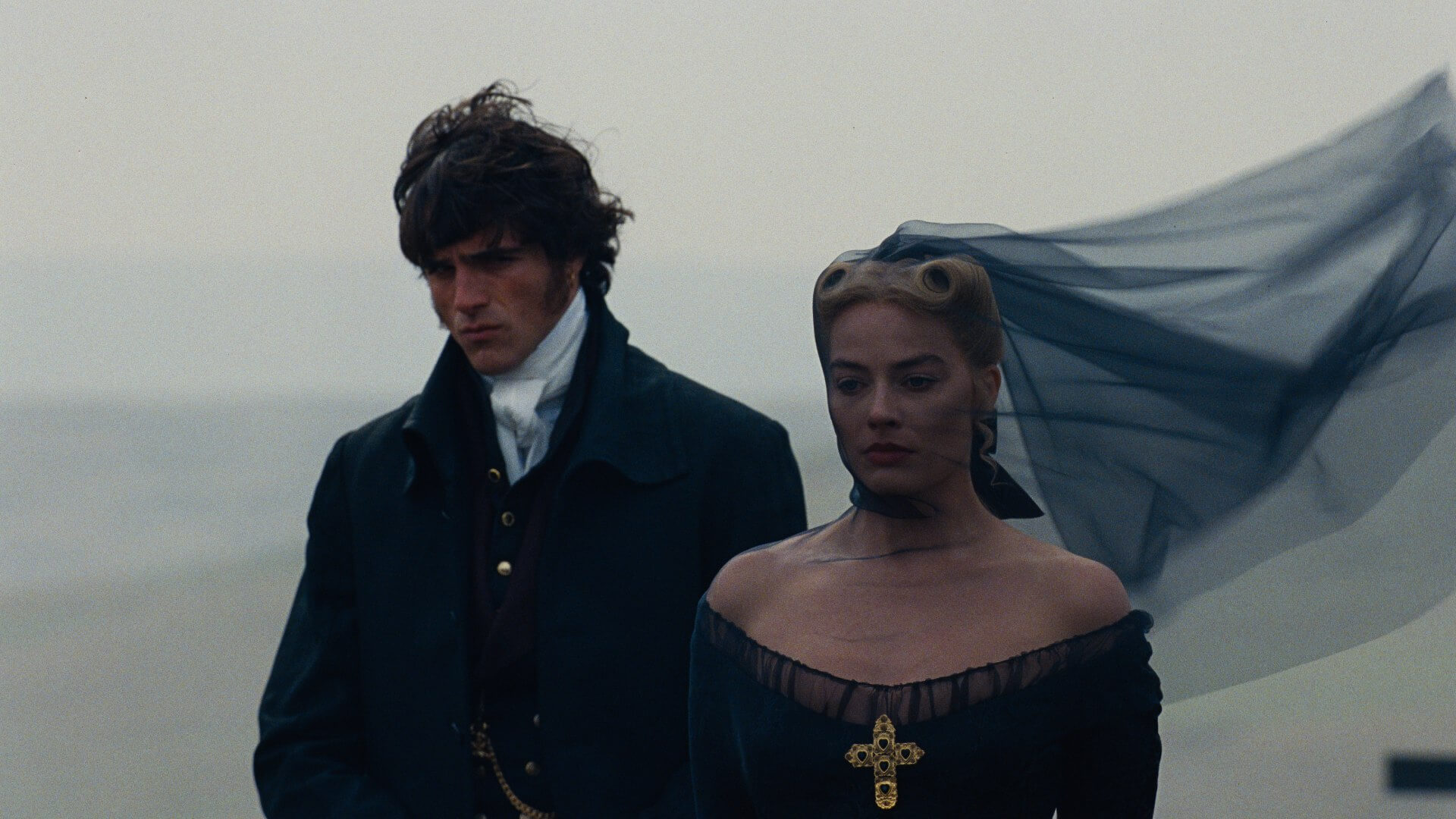
Margot Robbie simply plays Cathy, while Jacob Elordi embodies Heathcliff, her lifelong love. Much of the fabric of Brontë’s story is present, though somewhat remixed—certain characters are morphed together, while an overt (if oddly tame) sexual current runs throughout. Truthfully, one of the most jarring deviations from the book lies in the casting of Robbie and Elordi as the central characters. Despite being oft-equated with feminine perfection (i.e. Barbie), 35-year-old Robbie reads as far too mature of a choice for Cathy, who is 18 years old during the bulk of the narrative. Similarly, Heathcliff is originally described as a dark-skinned, ethnically indeterminate foundling (which leads to how he is treated throughout the narrative), so Fennell’s decision to cast the unambiguously white Elordi is puzzling. Had these choices factored into the plot, perhaps viewers could’ve gleaned some insight into how Fennell imagined these literary characters.
But Fennell’s script follows the path of most film adaptations, omitting the last act of the book, which focuses on the next generation of the titular estate’s inhabitants. This allows the focus to rest solely on Cathy and Heathcliff’s love story, which begins in earnest when they are children. Heathcliff (Owen Cooper, Adolescence star and youngest-ever Emmy-winner) is brought to Wuthering Heights by Cathy’s father Mr. Earnshaw (Martin Clunes), an impulsive drunk who resolves to house, clothe, and feed the boy in exchange for manual labor. Cathy (Charlotte Mellington) is delighted, vowing to treat Heathcliff as her “little pet.” They are immediately inseparable, spending their days roaming the nearby moors, frolicking about the grounds, and comforting each other when Mr. Earnshaw gets violently intoxicated.
Despite being raised as siblings, an onslaught of hormones result in sustained sexual tension between the two as they come of age. Now a ruggedly handsome stable boy, Heathcliff’s rippling physique hardly conceals a heart that beats only for Cathy. Acutely aware of her father’s mounting gambling debts and crippling alcoholism, Cathy pines for the wealthy new neighbor Mr. Linton (Shazad Latif), hoping that catching his eye would elevate her out of encroaching poverty. Cathy’s de facto lady in waiting, Nelly (Hong Chau, dreadfully underutilized), also understands the benefits of this union, and covertly lets word slip to Heathcliff that Cathy would rather marry for riches than romance. Heartbroken, Heathcliff abandons Wuthering Heights; Cathy is devastated, but accepts Linton’s proposal anyway. Thus she moves into Thrushcross Grange, the lavish manor he shares with his ebullient ward Isabella (Alison Oliver).
When Heathcliff returns several years later, the psychosexual antics of Wuthering Heights ramp up. Mysteriously wealthy and manicured—his long, wild mane trimmed and his missing tooth replaced with a gold filling—he is finally an acceptable match for Cathy, who is tragically now a married woman. Everyone becomes embroiled in bitter jealousy and plays cruel emotional games to torture each other. An overtly sensual slant is ostensibly supposed to cement this story in Fennell’s style, but the salaciousness falls short of feeling genuinely provocative. Instances of masturbation, voyeurism, adultery, and BDSM-lite simply lack the smack of taboo. It was reported in August that test screenings included a public execution where a “condemned man ejaculates mid-execution.” Wuthering Heights opens with a version of this scene, but that graphic visual must have ended up on the cutting-room floor. But then, why get Fennell’s take on this story in the first place? Promising Young Woman centers on sexual violence; Saltburn features semen-slurping and a full-frontal glimpse at Barry Keoghan. Void of nudity or graphic sexual details, Wuthering Heights sees a filmmaker whose transgressive edge earned her an Oscar tone herself down.
If there’s one rebellious thing in Wuthering Heights, it’s the transfixing costume and production design. The beauty of Cathy’s ensembles only intensifies as the film progresses, a small salve during a bloated 136-minute runtime. Jacqueline Durran—who also dressed Robbie in Barbie and otherwise has ample experience working with period garb—is abstract and playful, opting for bold patterns, unique fabrics, and an unorthodox dismissiveness regarding period accuracy. Certain styles evoke the late 18th century, while others feel more entrenched in Victorian fashion of the mid-to-late 19th century. The same idiosyncrasy can be found from production designer Suzie Davies, particularly in Cathy’s bedroom at Thrushcross Grange, which is outfitted with latex-coated wallpaper that replicates every vein and freckle on her peachy skin.
Overlong and undersexed, Fennell’s version of Wuthering Heights betrays her audience of edgelords and perverts. Even stranger, those who have fostered a distaste for the filmmaker’s sensibility will similarly find themselves disappointed. It’s one thing to make art that can be read as indulgent, ill-conceived, and tasteless—it’s another to turn around and make something that’s just boring in comparison. Robbie and Elordi transmit an undeniable chemical connection, but the absence of truly titillating carnal depravity means the film isn’t arousing, just annoying.
Director: Emerald Fennell
Writer: Emerald Fennell
Starring: Margot Robbie, Jacob Elordi, Hong Chau, Shazad Latif, Alison Oliver, Martin Clunes, Ewan Mitchell
Release Date: February 13, 2026


 Keep scrolling for more great stories.