Notice: Function _load_textdomain_just_in_time was called incorrectly. Translation loading for the wordfence domain was triggered too early. This is usually an indicator for some code in the plugin or theme running too early. Translations should be loaded at the init action or later. Please see Debugging in WordPress for more information. (This message was added in version 6.7.0.) in /home/devavclub/public_html/wp-includes/functions.php on line 6170 Yasmin Williams rewires our understanding of the guitarSkip to the content
Yasmin Williams rewires our understanding of the guitar
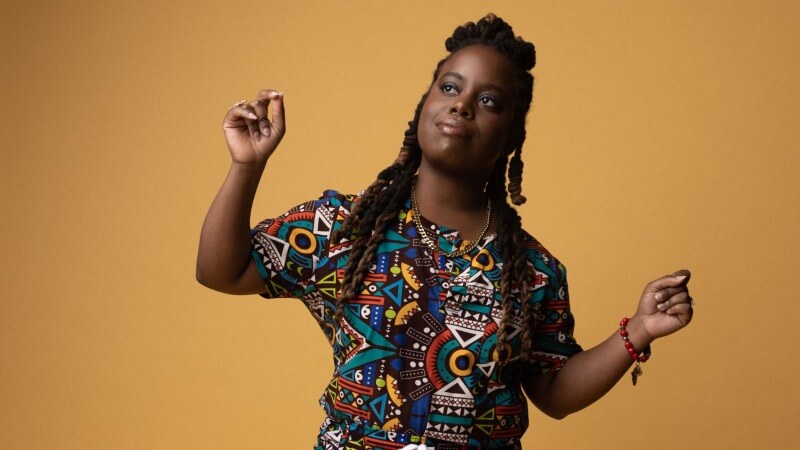
Watching the fingerstyle guitarist perform in a small Iowa City theater reaffirmed my belief in music’s ability to conjure new possibilities from ubiquitous sources.
This week, Paste is dedicating its editorial coverage to the wild and wonderful world of guitars. From January 26 through February 2, we will be publishing essays, lists, and reviews about the albums, solos, and players we love most.
I bought Urban Driftwood on a whim. It was January 2021—a month now infamous for its dearth of new music in a year I remember largely through Bandcamp Friday, which I participated in every week because I wasn’t spending much money elsewhere. I gave Yasmin Williams’ new LP a spin before actually committing to the purchase, and I was immediately struck by not only the sheer magnitude of her prowess, but how she balanced that innate virtuosity with breezy tranquility. From the filigreed fingerpicking of “I Wonder (Song for Michael)” to the thumping syncopation of “Swift Breeze” to the luminous melodies of “Juvenescence,” it didn’t take long at all for me to become enamored with her playing. When the vinyl eventually arrived, I played it one afternoon, and as soon as I turned it on, my now-wife asked who it was and has been a fan since. It quickly turned into one of our go-to albums. Whether we were in the car or cleaning our apartment, Williams’ guitar often accompanied us.
Two years later, we saw that Michelle Zauner had announced some book tour dates for her memoir Crying in H Mart. She wasn’t coming to our home of Kansas City, but she was going to Iowa City for a literature/music festival called Mission Creek. We’d never properly visited the college town, and it was a 4.5-hour drive away. The fest featured a solid lineup with Cat Power, Snail Mail, and Kevin Morby on the bill. It felt like a good excuse for a road trip. Yasmin Williams would be there, too, so we spontaneously got tickets and booked a hotel for our travels in a couple of months. As a lit and music nerd, it seemed like it’d be a great time—and it, of course, was.
We were both excited to see Williams, and although we frequently listened to her music, we still had only a rudimentary understanding of how she played her guitar. I knew she was a fingerstyle guitarist, but even that feels reductive in retrospect. On April 7, 2023, at the Riverside Theatre, fewer than 100 people gathered into the diminutive sitting area, consisting of roughly five descending rows, to watch Williams perform. We hurried from Sudan Archives’ set at the 725-seat Englert Theatre to make this show, scurrying down unfamiliar streets and taking alleys for shortcuts, and we settled into our seats as anticipation grew. As Williams took her own seat in front of the small crowd, she set her guitar in her lap, and from then on, we were utterly transfixed. She tore through the hammer-ons and pull-offs of “Restless Heart,” the finger-striking rhythms of “Through the Woods,” and even a ruminative rendition of Post Malone and Swae Lee’s song for Spider Man: Into the Spider-Verse, “Sunflower.”
A few songs into her performance, she explained how she first fell in love with the instrument and the methods she used to play it. Hooked on Guitar Hero II but unable to reach the blue and orange buttons required for the higher difficulty modes, she tried placing the plastic-guitar controller in her lap. Once she got her hands on an actual guitar, she played it like she had the video game. But whereas the game championed hair-metal histrionics and traditional guitar heroics, Williams’ playing is more lived in, earthy, and calming. There’s a comfort, a natural intuition, a sense of belonging. Its soothing atmosphere belies the peerless skill on display. For that show in Iowa City, I could feel the audience held in a similar, spellbound awe. Everything was quiet save for the tactility of the strings, the knocking of the guitar’s body, the ornate beauty of the music. When she demonstrated her technique to the audience, moving one hand up and down the guitar’s neck with an adroit fluidity, her fingers gracing the strings with a harpist’s graceful precision, people in the audience, myself included, began to laugh, marveling at how uncomplicated Williams made it seem.
As we watched her perform, I thought about my own introduction to the guitar. Like Williams, I also cultivated my six-string infatuation through Guitar Hero, specifically the third installment, the one with Tom Morello and Slash as playable characters and songs like “Cherub Rock” and “Knights of Cydonia” in its soundtrack. When my grandparents surprised me with an Ibanez electric guitar after I’d expressed interest in teaching myself how to play their old 12-string Spanish acoustic, I’d been drawn, initially, to power and octave chords, the lingua franca of the 13-year-old whose personality was defined by attending the next Warped Tour. My skills as a guitarist, over a decade later, are still oceans away from Williams’, but watching her play the instrument reminded me of its unbridled joys, its as-yet undiscovered paths. She conjured new possibilities out of one of the most ubiquitous instruments in popular music. My wife and I still talk about how transcendent Williams’ playing was, how it was not only the best performance of the weekend but one of the best shows we’ve ever seen, period.
At one point, she mentioned that she was about to play a new song, which was untitled at the time but is now known as the sprightly highlight “Hummingbird” from her 2024 album, Acadia. It was as jubilant and delicate as its titular animal. She lifted the guitar from its supine position and shifted it comfortably into her lap, holding it as most musicians would, positioned between her right thigh and her strumming arm. But the magic she evoked from it was unlike anything else. Everyone in the small theater was enraptured, concentrated on the performance at hand, mesmerized by Williams’ uncanny power to make shredding sound bucolic and gorgeous. Isn’t this one of music’s most notable qualities, to encourage us to reimagine something we once thought we completely understood, to challenge our perceptions and breed new revelations about art and ourselves? By that metric alone, Yasmin Williams is one of the greatest working guitarists (and musicians in general) that we have right now.
Grant Sharples is a writer, journalist and critic. His work has also appeared in Interview, Uproxx, Pitchfork, Stereogum, The Ringer, Los Angeles Review of Books, and other publications. He lives in Kansas City.


 Keep scrolling for more great stories.