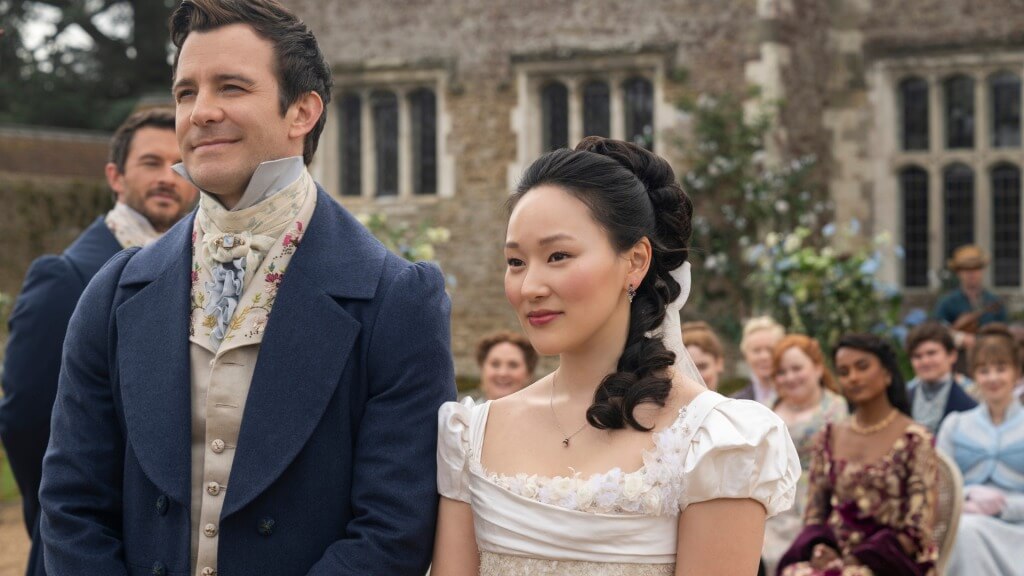
Yerin Ha’s Bridgertondebut as Sophie Baek is straight out of a fairytale. Sophie attends a masquerade ball donned in a gleaming silver gown and gets whisked off by the ton’s most eligible bachelor, Benedict Bridgerton (Luke Thompson), for a private dancing lesson in the garden. It’s a meet-cute that fuels the Netflix hit’s fourth season, which charts how Sophie and Benedict, who belong to different echelons of society, find their way back to each other.
Ha, who comes from a line of actors (her grandmother, Son Sook, is a South Korean star and former politician), previously appeared in Paramount+’s Halo and HBO’s sci-fi epic Dune: Prophecy. However, as a lifelong romance aficionado, she views this role as one that allowed her to tap into the parts of acting that she didn’t think she’d get to. The A.V. Club spoke to Ha about how she connected with Sophie, her family’s influence on her work, and continuing the legacy of Bridgerton‘s prior female leads.
The A.V. Club: What are some of the aspects of the romantic genre that you were excited to play as a performer?
Yerin Ha: The whole yearning aspect is so fun to play, isn’t it? It’s a dream. That’s the emotion I desire to have in my personal life as well, but to be able to play that is so wonderful because I’ve loved watching romance stories since I was a kid because, to me, they give hope to people. It’s a beautiful genre. I mean, it’s not like I went into every scene with that thought of, “Oh, Sophie’s yearning,” either. I was thinking about the main objective or the obstacle of the scene. Focusing on that each time took the pressure away from me, and it made it true to the character. As human beings, we all experience that feeling of, “Oh, I’m heartbroken because I want this person, but I can’t be with them.” Twisting and shifting that perspective helped me portray Sophie’s feelings. And to be able to play a character who is so desired and wanted is something that I didn’t think I’d get to do.
AVC: A lot of that yearning is portrayed efficiently and without much dialogue.
YH: The silent bits for Sophie are actually sometimes very loud. With all my work, I’m always very interested in what’s not said and figuring out what my inner dialogue is that’s happening. Maybe it’s the studious person in me, but I like doing a lot of prep to make sure I’m not just standing there like a neutral robot. To me, it’s all about listening and figuring out where she’s coming from at any point in time. A lot of the preparation is to be able to make those unsaid bits sing, and that’s the stuff I think people are really drawn to when they see someone being present in the moment.
AVC: What was some of the prep that you did?
YH: Sophie is very similar to me, and I felt like we were walking very parallel paths together. I learned so much from her, and I think she took lots of things from me. I did try to read a lot of romance books, though. What I love about first-person romance books is that there’s a lot of inner life and dialogue that’s written out, so approaching my character like that also helps. I read a lot of romance books from Emily Henry and Ali Hazelwood, but also a lot of classics, even stuff like A Little Princess. Ultimately, I felt like Sophie really came from me rather than trying to get inspiration from something else.
AVC: Is bringing yourself to the characters something you tend to do? What was it about Sophie Baek that made that easier?
YH: I can’t speak for other actors, but naturally, I feel like there’s always going to be a part of me that comes out in my characters. I’ll always try to find anchor points or hooks that I can relate to so that the character doesn’t feel distant. I have to empathize with who I’m playing in some regard. With Sophie, it just so happened that I could resonate in many different ways. I read [Julia Quinn’s An Offer from A Gentleman] so long ago, but there was so much inner life in her in that, too. The constant pain that she carries with her is the thing that I really tried to focus on in my performance and to understand why she’s struggling to be Benedict’s mistress or just the internal conflict whenever she sees him.
AVC: In volume two, the love confession in episode five feels pivotal because it begins with Sophie standing up for herself. How do you view that moment and what was it like to work with Luke Thompson to figure out the many beats of it?
YH: Luke and I actually didn’t really like to, minus the rehearsal period, work on scenes together. I think that was the beauty of whatever we created. We worked on it separately and then just tried to be as honest as possible at that time and see what we were feeling. What I thought about Sophie’s communication in that moment was that I really did want to portray someone who speaks up and can tell a man, “Actually, what you’re doing is not okay.” I wanted to make her character someone with resilience and not someone who surrenders. So filming that episode-five scene was meaningful. Luke keeps saying that he thinks he looks tired in it, but I just remember thinking he was such an incredible, fantastic scene partner and actor. That’s why it wasn’t hard for me to then play Sophie as someone who is finally putting her walls down. I do credit that probably to his theater training as well. When it’s constant energy feeding off of each other, the scene is the most honest and truthful that it can be.
AVC: Season four has a lot of key scenes from the book that fans love. Were there any that made you particularly anxious or nervous in terms of the execution?
YH: Oh, I was nervous about the prison scene. For the past three seasons, the Bridgerton world has been established in a colorful tone, so I was nervous about what a prison in this place looks like. The whole storyline feels quite dark in terms of the show. I think the question was: How do we get it right and make sure it makes sense and [ensure] everyone can feel the weight of it? The scene before the bathtub in the finale was also big for me, when Sophie breaks down about not feeling loved or wanted by anyone. I thought that was the penny-drop moment, and it makes everything make sense for her. What does it mean to actually tell somebody the things that you’re scared about and fearful about? That made it feel very real. I looked at it as the point of Sophie’s journey. Everything has led her to this scene and the conversation she has with Benedict.
AVC: Since you come from a family of actors, do you discuss your techniques or seek advice from them? Are they the ones who inspire you most?
YH: Well, when my grandpa was around—he passed away two years ago—he was such a thespian. I never really asked him for advice, but he was always such a lover of the craft. He would just tell me about how important it is to make sure that the character is three-dimensional. I miss him dearly. It’s so nice to have people around who have such a passion for their craft. My grandma’s also shy about giving advice. I don’t know why, and my mom tells me more about navigating the acting space and she’s always praying for me. She’s always saying, “Just do your best, that’s all you can do.” She grounds me. But for me, any actor who surprises me is always the most interesting to watch. I think audiences also love to feel surprised or to feel like they’re seeing different parts of this person. With the marketing and press stuff now, people see a certain image of someone and think of them one way; and then when they do a job, people are thrown off-kilter. Those are the interesting parts of acting, to me, and stuff that I like to gravitate towards.
AVC: After Simone Ashley in season two, you’re Bridgerton‘s second Asian lead. Can you talk about the significance of that, especially considering how vocal fans can get about it?
YH: Yeah, Simone’s gone through it all with such grace and kindness. She sent me flowers, actually, during my press tour to say congrats on the release of the show. She’s someone with so much heart and has obviously done so well in season two, which is why it is the way it is. Thanks to all the different leads of the show, and especially Simone, it just made me feel like I wanted to lead the set with a lot of heart and with a lot of responsibility, too, and to make sure we exist in these spaces and we have a seat at the table. I wanted to lead by good example and continue that good faith.
To be in a space with other Asian women on the screen this season is also such a gift because then it doesn’t feel like the pressure’s all on my back. We all share the pressure. [Laughs] Jokes aside, it’s rare to be in a room where we’re all Asian women and we get to play the family relationship rather than it being about the race. That is so refreshing. We still pinch ourselves about it, and the fact that we’re all mostly newbies as well, coming into this phase. Katie Leung is getting to play the antagonist, and I’m getting to play this “Cinderella.” We’re all just thinking about how cool it is that we’re creating these spaces for us.
AVC: One of the common traits about Bridgerton‘s female leads is their confidence for a show set in the Regency era. How do you view Sophie through that lens?
YH: The thing about Sophie is that she’s about the journey of understanding that it’s important to be seen for who you are on the inside and understanding that softness is also a strength. And women do that so well, right? We’re emotional, carefree, and giving. Men sometimes tend to view all that in a very negative light, but I mean it in the most positive, uplifting way. That’s why we connect so well with each other as women. So with Sophie, I want her to be about understanding that your flaws are the things that make you who you are and make you special. I want that to be her empowering message.
AVC: Having done this romance drama, what’s a genre you want to tackle next?
YH: Maybe it’s my imposter syndrome, and I’m always afraid that this will be my last job, so I just want to keep working. I would love to work until I die. But I would also love to do a film that has a lot of music and dancing in it.


 Keep scrolling for more great stories.