When did young, ambitious TV characters stop trying to be artists?

I Love LA and other modern shows depict social-media fame and marketing gigs as the new dream jobs.

When did young, ambitious TV characters stop trying to be artists?
Listen to this article

In the pilot of Girls, Hannah (Lena Dunham) thinks she could be the voice of her generation, or at least a voice of a generation. Her parents have just cut her off financially after a couple of years of living in New York post-college, and she spends a lot of the rest of the show getting and losing various jobs: a recurring stint at a coffee shop, a gig as a commerce writer at GQ, a teaching spell that creates incredibly inappropriate relationships with both students and fellow staff. But her ultimate aspiration and north star is to be a writer (and not a journalist). Marnie (Allison Williams) and Elijah (Andrew Rannells), her most consistent friends over the course of the series, also aspire to the arts: Marnie becomes a singer, while Elijah and Hannah’s on-again, off-again boyfriend, Adam (Adam Driver), both end up on Broadway. 

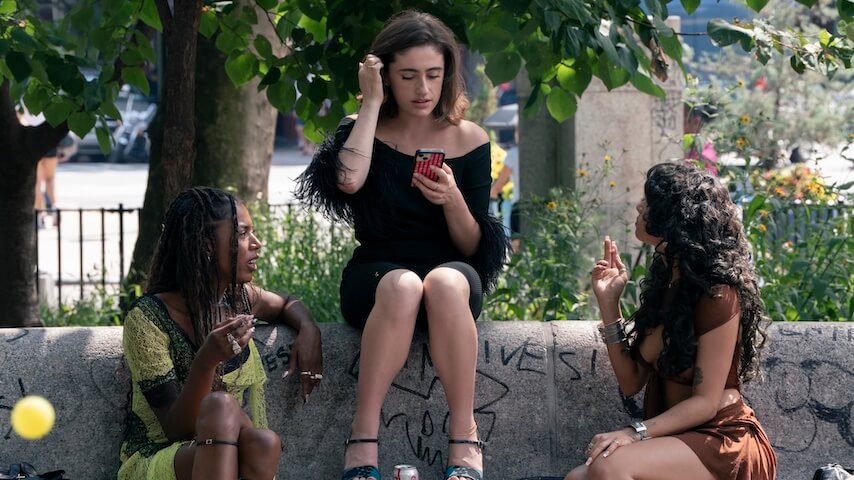
For a cohort that was too young to experience the Brooklyn depicted in Girls, the series has become a classic, more frank and realistic than Friends or Sex And The City but still something of a fantasy. As Girls experienced a new wave of popularity, with twentysomethings now finding it on HBO Max, conversations inevitably turned toward finding the “Gen Z Girls.” Despite its creators’ reluctance to accept the comparison (Rachel Sennott has likened it more to Entourage), I Love LA has fallen into this slot since its premiere last month. 

It’s not hard to see how people arrived at the comparison: They’re both HBO series that were created by—and centered around—women in their twenties; they’re both about a “group of codependent friends”; they even both have cocaine storylines. And the character makeup of the series is pretty similar, too: I Love LA centers on Maia (Sennott), her two girl friends (Odessa A’zion’s Tallulah, True Whitaker’s Alani), one gay guy pal (Jordan Firstman’s Charlie), and boyfriend (Josh Hutcherson’s Dylan). Like Girls, the twentysomethings in I Love LA are narcissistic and know much less than they think. But they’re also way less pretentious and don’t put up any fronts about aspiring to careers in the arts. Where getting one of her songs on an episode of Grey’s Anatomy was a coup for Marnie, I Love LA‘s resident influencer Tallulah spends her days pursuing brand deals with everything from Balenciaga to Ritz Crackers. Maia’s mid-level job at a talent agency isn’t a survival job to pay the bills while she pursues her passion. It’s a ladder she intends to climb. 

Across TV in 2025, young characters don’t aspire to the artist jobs as they did 10 years ago, but there are plenty of ones pursuing creative-adjacent fields like advertising or management. Emily In Paris follows Lily Collins’ titular character, who works in marketing and moves to France. Too Much, Lena Dunham’s series for Netflix, chronicles Jessica (Megan Stalter), a thirtysomething woman who toils in advertising and uproots to the U.K. (Stalter also portrays a talent agent in Hacks.) In FX’s Adults, Billie (Lucy Freyer) loses her journalism job almost immediately; the rest of the friends seem basically unemployed (thanks to a rent-free living situation), excepting Anton’s (Owen Thiele) vague email job, another post-pandemic staple. 

Compare these to the post-college, pre-parenthood characters of decades past. The women of Broad City were often aimless, but Abbi always wanted to be an illustrator and ends the show with the decision to commit to that path. How I Met Your Mother‘s Lily (Allyson Hannigan) also had artistic dreams, and Friends and The Big Bang Theory both had an aspiring actor in their ensembles. Glee spent three seasons where practically everyone from a public high school in Ohio successfully pursued careers in the performing arts. Even when twentysomething and early thirtysomething characters went after careers that weren’t on an MFA track—take Two Broke Girls or Happy Endings‘ aspiring culinary talents—rarely were there so many people working in marketing, advertising, or public relations. (Of course, there were exceptions to this back in the day, including Samantha Jones, Chandler Bing—eventually—and the crew at Sterling Cooper Draper Pryce.) 

Obviously, culture and media have changed enormously in the intervening years. Any traditional media now has to fight social media for eyeballs. A significant chunk of Gen Z would rather watch TikTok than TV, so it’s no surprise that they would also aspire to influencing as a career path. This has already been the case for nearly a decade but has heated up over the last year, with a viral GAP campaign by KATSEYE overshadowing the music they released and Sydney Sweeney’s American Eagle ad generating more attention (and even comment from the president) than her performance on the big screen.

Both Sennott and Stalter were lifted from comedy clubs in New York and Chicago thanks in no small part to their social-media accounts. Comedic online presences also helped Benito Skinner (Overcompensating), Brian Jordan Alvarez (English Teacher), and Quinta Brunson (Abbott Elementary) get their TV shows off the ground. This transition was also depicted on television almost in real time. In Hacks, for instance, achieving the dream job of late-night host, as Deborah (Jean Smart) finally does in the show’s fourth season, comes with making near-constant short form videos for social media. And interestingly, real-life influencer and podcaster Jake Shane landed the role of annoying social media consultant for the show within a show. 

But in the case of I Love LA, social-media success is not a stepping stone or something you have to stomach but rather the end goal. Maybe Tallulah will get a cameo in a sitcom or stint on a reality show in coming seasons, but that’s not what she and Maia are chasing. The characters of I Love LA want fame, or at least the proximity to it. And maybe one way to answer why Sennott chose to tell the tale of an influencer and her manager is because having a huge social-media presence is equivalent to being famous these days. (Another very obvious reason may be that it’s a subject Sennott knows about, is interested in, and believes makes a good backdrop for a half-hour comedy.) The characters on Girls, The Other Two, and all the rest wanted fame too (or at the very least validation by their peers), but there was more pretense. No one on I Love LA cares to justify wanting attention, which, given the state of the industry, sort of makes sense. “I feel like that’s kind of the period we all sort of lost out on a little bit,” Sennott said of the Girls era and show business at that time on, naturally, the Girls Rewatch Podcast. “Instead, it [now] feels like this desperate grab for the last scraps of whatever. We’re all on the last little bit of the Titanic shouting ‘I’m playing violin the loudest!’ as the boat sinks.”   

Drew Gillis is The A.V. Club‘s news editor.   

 
Join the discussion...