Who fits under The Amazing Digital Circus’ big tent?
To make sense of the animated YouTube sensation’s box-office breakout, look at it through the eyes of a 10-year-old who calls it her favorite show of all time.
For much of the past month, it’s looked as if Gen Z filmmakers—and perhaps more importantly, Gen Z interests—are finally infiltrating legacy mass media in ways that felt nearly impossible as recently as last year. With the smash success of Obsession and Backrooms, audiences are showing up at theaters to see horror movies that reflect the backgrounds (made by YouTube-fluent directors), sensibilities (memetic images), and fears (social fumbling and/or isolation) of a generation that came of age at least partially during a global pandemic and has lived a considerable chunk of their lives online.
Both movies also accomplish what so many horror titles strive to do: They make these specific fears and sensibilities relatable to a broader audience. The dreamlike imagery and retro setting of Backrooms extend an inviting hand to moviegoers whose first reaction to the titular yellow purgatory is not a full-body chill of terror, but rather admiration at all of that rent-free storage space on screen. Obsession is even more accessible, as evidenced by its “be careful what you wish for” premise dating back to the first publication of “The Monkey’s Paw” (if not all the way back to classical antiquity and the myth of King Midas). Some older cinephiles have even remarked that there’s something gratifyingly traditionalist about twentysomethings who’ve courted so much success on the internet still wanting to make movies for theaters. (It’s me. I’m “older cinephiles.” But I’m not the only one!) So it seems important to note that a glimpse even further into the future is available at multiplexes, bubbling up just beneath these box office phenoms and outgrossing plenty of more mainstream releases. Perhaps less reassuringly to the old guard, it’s not a movie at all, but rather a feature-length compilation of a sporadically released, massively popular web cartoon that’s like a hybrid of Harlan Ellison’s “I Have No Mouth, And I Must Scream” and The Twilight Zone’s “Five Characters In Search Of An Exit” set in an inescapable, circus-themed virtual reality.
In form, The Amazing Digital Circus is more or less an animated television series, though the details are far from traditional: Previous episodes have premiered on YouTube before eventually hitting Netflix. The 90-minute cut that’s currently playing in theaters, dubbed The Final Act, assembles a quick recap, the previously released eighth episode, and the never-before-seen finale—the last of which is set for its online debut June 19. Up to this point, The Amazing Digital Circus’ general release schedule more closely resembles a book series aimed at middle-schoolers; no more than three new episodes have ever premiered within a calendar year.
Though that release cadence is probably owed to its independent production and the creative capacities of creator Gooseworx (the handle of Cooper Smith Goodwin), who writes and directs every episode herself, I don’t think that book-series resemblance is exactly coincidental, either. I know about The Amazing Digital Circus and the Sisyphean ordeal of its whimsically designed, amnesiac avatars for the same reason I know about Warriors, the deathless middle-grade book series about warring tribes of feral cats: I have a 10-year-old daughter. The Amazing Digital Circus is currently her favorite show of all time and her self-described “hyperfixation.”
As such, I dutifully trekked out to see The Final Act with her. In it, and in the other episodes she’s shown me, it’s impossible to avoid seeing perhaps the purest expression I’ve yet caught of a Gen Alpha sensibility, one that feels further apart from conventional TV or movie frameworks than either Backrooms or Obsession—despite the fact that Gooseworx herself is, according to online sources, 31 years old, which technically makes her not even the Alpha-adjacent Gen Z, but a young millennial.
That should be more evidence for the argument that generational divides are entirely manufactured: Why would someone of Gooseworkx’s age automatically have an affinity with people 10 years her senior, rather than a cohort just a few years younger? (As a Gen-X/millennial cusper, I know this division well.) Yet despite the show’s Zillennial origins and age-agnostic presentation, The Amazing Digital Circus does strike me as gen-specific, particularly in the way it obliterates the norms of demographic targeting. While some generations may not collectively vibe with a piece of art the way that others do, age-based signposts have been a part of movies and especially TV for most of their existence. Yes, some children will always gravitate toward shows and movies above that guidance, and some kids’ shows will cultivate an adult audience. But Digital Circus takes the age-blurring effect of properties like Five Nights At Freddy’s or Backrooms and makes it seem integral to the show’s whole deal, not just an inevitable internet fascination.
It’s not precisely a children’s show, dealing as it does with heady issues of identity, anxieties, and guilt through a sci-fi lens. But judging by the screening where I may have been the oldest person in attendance by decades, it seems to speak most clearly to a still-young demographic. In that way, it’s a bizarre twist on the Simpsons-codified construction of an animated show that looks kid-friendly but actually offers more for adults. The Amazing Digital Circus comes across like one of those shows, only looped back around for a generation—covering anyone of TV-watching age born since 2010—that doesn’t have any actual adults in it yet. It’s a kids’ show for adults that’s actually for kids.
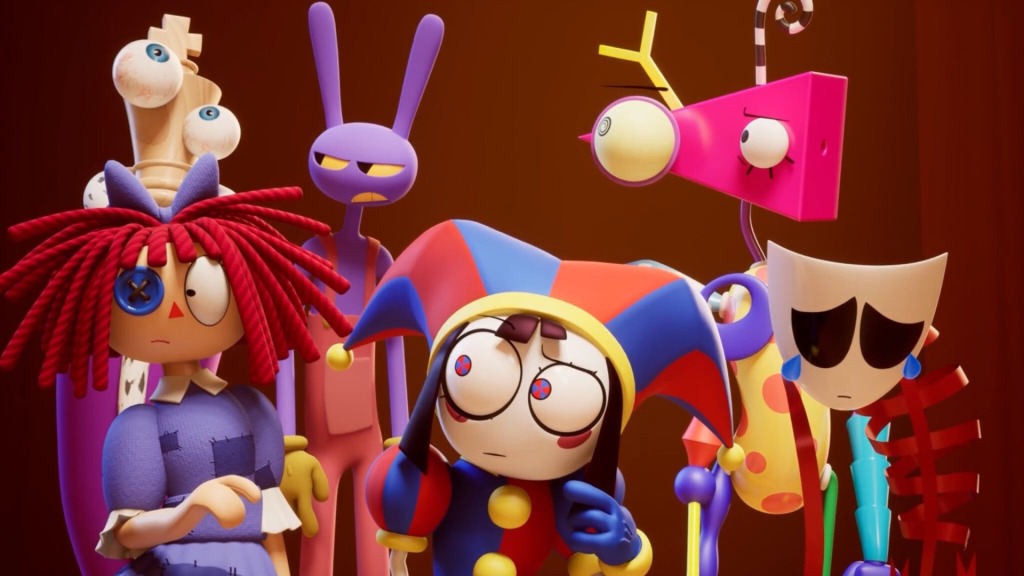
Gen Alpha may not prove appreciably more online than their Gen-Z predecessors, and their COVID-19 isolation may not prove as long-term damaging as it did for their older siblings who spent a substantial portion of their adolescence barred from public spaces for one reason or another. But both the digital world and the isolation that nudges people further into it remain a presence in their lives, and The Amazing Digital Circus has a premise that seems to speak to those conditions on a more creative level than Gen Alpha’s more traditionally oriented mass-hypnotism, merch-driven (though The Amazing Digital Circus is far from immune to a licensing deal) childhood favorites like Paw Patrol. The show follows Pomni (Lizzie Freeman), who finds herself inhabiting a new body (and forgetting details of her previous life) when a virtual reality headset transports her, along with several other humans, to the big-top realm presided over by the artificial intelligence Caine (Alex Rochon), who devises various adventures and quests for his captives, attempting to occupy their endless time.
The humans in their reconfigured cartoony forms, who also include cheerful doll-like Ragatha (Amanda Hufford) and sarcastic purple bunny Jax (Michael Kovach), play along with Caine’s games while ruminating on possible escape (which Jax and others insist is impossible) and expressing various social anxieties. Multiple episodes (and some entire characters) are predicated on the idea of losing your mind and, with it, your sense of self. The most extreme cases “abstract” into unrecognizable, cloud-like monsters. (It’s an imperfect metaphor for either clinical depression or suicide, but it evokes both.) Gooseworx seems profoundly keyed into the creative and social possibilities of living a digital-first life, as well as the nightmarish side of going down an internet rabbit hole, intentionally or not.
It’s a softer form of horror, though, than the recent bumper crop of YouTube-transplant movies. Aesthetically, the show imitates the garish experimentation of early CG projects from the ’90s and ’00s (think ReBoot, a show that premiered the same year Gooseworx was born), but animated at 30 frames per second, giving it a slightly motion-smoothed gloss. It’s an energetic combination of adorable and eyesore, recalling the awkward pre-adolescence of computer animation itself. Gooseworx is a trans woman, and there’s plenty of subtext to be mined from her creating a series in which multiple characters are made to inhabit bodies that don’t match their self-image. For that alone, the show is more sophisticated and sensitive than its own pretend-nonsense-fun image. It’s an ironic counterpoint repeatedly underlined with what might be described as a glitchy version of theater-kid energy, of the sort that’s inspired countless Broadway-style tribute songs on YouTube. The Amazing Digital Circus has garnered a truly dedicated fanbase that fervently wishes for a show with one original song to somehow become a full-fledged musical.
This also speaks to how content-agnostic the show often feels. In addition to retro CG animation, it has Looney Tunes moments that recall shorts as old as “Porky In Wackyland,” the ongoing narrative of a more novelistic TV series, and the mopiness of a singer-songwriter. Indeed, The Amazing Digital Circus plays like an unholy offspring of several broader mass-culture trends that have risen during Gen Alpha’s birth years: It’s lore-heavy, steeped in the language of gaming (designations of “NPC” abound, though they’re mostly literal rather than snide insults), and keenly attuned to mental-health issues. It also, to these jaded just-barely-Gen-X eyes, sometimes reaches unbearable levels of emo vagueposting, especially in its handling of wounded jerk Jax. Without clear memories of their own lives—the kind of backstory that, whether clearly conveyed or not, would inform the drama of a more old-fashioned TV show—the characters behave more like free-floating neuroses without much grounding in actual behavior. In these moments, its appeal to a tweenage audience crystalizes; the show’s friendships feel as desperate and capricious as a particularly sensitive class of grade-schoolers, without any life experience to flesh out the psychology. Though Gooseworx obviously has plenty of years to draw upon, her characters don’t always read like the young adults most of them are apparently supposed to be.
Their approximate ages come into play during the finale, which hinges on some bittersweet conclusions about the endless search for happiness and connection and the powers of creativity and friendship. It’s potent stuff, but I was still taken aback when I stole a glance at my daughter and saw her abjectly weeping, easily the most I’ve ever seen her cry at a piece of media that wasn’t actively upsetting her. (Maybe I jumped the gun on taking her to see A.I.)
I doubt she was thinking specifically about the abstraction that is a “grown-up” life, or the unformed nature of a generation that’s only just now reaching driving age, or what an optimistic take the show is offering about the potential richness of life lived either on or offline. She hasn’t seen Backrooms as a point of comparison—and the older, fustier parent in me might prefer a jump to more cautionary tales. If anything, the show has instead functioned as an internet-content gateway drug, from watching YouTube videos to writing personality quizzes matching users to Amazing Digital Circus characters. But these characters, thin as they seem to me, clearly do register as people to her, blank slates or not. She’s grown so much since 2015, but she’s also still a kid. We can both love Bob’s Burgers and Futurama, but her absolute favorite show doesn’t speak to me the same way it speaks to her. Still, there’s value in learning a little bit of its language, and that’s an important reminder for an old guy like me.


 Keep scrolling for more great stories.