In the fiction of the Avatar universe, it can take hundreds of years for a new Avatar to arise and unite the people of the world, but here in the real world it only takes about a decade. While live-action remakes and feature-length interludes have kept 2005’s Avatar: The Last Airbender alive as a franchise in the 2020s, a proper sequel series following a new master of all four elements has not graced screens since The Legend Of Korra ended its four-season run in 2014. Now, Avatar: Seven Havens has arrived to introduce us to a third Avatar, and in doing so, boldly breaks from what came before.
It’s the first of several commendable choices made by Avatar creators Michael Dante DiMartino and Bryan Konietzko, who have reunited with a number of their previous collaborators for Seven Havens. The assembled team could have done something safe, continued the trend of generational progress that Korra established:— deepening the Avatar mythology, industrializing its world. Instead, Seven Havens blows everything up. In a jarring twist, the show establishes that Avatar Korra triggered an apocalyptic cataclysm, nearly destroying the entire world. This fact, sure to be wildly destabilizing for longtime fans, is delivered casually, a central myth that’s been in place for over 200 years at the start of the new series.
This tension is one of the most compelling things about Seven Havens, a really deft way of making a show accessible to newcomers—this is effectively a new world—while still including the Avatar faithful. The wild revelation about the previous series’ protagonist is almost certainly not the character assassination it appears to be, and likely the heart of a season- or series-long mystery. In the meantime? There’s all this uncharted territory to explore.
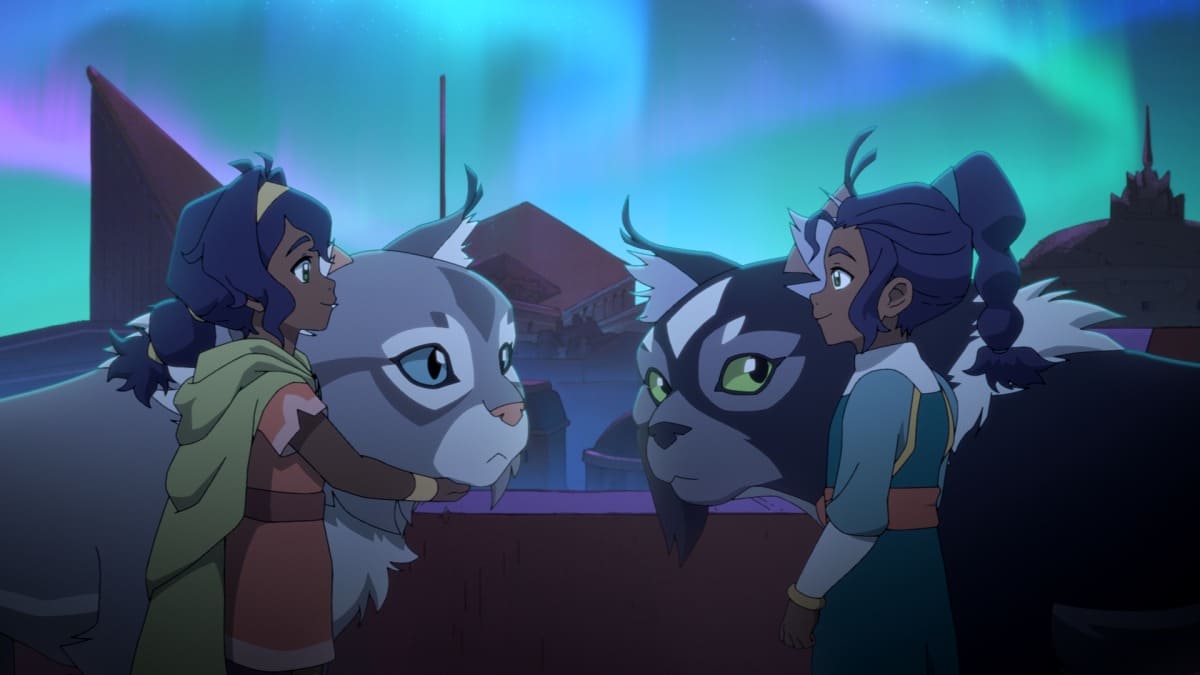
At the heart of it is Pavi (Saheli Khan), the new Avatar who must hide her identity from a public that now hates the Avatar, and believes a new one—there hasn’t been a reincarnation since Korra—will once again herald destruction. A young vagrant with only a hazy recollection of her past, Pavi scrapes by on the streets of Ellora, one of the eponymous Seven Havens built to survive the post-apocalypse. While Ellora is the only one of the Seven Havens seen in the six episodes sent to critics in advance, it’s a wonderfully vibrant setting, a desert city that could support a whole series, even if it’s only meant to be home for a single season.
French artist Moebius‘ influence is incredibly strong here, with clean, inky lines and flat colors giving the franchise’s longstanding anime inflections new flavor. The animation is less dazzlingly fluid than Korra or the recent Avatar Aang film at their best, but it feels intentional, a different presentation for a different kind of story. That intent carries over to the synth-heavy score from Avatar and Korra composer Jeremy Zuckerman, which ditches the woodwinds and familiar motifs of its predecessors for the sounds of science fiction—a fun bit of dissonance that really sells how invested Seven Havens is in striking new ground.
Embargoes dictate that this review can’t delve into just how new that ground is; suffice it to say an early twist serves up an ongoing mystery that takes things in a novel direction for the franchise. But we can reveal that Seven Havens has good bones: The show organically builds its cast around Pavi, whose attempts to stay hidden are quickly foiled. In the Seven Havens, Benders able to command one of the four elements are registered and enlisted in a Bending Corps of sorts, and when one young conscript, an airbender named Jae (Major Curda) learns of the new Avatar’s existence, his commander, Karthik (Akshay Khanna) instructs him to help hide her—because he’s also found Pavi’s twin sister, Nisha (Aishu Devan).
Seven Havens builds out its story engine with remarkable efficiency, gears and pistons firing with minimal setup. The mystery of Pavi and Nisha’s separation and why they can’t remember each other runs in parallel with the mystery of the cataclysm, its ties to Korra, and what lingering threat it may pose. The show doesn’t forget how to have fun, either, building episodes around Pavi getting to know Ellora and its denizens, in disguise and under Karthik’s protection.
It’s quite remarkable, the number of needles Seven Havens manages to thread in its efforts to satisfy dieheards and novices alike. Much of the show feels like a genuine attempt to correct for the franchise’s previous shortcomings, rebuilding an established universe in a way that’s less cultural appropriation and more cultural appreciation. The world of this series is no longer composed of riffs on real-world Asian and Indigenous cultures; while we only see one Haven in the first six episodes, that setting sets a model for the rest: a diverse population living in a city designed in response to the ruined world around them. It reads as a genuine attempt to thoughtfully evolve, even if some of that evolution—such as some characters’ queerness, which is strongly implied but not displayed outright as of yet—remains frustratingly slow.
Avatar: Seven Havens’ eagerness to make a statement only amplifies those frustrations. This story is a powder keg, its volatile contents consisting of a culture built on and primed by fear that’s attempting to control what it can’t understand and primed to tear itself apart once its chosen scapegoat reemerges. It is an uncertain show arriving at an uncertain time, where stability is very much a myth on all fronts. With Skydance’s acquisition of Warner Bros. Discovery, Avatar Studios’ corporate parents now own a vast swath of the American animation industry, and Seven Havens‘ survival (a word which is, coincidentally, the subtitle of season one) could depend not on acclaim and popularity but fickle C-suite whims. Avatar shows are beloved for being all-ages entertainment unafraid to mount mature examinations of xenophobia, culture, and authoritarianism, all in pursuit of the wider goal of balance. And this is the tragedy of Seven Havens: It may now be that the world is too unbalanced for even the Avatar to survive it.


 Keep scrolling for more great stories.