It all started with Kim Bauer on 24.
Certainly, there were annoying teens on TV before Kim, but the ire directed at Jack Bauer’s daughter whenever she was in danger—maybe involving a cougar—is legendary. Nearly 25 years later, Kim remains the benchmark for adolescent characters that audiences loathe. Dana Brody’s hit-and-run storyline on Homeland came next, then Paige Jennings learning her parents’ secret on The Americans. (I defended Paige then; I will continue to do so now.) Kim was an only child with no other sibling to draw attention, but first-born children Dana and Paige took the brunt of viewers’ vitriol, in part because a young woman is an easier target, and their respective younger brothers spent more time in the background than affecting the plot. To borrow a sentiment from Widow’s Bay, there’s misogyny in the air; more than a whiff.
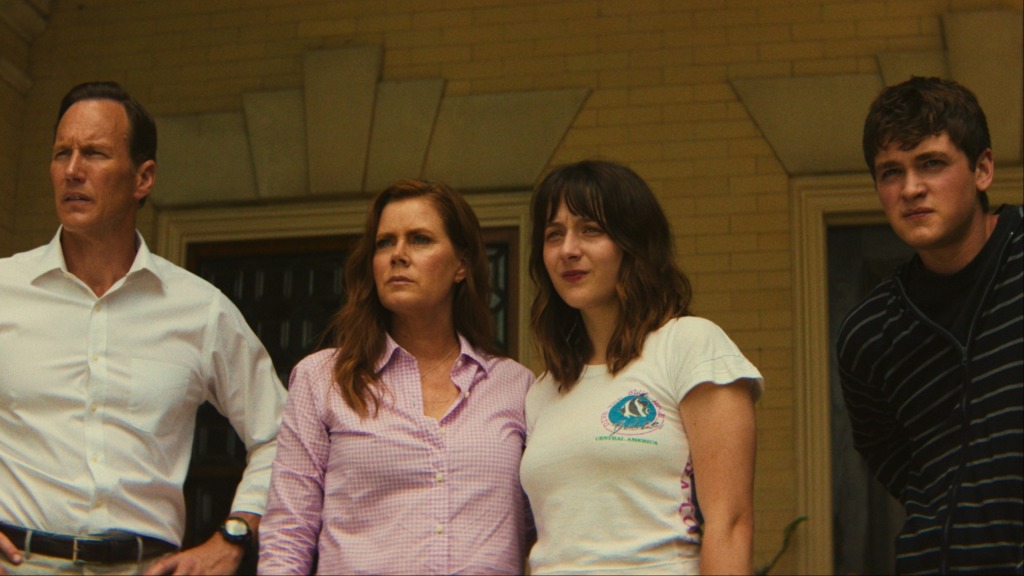
Enter the Bowden family on Apple TV’s Cape Fear, who attempt to reset this balance, delivering a son and a daughter whose frequently terrible decision-making tests our patience. With every passing episode, the Bowden siblings and their equally frustrating parents push me closer to wanting villain Max Cady to come out on top.
The latest Cape Fear adaptation follows only the broadest brushstrokes of John D. MacDonald’s novel, The Executioners, and its subsequent film versions. Not only is defense attorney Sam Bowden gender-flipped, becoming Anna Bowden, but Anna’s husband, Tom, now plays a significant role in Max Cady’s murder trial: In this version of the story, he was the prosecutor. What remains the same: After Max is proven innocent of murdering his wife and their unborn child, he seeks to unleash a layered campaign of terror against the attorneys he blames for the years spent behind bars. One of those layers involves 17-year-old Natalie Bowden and her younger half-brother Zack, instantly sowing seeds of discontent that tip the pair into one of TV’s most frustrating archetypes: the teenager who can’t help but make things worse. Only now there are two of them.
The line between “rebellious youth” and “irritating nuisance” is razor-thin, so it’s easy for Natalie and Zack to run afoul of the latter. In a home built on a foundation of secrets (such as Tom dabbling in microdosing), acting out is the natural path; Anna and Tom give their kids plenty of reasons to ignore their authority. For starters, Tom is Natalie’s stepfather, but the timeline of when he got together with Anna is questionable, and this ripples throughout the season. The Bowden siblings continue to find themselves in increasingly sticky predicaments as Nick Antosca’s adaptation progresses and the family becomes more fractured. With each impulsive choice, my sympathy wanes.
Suffice it to say, contemporary TV makes me think a lot about the oft-quoted opening stanza of Philip Larkin’s “This Be The Verse”—the one that begins “They fuck you up, your mum and dad,” and ends with a wry comment on the inheritance and proliferation of familial flaws. This is especially true of Cape Fear, Widow’s Bay, and their fellow Apple TV originals For All Mankind and Your Friends & Neighbors. It doesn’t matter if the character is a federal agent, spy, astronaut, mayor, or lawyer; the parent’s job pulls their children into peril as they come of age. The kids being left to their own devices means getting into scrapes, looking where they shouldn’t, and threatening a precarious dramatic ecosystem.
It may be the one curse that’s ever broken on Widow’s Bay’s bedeviled, titular island. As we learn over the course of season one, Mayor Tom Loftis (Matthew Rhys) has been keeping secrets from his son Evan (Kingston Rumi Southwick) that could’ve led to destructive behavior similar to the Bowdens. (Between the horror-comedy and The Americans, Rhys is an expert at this type of role.) Evan, for his part, pushes boundaries and tests his father’s patience: He stays out late, smokes weed in his garden, and tries to impress off-island girls by trespassing on the property of a supposed serial killer.
With all that in mind, I was gearing up for Evan to join the list of annoying teens—especially when Evan makes his dad divulge some hard truths at the top of the season’s eighth episode, “Your Baggage.” And yet Katie Dippold’s horror-comedy zigs when I expected it to zag. The combination of Southwick’s performance and the nuance in Emma Ketchum’s “Your Baggage” script allows space for pushback without falling into the same trap as his Cape Fear counterparts. Evan’s bitterness after this discovery is warranted, as is his anger directed at Tom. But instead of saying his piece and bolting out of the house toward danger, Evan listens to his father’s heartbreaking explanation and stays. Manufactured petulance isn’t required to make a story more compelling.
From Cape Fear’s first episode, Zack’s surliness has been a defining characteristic, and he hasn’t moved much beyond that baseline. He’s depicted as the Bowdens’ “problem child,” one who ends the premiere having bitten off his own toe while tripping on a heavy dose of the motion-sickness drug scopolamine, a.k.a. “Devil’s Breath.” Over time, we learn that Zack shared nudes of his girlfriend on a group chat and is now a social outcast. Natalie, meanwhile, is fed up with being the “perfect daughter.” Both are perfect marks for Max.
Initially, I thought Natalie might escape this fate, with Cape Fear subverting a trope by diving headlong into its most vexing characteristics. Lily Collias gives a stirring performance as the Bowdens’ disaffected daughter, but that’s not enough to sidestep any side-eye. She’s manipulated at every turn, often at the hands of Max’s daughter, Nevaeh. Yep, there is another delinquent teenager in the mix here, one who strains credulity with the success of the honeytraps she lays for Zack and Natalie.
Cape Fear is hard to take seriously because everyone, regardless of age, is the dumbest version of themselves: Anna walks into a bloody crime scene and touches things with her bare hands; Tom goes for a drink with Max and gets into a bar fight. But the most egregious decisions are reserved for the younger Bowdens, like Natalie—who has already shed her straight-A student persona after Nevaeh’s encouragement—going on a road trip with Max. She takes one of Tom’s guns with her for protection, and you don’t need to know anything about Chekhov’s attitude about presenting a firearm in the first act to know how this plays out.
Natalie has a reason to mistrust her mother, yet her choice to run headlong into danger is another cliche that Cape Fear can’t help but embrace. Meanwhile, Zack has zero agency after exposure to enough hallucinogens convinces him that Max is his father; he’s placed on an involuntary psych hold at the same time his sister is hanging out with the architect of their misery. Max doesn’t have to do much to bring his plans to fruition, but the Bowdens’ self-destruction comes across less like the work of a Machiavellian operator and more like a pile-up of plot contrivances.
The melodrama reaches fever pitch when a third answer to the mystery of Natalie’s paternity is introduced: Max may be her biological father. By this point, I’m coming back to Natalie’s side—wouldn’t you be annoying if you were in the midst of a Mamma Mia! situation, minus the ABBA songs and idyllic Greek island and plus angst over possibly sleeping with your half-sister? By the penultimate episode, Natalie is locked up in the same juvenile detention center as Nevaeh, and rather than crumble, she becomes the master manipulator. It took nearly the whole season, but she’s finally adapting. Maybe Max is her father after all. But unless the finale proves otherwise, Zack has inherited his instincts from Anna and Tom, meaning he lives to pass his annoying-teen DNA to some future TV drama’s least-popular storyline.


 Keep scrolling for more great stories.