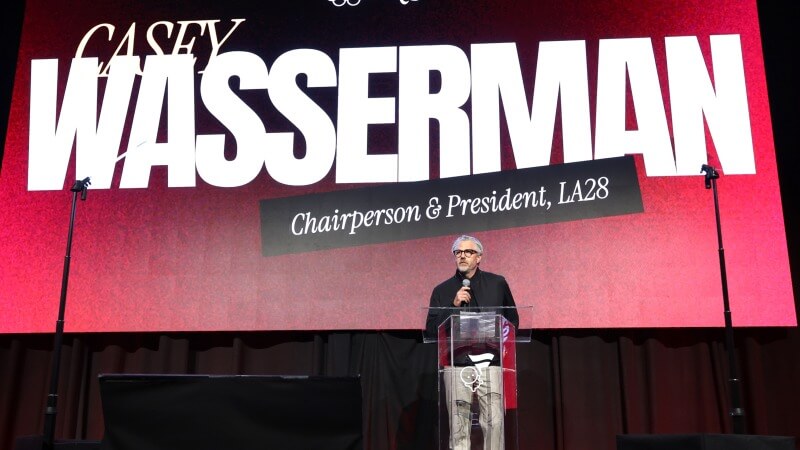
Casey Wasserman, who was named in the latest batch of Jeffrey Epstein documents released by the Justice Department, is selling his company, per a report by The Wall Street Journal. In a memo sent to staff, reviewed by WSJ, Wasserman labeled himself a “distraction” to the business, writing: “I’m deeply sorry that my past personal mistakes have caused you so much discomfort. It’s not fair to you, and it’s not fair to the clients and partners we represent so vigorously and care so deeply about.” He also cited the victims of Epstein and his associate Ghislaine Maxwell (the latter of whom Wasserman was directly linked to via salacious emails) and called the “pain experienced” by them “unimaginable.”
In response to these writings coming to light, many Wasserman-backed musicians, including Chappell Roan, Bully, Wednesday, Weyes Blood, Orville Peck, Sylvan Esso, and Water From Your Eyes, left the company in a mass exodus drawn out over the last week. “I hold my teams to the highest standards and have a duty to protect them as well,” Roan shared online. “No artist, agent, or employee should ever be expected to defend or overlook actions that conflict so deeply with our own moral values.” Best Coast’s Bethany Cosentino was the first musician to announce her departure from Wasserman’s agency, on February 5. “Staying quiet isn’t something I can do in good conscience—especially in a moment when men in power are so often protected, excused, or allowed to move on without consequence,” she wrote on Instagram. “Pretending this isn’t a big deal is not an option for me.”
In the immediate days after, Beach Bunny, Wednesday, and other artists shared their support for Cosentino, left in solidarity with her, or revealed why they’re unable to leave the agency (Alexis Krauss of Sleigh Bells shared a compelling statement about the financial impact of leaving Wasserman Music). Wasserman’s association with Maxwell had previously been reported as early as 2024, and, in a report filed by Rolling Stone, he assured his senior staff that “nothing else” could implicate him with the Epstein-Maxwell trials. The recent dump of emails suggested otherwise, and Wasserman’s moral downplays were met with swift condemnation by his most at-risk employees.
Wasserman, who is still chairman of the 2028 Los Angeles Olympics, first shared a defense statement with the New York Times on February 1: “I deeply regret my correspondence with Ghislaine Maxwell which took place over two decades ago, long before her horrific crimes came to light. I never had a personal or business relationship with Jeffrey Epstein. As is well documented, I went on a humanitarian trip as part of a delegation with the Clinton Foundation in 2002 on the Epstein plane. I am terribly sorry for having any association with either of them.” In his memo sent to agency staff on February 13, he reiterated the latter part of this apology.
As of three days ago, 11 Los Angeles officials have requested Wasserman step down from the Olympics committee, including controller Kenneth Mejia and Councilwoman and prospective mayoral candidate Nithya Raman. LA County supervisor Janice Hahn told the LA Times that “having him represent us on the world stage distracts focus from our athletes and the enormous effort needed to prepare for 2028.” The Los Angeles Olympics 2028 Executive Board published a statement supporting Wasserman. Eight days passed between Cosentino’s departure and a public acknowledgement of Wasserman’s decision to sell his agency. Sure, it’s great that these musicians’ pressures have resulted in quantifiable change, but Wasserman isn’t facing any real repercussions for his relationship with Maxwell. He’s about to sell his company for millions of dollars and he gets to stay on the Olympics committee. In fact, the games committee unanimously voted for him to remain chairman.
One stray observation I’ve had since Cosentino’s statement was published last week: a large majority of the artists who announced their departures were either women or bands fronted by women or non-binary people. To reiterate what my colleague Casey Epstein-Gross wrote earlier this week, it’s the people with little to no power who have paid the ultimate price for Wasserman’s mistakes, which, until 24 hours ago, he considered to be an unfortunate “association” based on humanitarian causes. The pockets of the corrupt continue to line while innocent artists’ livelihoods hang in the balance. Where’s the justice in “deep regrets” getting bankrolled?


 Keep scrolling for more great stories.