The following contains spoilers for Wuthering Heights.
The debate over Emerald Fennell’s Wuthering Heights has splintered into two factions that ultimately agree on the facts. Fans of the movie think it delivers style over substance in a good way, while detractors think it prioritizes style over substance in a bad one. But while it’s fair to say that Fennell favors flashy sensuality over meaty storytelling, it’s not entirely fair to say there’s no substance to her candy-colored, Charli xcx-soundtracked riff on Emily Brontë’s classic novel. In fact, there’s actually an underappreciated core to Fennell’s loose adaptation. Her Wuthering Heights may market itself as a dark and steamy Valentine’s Day romance, but at its heart it’s actually a story of childhood trauma bonds run amok.
It’s a theme that emerges thanks to one of the bigger changes Fennell makes to her exploration of the doomed love story between Cathy Earnshaw (Margot Robbie) and Heathcliff (Jacob Elordi). In the novel, Cathy’s father is a minor supporting character who adopts an orphaned Heathcliff as his favorite child but then dies relatively early into the story. It’s then Cathy’s older brother Hindley (a character the film cuts entirely) who inherits the Wuthering Heights estate and proceeds to jealously mistreat Heathcliff—forcing him to live and work as a servant, thus setting up the class/social stratification that keeps Cathy and Heathcliff apart.
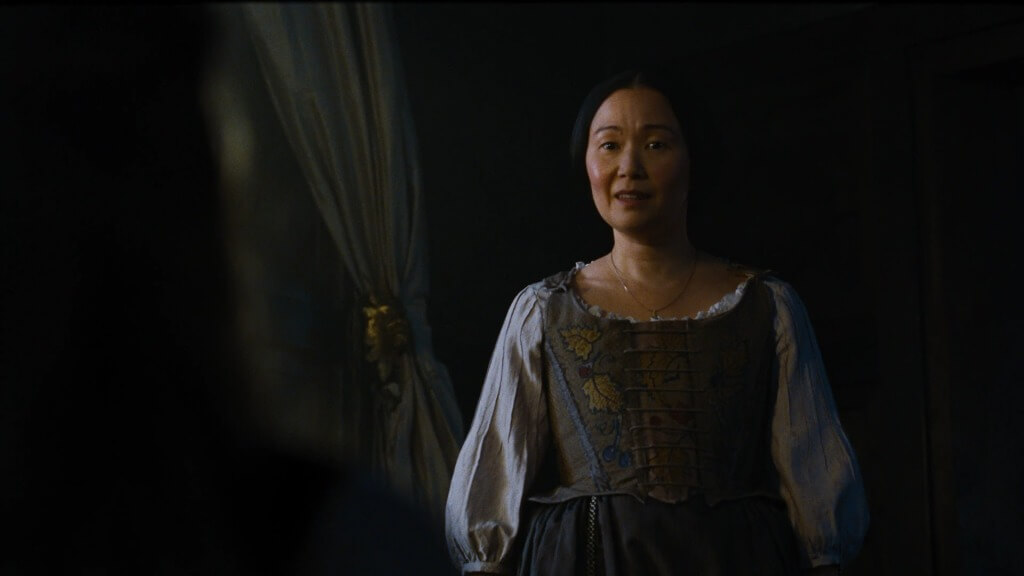
In the movie, however, we simply have Cathy’s alcoholic father Mr. Earnshaw (Martin Clunes), who brings Heathcliff home to save him, but then proceeds to mistreat him as well. That simple act of character condensing shifts the entire story. While Brontë’s Wuthering Heights begins with a stable family that’s slowly corrupted by jealousy and grief, Fennell begins with a version that’s hollow from the start. Instead of a big house with characters coming and going, Wuthering Heights is more like an island prison lorded over by a capricious man who seems to be collecting children he can keep under his thumb—including Cathy’s servant-companion Nelly (Hong Chau), whom Fennell reimagines as the illegitimate daughter of a nobleman.
From the first moments we meet young Cathy (Charlotte Mellington) and Nelly (Vy Nguyen), it’s clear that Wuthering Heights isn’t a safe place to grow up. Both girls know they have to carefully manage their emotions so as not to set off Mr. Earnshaw’s temper. And without any kind of positive parental figure in their life, they’ve both developed maladaptive personalities. Cathy is self-centered and melodramatic, while Nelly is tumultuously infatuated with her impulsive mistress, who has all the privilege Nelly’s been denied access to. Both girls build their emotional worlds around Cathy, forging a codependent bond that helps them weather the storm of Mr. Earnshaw’s drunken fits of rage.
Once young Heathcliff (Owen Cooper) enters the story, however, that bond gets upended. Cathy shifts her melodramatic yearning to a more conventionally romantic figure, while young Heathcliff is inspired to take his protective instincts to self-sacrificial levels because it so clearly fuels Cathy’s love of drama and angst. Nelly, meanwhile, is left seething with jealousy over how Heathcliff has supplanted her role in Cathy’s life. All the love they’re denied from their father figure gets transposed onto one another in increasingly thorny, complex, psychosexual ways. Or, as grown-up Cathy screams at her dad when he complains about being ill, “We are all ill because of you!”
It’s a sentiment Fennell captures with equal parts satire and horror. While Fennell has sympathy for Cathy as a victim, she also has a keen eye for how hilariously petulant and annoying she can be. Her arrested development is cause for a whole lot of unnecessary drama in its own way. Meanwhile, horror touches—like a scene where Heathcliff yanks Cathy under a bed like a 1980s horror villain—subvert the film’s romantic tone. Though there is something sweet and genuine going on between Heathcliff and Cathy, it stems from a place of survival as much as anything else. They have no one around to save them but themselves.
This fuels Fennell’s pointed critique of the patriarchal forces that undergird upper-class British nobility in the 18th century. Because a landed man is considered the highest authority, there’s no social or child protective services to call when he’s misusing that power. Instead, his staff and family must simply bend to his various whims and power plays. Wuthering Heights deploys a lot of dollhouse imagery, and Cathy, Heathcliff, and Nelly might as well be dolls Mr. Earnshaw is playing with as he shouts “I am the kindest man alive!” into the void.
It’s an idea Brontë explores too, although in a very different place in the novel. In Brontë’s original story, the saga continues on after Cathy’s death with a second generation of characters who find themselves living under Heathcliff’s isolated, abusive thumb. Hindley’s strapping heir, Cathy’s strong-willed daughter, and Heathcliff’s own sickly son are left to build complicated bonds with one another while Heathcliff lures them all to Wuthering Heights and tries his best to emotionally destroy their lives as revenge for his own suffering.
While Fennell—like most Wuthering Heights adaptors—cuts that part of the story, she intentionally folds some of its themes into her streamlined adaptation. Though she reimagines Heathcliff as a far kinder, more sympathetic figure than he is in the novel, her dark take on Mr. Earnshaw gets at some of the patriarchal abuse that Brontë is interested in too. It’s like Fennell has collapsed the two generations into her Cathy/Heathcliff/Nelly dynamic, which is a clever way to engage with the novel’s core ideas without adapting its plot beat-for-beat.
It’s a shame, then, that after such a strong start, Fennell’s ideas lose steam in the film’s second half. More than anything, Wuthering Heights is a movie about three codependent people who are absolutely terrified of the idea of getting left behind. And Fennell’s exploration of Cathy, Heathcliff, and Nelly’s fraught bond reaches its climax in a scene where Nelly actively manipulates a miscommunication between her “siblings.” In the novel, Heathcliff accidentally overhears Cathy say she could never marry him. In the movie, however, Nelly intentionally provokes Cathy’s confession once she realizes Heathcliff is listening outside the door. She blows up Cathy and Heathcliff’s love, just as she felt her love for Cathy was blown up by Heathcliff.
After that, Fennell seems less sure what to do with the themes she’s set up. Once Cathy marries her neighbor Edgar Linton (Shazad Latif) and Heathcliff disappears and returns a rich, dashing man, Wuthering Heights devolves into a style-over-substance fantasia. There are fun montages showing off the over-the-top production design of the Linton family home and some “provocative” adaptation changes—like making Heathcliff’s relationship with Isabella Linton (Alison Oliver) a consensual BDSM one, rather than an abusive marriage. But because Fennell has frontloaded all the interesting emotional drama into the first half of the movie, there’s nowhere for her characters to go as Cathy and Heathcliff finally start consummating their relationship.
There are still sharp moments here and there, like when Cathy tells Nelly, “You like to see me cry,” and Nelly counters, “Not half as much as you like crying.” Or the way Cathy responds to her father’s eventual death with both grief and violent relief. Fennell effectively renders her central trio as people too stunted by their childhood traumas to ever really mature into adulthood. But in the rush to make Wuthering Heights a sexy, smutty, earnest romance, Fennell’s spikier themes fall by the wayside. Nelly is positioned as the ultimate tragic antihero, given that her vengeful meddling in Cathy’s life results in Cathy’s death. But the film doesn’t care about the character enough to make that twist land. Instead, Wuthering Heights devolves into a more basic Romeo And Juliet-style tragedy.
Still, there’s something to Fennell’s adaptation. In some ways, it’s a soft choice to make Heathcliff a more sympathetic romantic lead rather than the complicated, cruel figure he is in the novel. But given that Brontë ultimately ends with a sense of hope about children being able to break the cycles of abuse set by their parents, amping up Mr. Earnshaw as an antagonist and giving that hopeful arc to Heathcliff instead still (sort of) tracks with what the novel is trying to explore. That alone won’t please the Brontë purists, but it does prove that Fennell’s flexible reimagining is more than its quotation marks.


 Keep scrolling for more great stories.